
Authors
Olina Lind, Maria Andersson, Kia Heimersson, Lotta Hansson, Anders Österborg and Marzia Palma.
Background
Chronic lymphocytic leukemia (CLL) is characterized by a dysregulated immune system contributing to high risk of infections, low vaccination response and treatment failure to cellular therapies. Defects in the apoptosis pathway are also seen, which are mediated by an increased expression of the B-cell lymphoma-2 (BCL-2) prosurvival protein. The first selective small molecule inhibitor of BCL-2, venetoclax, targets this dysregulated pathway and has significantly improved the prognosis in patients with CLL.
Treatment with venetoclax induces a rapid decrease in leukemic cells and apoptosis has been observed within 4-8 hours after drug exposure. However, the modulation induced by venetoclax monotherapy on the immune environment during early treatment has not yet been investigated.
In the present study, we aimed to analyze the changes in the different populations of immune cells during the first 4 weeks of venetoclax monotherapy in patients with CLL.
Method
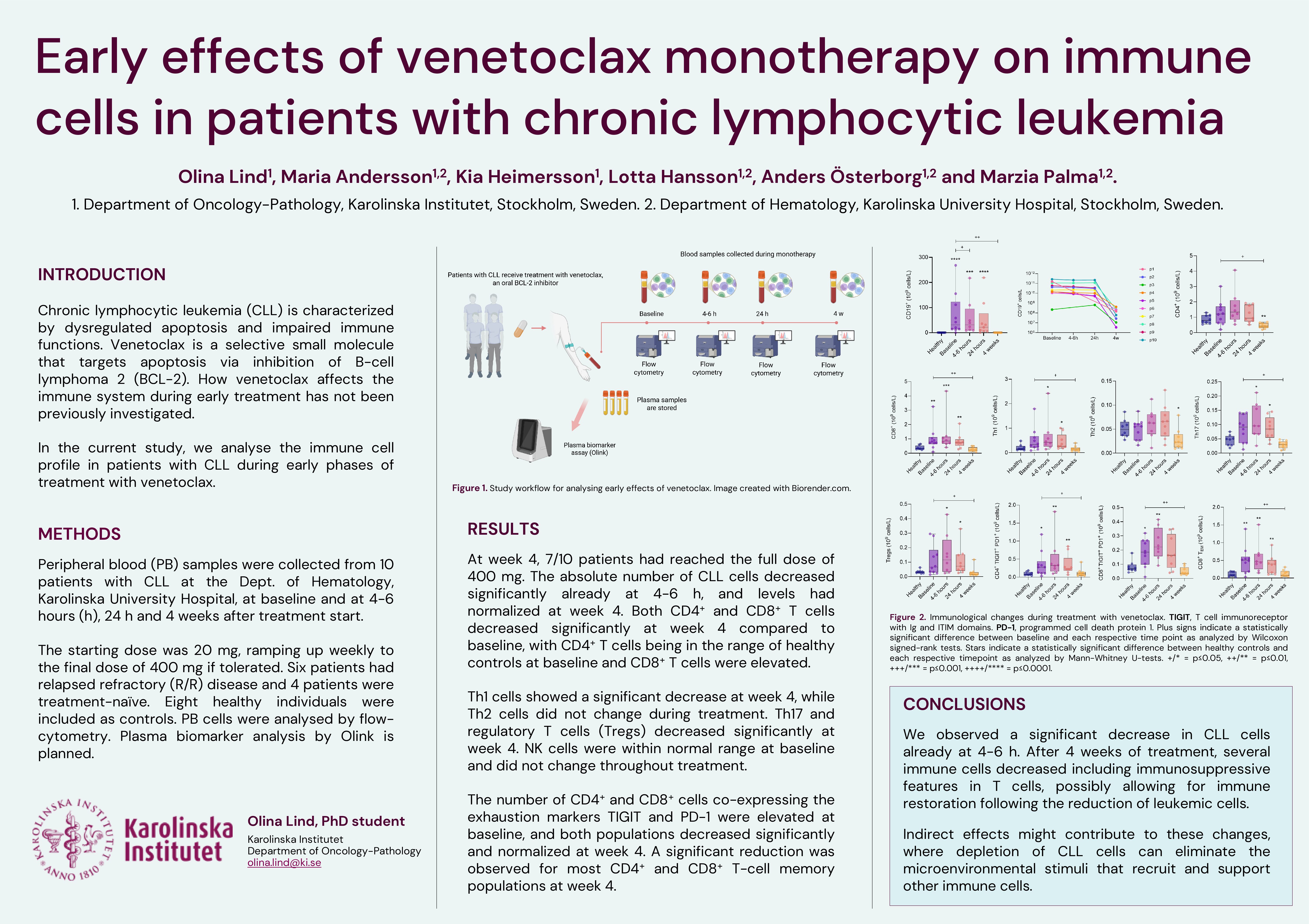
Peripheral blood (PB) samples were collected from 10 patients with CLL at the Dept. of Hematology, Karolinska University Hospital, before start of treatment and at 4-6 hours, 24 hours and after 4 weeks of treatment. The starting dose was 20 mg, ramping up weekly to the final dose of 400 mg if tolerated. Six patients had relapsed refractory (R/R) disease and 4 patients were treatment-naïve. Eight healthy individuals were included as controls. PB cells were analyzed by flow-cytometry.
Results
At week 4, 7/10 patients had reached the full dose of 400 mg. The absolute number of CD19+ cells decreased significantly already at 4-6 hours compared to baseline, and at week 4 levels were no longer significantly higher than those of healthy controls. At baseline, the numbers of CD4+ T cells were in the range of healthy controls and decreased to significantly lower levels at week 4. CD8+ T cells were significantly higher at baseline and normalized at week 4. Compared to baseline, both CD4+ and CD8+ T cells decreased significantly at the 4-week timepoint (p≤0.05).
For the T-helper subsets, Th1 and Th2 cell numbers were not elevated at baseline. Th1 cells showed a significant decrease at week 4 (p=0.05), and Th2 cells did not change during treatment. Th17 and T regulatory cells (T-regs) were higher compared to controls at early timepoints (but not at baseline) and decreased significantly at week 4 (p=0.05). NK cells were within normal range at baseline and did not change throughout treatment (p=0.05).
The number of CD4+ and CD8+ cells co-expressing the exhaustion markers T cell immunoreceptor with Ig and ITIM domains (TIGIT) and programmed cell death protein 1 (PD-1) were elevated at baseline, and both populations decreased significantly and normalized at week 4 (p≤0.05). A significant reduction (p≤0.05) was observed for all memory T cell populations at week 4 (CD4+ & CD8+ naïve cells, central memory CD4+ & CD8+ cells TCM, effector memory CD4+ & CD8+ cells TEM and T cells re-expressing CD45RA, CD8+ TEMRA), except for CD4+ TEMRA, which did not decrease compared to baseline. Most memory T cells were not elevated at baseline, except for CD8+ TCM and CD8+ TEM, while CD4+ naïve cells were lower than in healthy controls at baseline.
Conclusion
Investigating how targeted treatment modulates the immune system is important since infections are still a major complication in patients with CLL. Our analysis of venetoclax monotherapy reveals early changes in several immune cell populations. We observed a significant decrease in CLL cells already at 4-6 hours, and showed that major changes in T cells are induced primarily at the 4-week timepoint. All T cell populations decreased with a few exceptions, and cells initially elevated such as CD8+ T cells, CD8+ TEM as well as T cells expressing markers of exhaustion were normalized at week 4.
Altogether, we showed here that venetoclax reduced immune cells including immunosuppressive features in T cells, possibly allowing for immune restoration following the reduction of leukemic cells. Indirect effects might contribute to the changes observed, where depletion of CLL cells might affect the number of normal lymphocytes. Olink analysis is ongoing to reveal very early changes in the proteomic pattern.
Keywords : venetoclax, early, immunomodulation
Please indicate how this research was funded. :
Please indicate the name of the funding organization.: