Authors
Tamar Tadmor, Toby A. Eyre, Ohad Benjamini, Arvind Chaudhry, Juan Shen, Siyang Leng, Mohammed Z. H. Farooqui, David Lavie.
Background
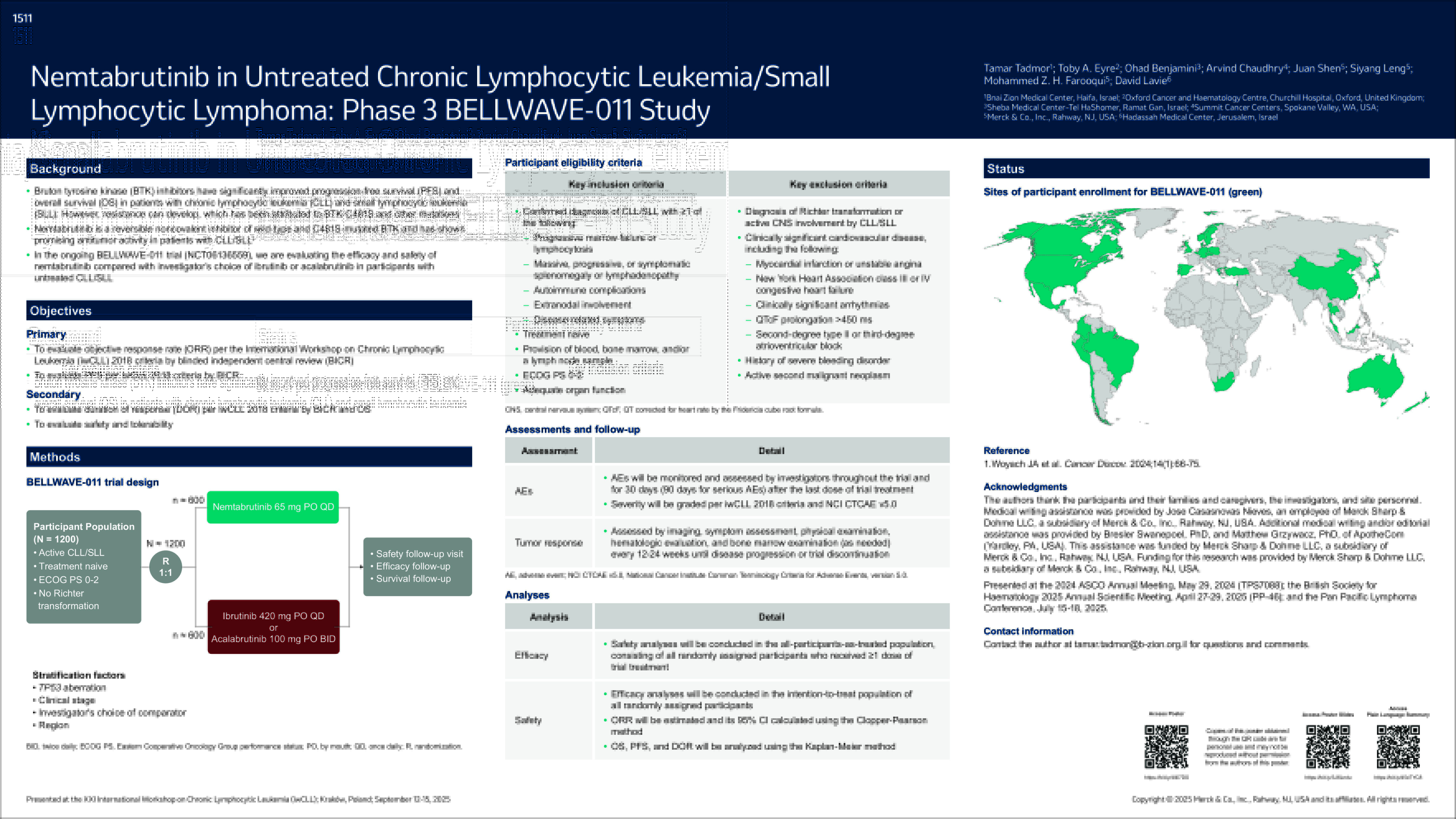
Bruton tyrosine kinase (BTK) inhibitors have contributed greatly to the advancement of treatment for chronic lymphocytic leukemia (CLL) and small lymphocytic lymphoma (SLL). Nonetheless, resistance to irreversible inhibitors such as ibrutinib can develop, often because of a BTK C481 mutation. Nemtabrutinib, a reversible, noncovalent, competitive inhibitor that targets wild type and C481S-mutated BTK, has shown promising antitumor activity in participants with relapsed or refractory CLL/SLL in the phase 1/2 BELLWAVE-001 study. The randomized, active-controlled, parallel, multisite, open-label, ongoing BELLWAVE-011 study (NCT06136559) is being conducted to compare efficacy and safety of nemtabrutinib with investigator’s choice of ibrutinib or acalabrutinib in participants with untreated CLL/SLL.
Methods
Eligible participants are aged ≥18 years with confirmed CLL/SLL and active disease per International Workshop on Chronic Lymphocytic Leukemia (iwCLL) 2018 criteria, which include at least 1 of the following: progressive marrow failure; progressive lymphocytosis; massive, progressive, or symptomatic splenomegaly or lymphadenopathy; symptomatic or functional extranodal involvement; autoimmune complications, including anemia or thrombocytopenia refractory to corticosteroids; and disease-related symptoms such as unintentional weight loss, significant fatigue, fever, or night sweats. Participants must be treatment naive and have an Eastern Cooperative Oncology Group performance status of 0 to 2. Participants with Richter transformation, central nervous system involvement by CLL/SLL, and second malignancy or severe bleeding disorder are excluded. Participants will be randomly assigned 1:1 to receive nemtabrutinib 65 mg once daily by mouth or investigator’s choice of ibrutinib 420 mg once daily by mouth or acalabrutinib 100 mg twice daily by mouth. Treatment will continue in both arms until unacceptable toxicity, disease progression, withdrawal, or other discontinuation criteria are met. Treatment response assessment, including imaging, physical examination, constitutional symptoms, hematologic evaluation, and bone marrow biopsy, will be completed every 12 weeks up to week 97 and every 24 weeks thereafter. Adverse events will be monitored throughout the trial and for 30 days (90 days for serious adverse events) after treatment and graded per National Cancer Institute Common Terminology Criteria for Adverse Events version 5.0, and iwCLL 2018 criteria for hematologic toxicity. The primary end points are objective response rate and progression-free survival per iwCLL 2018 criteria by blinded independent central review. The secondary end points are overall survival, duration of response per iwCLL 2018 criteria by blinded independent central review, and safety and tolerability. Recruitment is ongoing. ©2024 American Society of Clinical Oncology, Inc. Reused with permission. This abstract was accepted and previously presented at the 2024 ASCO Annual Meeting. All rights reserved.
Keywords : Chronic lymphocytic leukemia/small lymphocytic lymphoma, treatment naive, nemtabrutinib
Please indicate how this research was funded.: Merck Sharp & Dohme LLC, a subsidiary of Merck & Co., Inc., Rahway, NJ, USA
Please indicate the name of the funding organization. : Merck Sharp & Dohme LLC, a subsidiary of Merck & Co., Inc., Rahway, NJ, USA