
Authors
Bolarinwa R.A, Ahmed I.O, Omoyiola A.O, Adegbenro S.T, Oguns O.O, Akinola N.O
Background
Chronic lymphocytic leukaemia (CLL) is common in adults, accounting for 17-20% of all haematological cancers in Nigeria. Late presentation and poor access to targeted therapies are responsible for poor treatment outcomes in poor-resource settings like ours. This study evaluated the response and survival of newly diagnosed chronic lymphocytic leukaemia patients treated with the Fludarabine, Cyclophosphamide, and Rituximab combination (FCR).
Patients and Methods
This is a retrospective comparative study of CLL patients diagnosed at the haematology unit of the Obafemi Awolowo University Teaching Hospitals Complex between 2014 and 2024. Patients’ data were extracted from the haematology unit database. A total of 88 patients were diagnosed with CLL during the study period; however, only 42 patients had complete information. Of these, 11 received 6-8 cycles of FCR while the remaining 32 patients had non-Fludarabine-based therapy (non-FCR) (16 patients received Cyclophosphamide, Vincristine and prednisolone (CVP), while 9 and 6 patients received 6-8 cycles of Cyclophosphamide and prednisone (CP) and Chlorambucil and prednisolone (ChP), respectively, due to financial constraints. All the FCR cohort had immunohistochemistry of the bone marrow trephine tissue which confirms at least CD 20. The response to chemotherapy was determined according to the International Workshop on Chronic Lymphocytic Leukaemia (iwCLL) recommendations on response definition. Data was analyzed using inferential statistics, at a P-value ≤ 0.05. The survival rate for each chemotherapy group was determined using the Kaplan-Meier survival curve.
Results
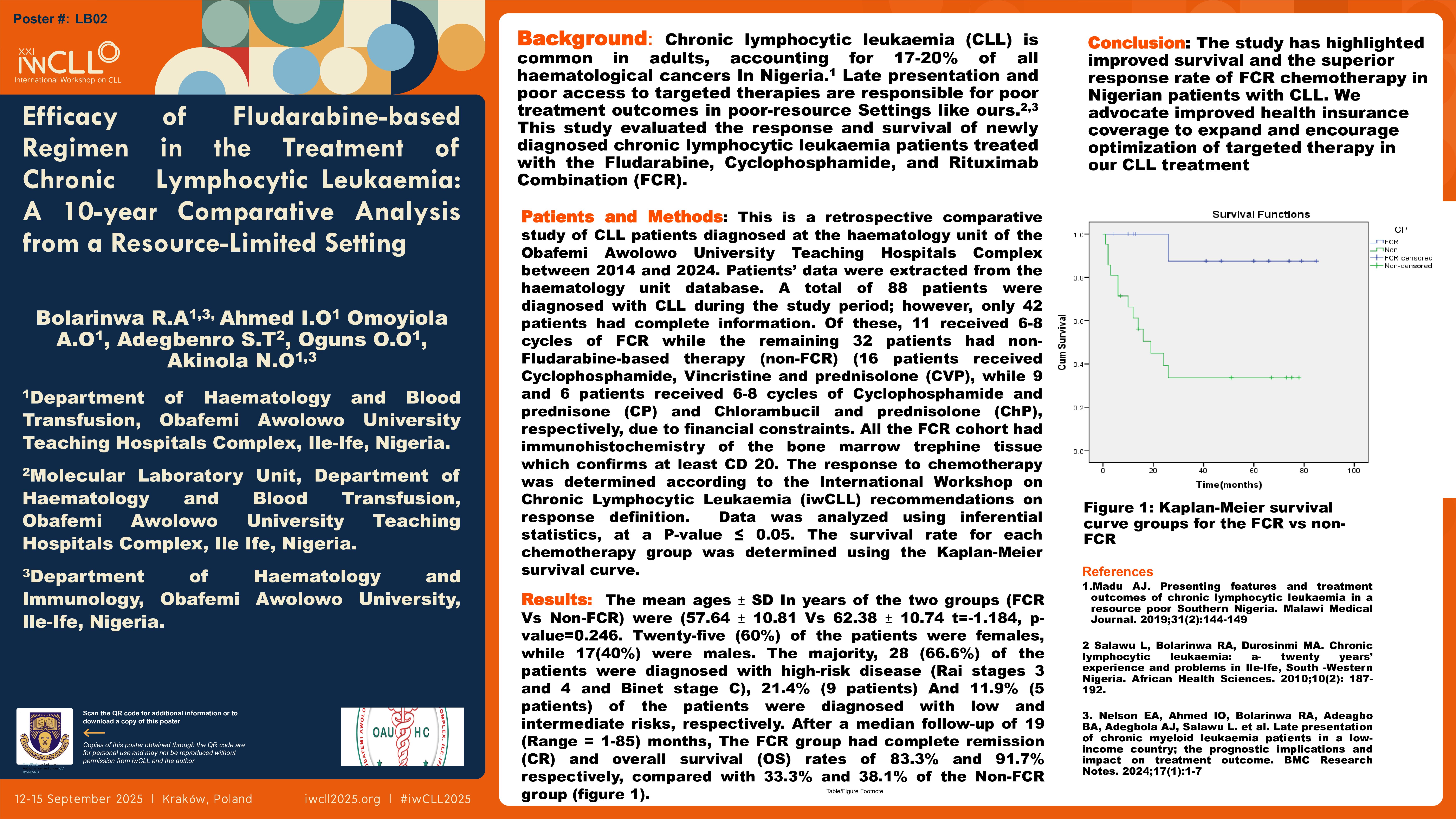
The mean ages ± SD in years of the two groups (FCR vs non-FCR) were (57.64 ± 10.81 vs 62.38 ± 10.74 t=-1.184, p-value=0.246. Twenty-five (60%) of the patients were females, while 17(40%) were males. The majority, 28 (66.6%) of the patients were diagnosed with high-risk disease (Rai stages 3 and 4 and Binet stage C), 21.4% (9 patients) and 11.9% (5 patients) of the patients were diagnosed with low and intermediate risks, respectively. After a median follow-up of 19 (range=1-85) months, the FCR group had complete remission (CR) and overall survival (OS) rates of 83.3% and 91.7% respectively, compared with 33.3% and 38.1% of the non-FCR group.
Conclusion
The study has highlighted improved survival and the superior response rate of FCR chemotherapy in Nigerian patients with CLL. We advocate improved health insurance coverage to expand and encourage optimization of targeted therapy in CLL treatment.
Keywords : CLL, FCR-therapy, Response-Rate
Please indicate how this research was funded. : This research was part of the 2023 FUNDING by the iwCLL by Prof RA Bolarinwa for the project title: “Molecular, Immunologic and Cytogenetic Characterisation of Chronic Lymphocytic Leukaemia to enhance Diagnosis and Prognosis of Patients in South West Nigeria”
Please indicate the name of the funding organization.: iwCLL