Authors
Alexey Danilov, Alvaro Alencar, Jackson Gao, Jennifer Zhao, Minna Balbas, Vishalkumar Patel, Suhyun Kang, Bruce D. Cheson.
Background
Covalent Bruton tyrosine kinase inhibitors (cBTKi) have significantly improved the outcomes for patients with chronic lymphocytic leukemia (CLL) and small lymphocytic lymphoma (SLL). However, resistance and intolerance to these agents is common, limiting the duration of treatment, and resulting in poorer outcomes after cBTKi failure. Pirtobrutinib, a highly selective, non-covalent BTKi, demonstrated clinically meaningful efficacy and a favorable safety profile amongst patients who had received a prior cBTKi in the pivotal 1/2 BRUIN study (LOXO-BTK-18001, NCT03740529), leading to FDA accelerated approval for adults with CLL/SLL after at least two prior lines of therapy including a BTK inhibitor and a BCL-2 inhibitor. Pirtobrutinib exhibited efficacy across a wide range of doses (25-300 mg daily), with no dose-limiting toxicities. The efficacy and safety were confirmed in a randomized phase 3 study (BRUIN CLL-321, NCT04666038) in patients with relapsed/refractory CLL/SLL. However, most data reflect later-line use, and relatively few patients received doses below the recommended dose of 200 mg. This has prompted further evaluation of lower doses to determine if there is an improved safety profile without compromising efficacy.
Aims
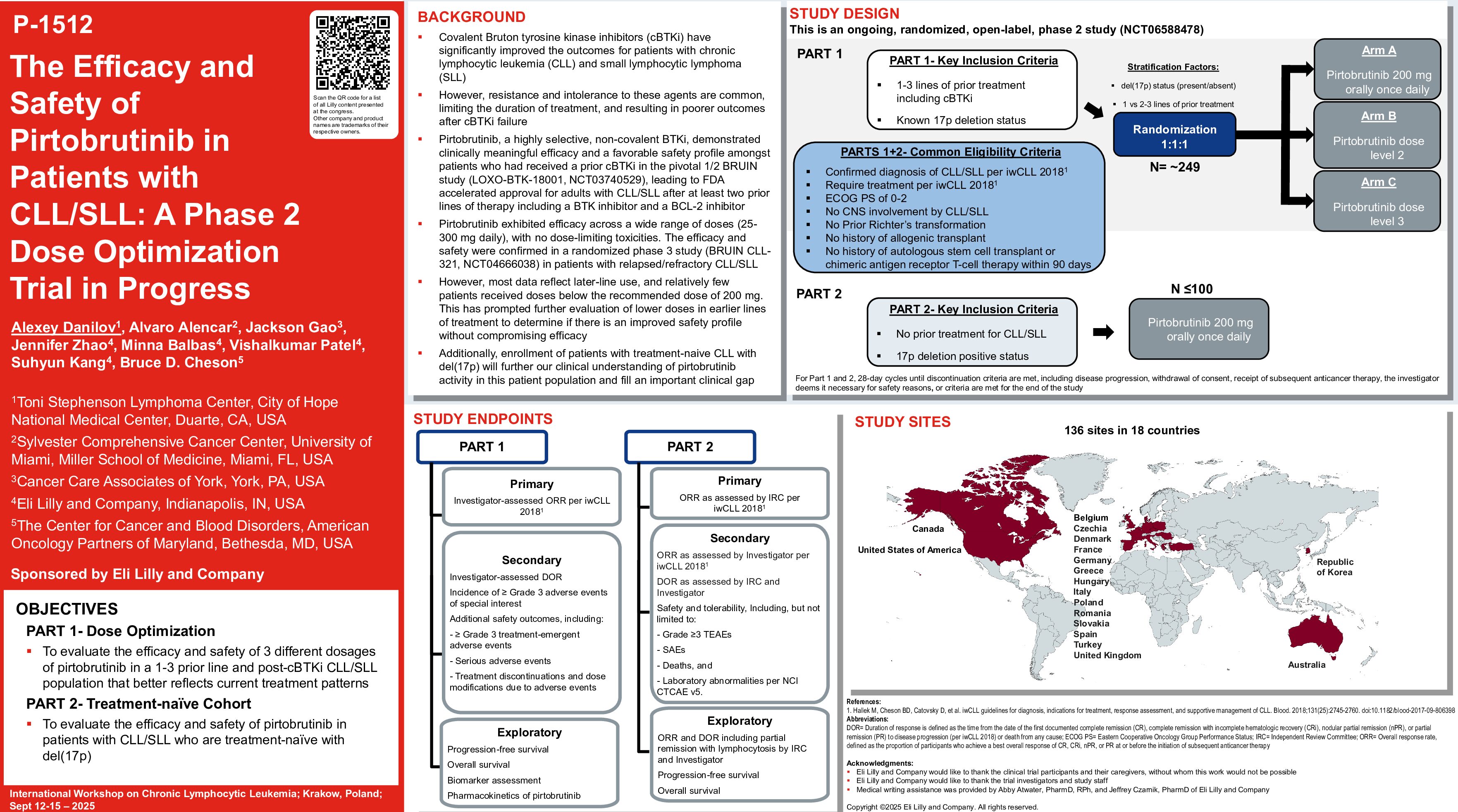
This ongoing phase 2, open-label, randomized study (NCT06588478) evaluates the efficacy and safety of 3 dose levels of pirtobrutinib in a less heavily pretreated post-cBTKi CLL/SLL population that better reflects current treatment patterns.
Methods
Approximately 249 patients will be randomly allocated across three different dose groups and stratified by del(17p) status (present/absent) and 1 vs 2-3 lines of prior treatment. Eligible patients require therapy per iwCLL 2018 criteria and key exclusion criteria include central nervous system involvement by CLL/SLL, prior Richter transformation, prior treatment with BTK degrader or non-covalent BTKi, or history of hematopoietic stem cell transplant or chimeric antigen receptor T-cell therapy within 90 days prior to randomization. Patients will receive pirtobrutinib continuously in this study until discontinuation criteria are met, including if patients experience disease progression, withdraw consent, receive subsequent anticancer therapy, the investigator deems it necessary for safety reasons, or criteria are met for the end of the study. The primary endpoint is comparison of investigator assessed overall response rate (ORR) per iwCLL 2018 criteria. ORR is defined as the proportion of participants who achieve the best overall response of complete remission, complete remission with incomplete hematologic recovery, nodular partial response, or partial response at or before the initiation of subsequent anticancer therapy. Secondary endpoints include investigator-assessed duration of response and safety endpoints.
Results
This study is a Trial in Progress. The results will be presented at a later date.
Conclusions
This study is a Trial in Progress. The conclusions will be presented at a later date.
Keywords : BTK Inhibitor, chronic lymphocytic leukemia, small lymphocytic lymphoma
Please indicate how this research was funded.: Eli Lilly and Company
Please indicate the name of the funding organization. : Eli Lilly and Company