
Authors
Deyan Y. Yosifov, Sandra Robrecht, Adam Giza, Armin Riecke, Christof Schneider, Palash Chandra Maity, Billy Jebaraj, Hassan Jumaa, Marc Young, Manish Kumar, Anna-Maria Fink, Kirsten Fischer, Barbara Eichhorst, Michael Hallek, Petra Langerbeins, Stephan Stilgenbauer, Eugen Tausch.
Introduction
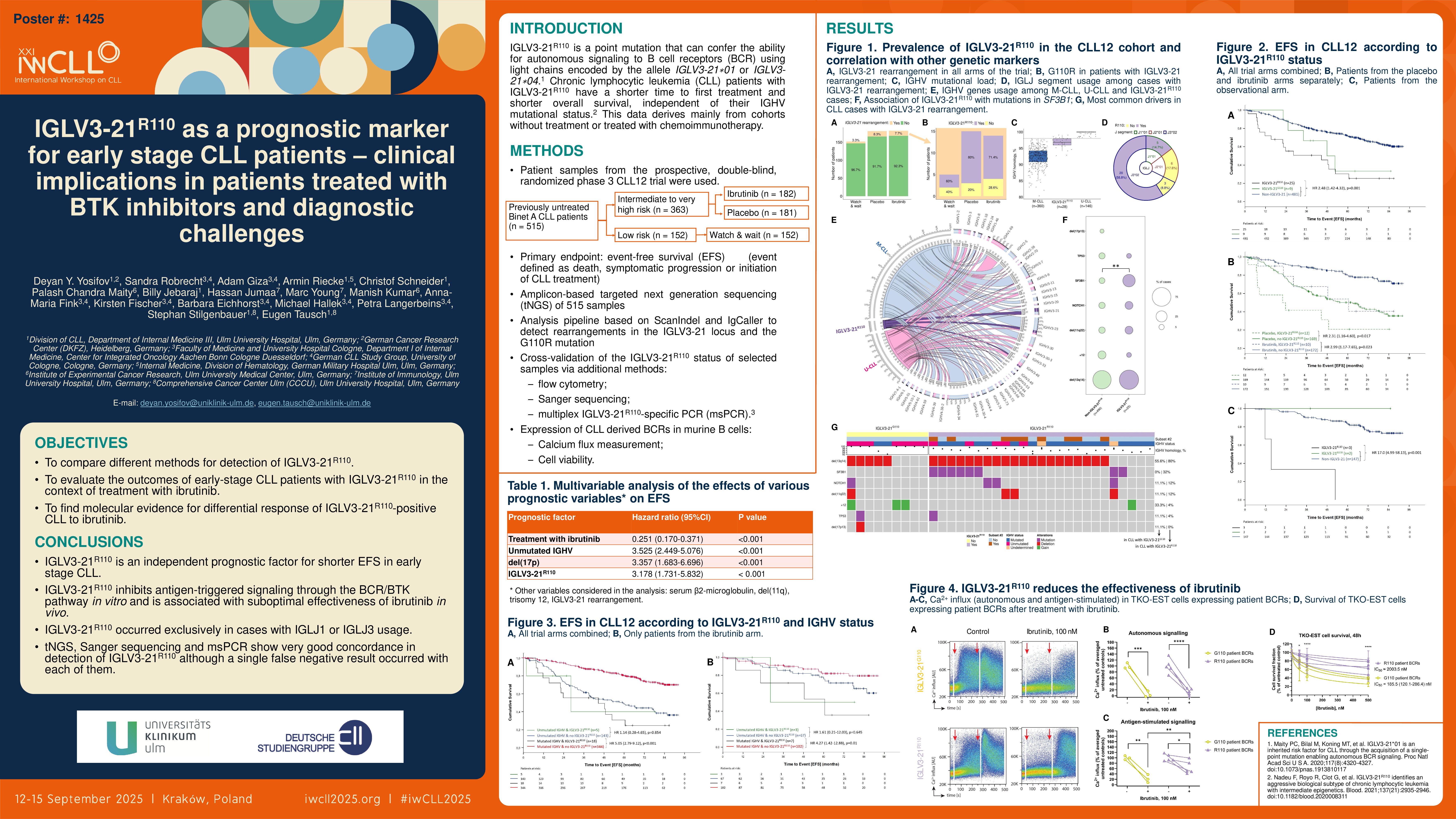
IGLV3-21R110 is a point mutation in light chain allele IGLV3-21∗01 or IGLV3-21∗04 that enables autonomous B cell receptor (BCR) signalling in chronic lymphocytic leukemia (CLL). It has been associated with shorter time to first treatment and shorter overall survival in various CLL cohorts. Although various methods exist for detecting IGLV3-21R110, their relative performance and concordance remain unclear. Furthermore, it is not yet known whether BTK inhibitors (BTKi) can effectively inhibit BCR signalling in IGLV3-21R110 positive CLL, and whether this mutation influences treatment outcomes.
Methods
The CLL12 trial compared ibrutinib vs. placebo in previously untreated Binet A CLL patients with intermediate to very high risk, while low risk patients were assigned to watch & wait (w&w). We analyzed all samples from this trial (n=515) using targeted next-generation sequencing (tNGS). Ambiguous results (n=5) were clarified by flow cytometry. All samples with IGLV3-21 rearrangement identified by tNGS, as well as 42 IGLV3-21R110-negative samples were reanalyzed by Sanger sequencing of cDNA and multiplex IGLV3-21R110-specific PCR (msPCR). Selected BCRs carrying either wild-type IGLV3-21G110 or mutated IGLV3-21R110 light chains were expressed in murine triple knock-out (TKO) B cells lacking Rag2, λ5, and SLP-65, but expressing inducible ERT2-SLP65 (EST) fusion protein. Cell-autonomous and antigen-stimulated BCR signalling were assessed in these TKO-EST cells by flow cytometric measurement of Ca2+ flux, as well as survival upon ibrutinib treatment in a concentration-dependent manner.
Results
Using tNGS, we identified 24 of 515 CLL samples as IGLV3-21R110-positive. All were confirmed by msPCR, and 23 also by Sanger sequencing. The false-negative result was due to a point mutation in the binding site for the Sanger forward sequencing primer. Two additional discrepancies were observed: One patient expressed the IGLV3-21*03 allele without the G110R mutation (confirmed by tNGS and Sanger) but showed elevated normalized intensity of the non-specific 140-bp band in msPCR, meeting the formal threshold for IGLV3-21R110 detection (Syrykh et al., Blood Advances, 2023). However, as the 240-bp amplicon’s forward primer is specific for IGLV3-21*01 and IGLV3-21*04 alleles only, the sample was classified as IGLV3-21G110. A third discrepant sample was identified as IGLV3-21R110 by both msPCR and Sanger, while tNGS detected the G110R mutation in only 5 out of 1424 reads. A similar pattern was observed in a second sample and the patient was classified as IGLV3-21R110.
In total, 34 patients had productive IGLV3-21 rearrangements: 5/152 (3.3%) in the w&w, 15/181 (8.3%) in the placebo and 14/182 (7.7%) in the ibrutinib group. Among these, 25 were IGLV3-21R110-positive (3/5, 12/15 and 10/14, respectively). IGLV3-21R110-positive patients had an intermediate IGHV mutational load and all expressed the IGLV3-21*04 allele. Among the 9 patients expressing IGLV3-21 chains without G110R, 3 used the IGLV3-21*04 allele, 4 IGLV3-21*02 and 2 IGLV3-21*03. All 5 cases using IGLJ1, but none of the 6 with IGLJ2, had the G110R mutation. Nine of the 25 IGLV3-21R110-positive cases (36%) carried stereotyped IGH genes and belonged to subset #2. Other frequently used heavy chains were IGHV3-23 and IGHV3-48. None of the IGLV3-21R110 cases had del(17p13), whereas SF3B1 mutations were more frequent in this group (32.0% vs. 6.1%, p< 0.001).
CLL patients with IGLV3-21R110 had shorter EFS in all study arms: w&w (HR 17.03, CI95% 4.99-58.13, p< 0.001), placebo (HR 2.31, CI95% 1.16-4.6, p=0.017), and ibrutinib (HR 2.99, CI95% 1.17-7.65, p=0.023). In multivariable analysis including other prognostic factors associated with EFS in univariate analyses (treatment with ibrutinib, serum β2-microglobulin, IGHV status, del(17p), del(11q) and +(12)), IGLV3-21R110 emerged as an independent prognostic factor of EFS (HR 3.18, CI95% 1.73-5.83, p< 0.001), in addition to U-IGHV, del(17p13) and treatment with ibrutinib.
Preliminary functional experiments using the TKO-EST system demonstrated that BCRs carrying the IGLV3-21R110 mutation require higher concentrations of ibrutinib to achieve effective inhibition of cell-autonomous BCR signalling and loss of cell viability, compared to their non-autonomous counterparts.
Conclusions
IGLV3-21R110 was identified as an independent prognostic factor for shorter EFS in early stage CLL and was associated with reduced efficacy of ibrutinib, both clinically and in vitro, as consequence of activated autonomous signalling. The emergence of IGLV3-21R110 as an important prognostic factor in CLL underscores the need for reliable detection, especially as its presence might also influence therapeutic decisions. Our comparison demonstrated overall concordance between the different sequencing and PCR-based methods, but also possible limitations with each of them.
Keywords : IGLV3-21R110, biomarker, BTK inhibitors
Please indicate how this research was funded. :
Please indicate the name of the funding organization.: