
Authors
Klaudia Zielonka, Błażej Izdebski, Joanna Drozd-Sokołowska, Katarzyna Pruszczyk-Matusiak, Bartosz, Puła, Kamil Wiśniewski, Waldemar Sawicki, Elżbieta Kalicińska, Paula Jabłonowska-Babij, Aleksandra Butrym, Tomasz Buczek, Edyta Subocz, Janusz Hałka, Magdalena Witkowska, Mateusz Wilk, Maria Hryniewiecka, Karolina Gruenpeter, Edyta Cichocka, Piotr Halicki, Kamil Wdowiak, Elżbieta Iskierka-Jażdżewska, Anna Kopińska, Anastazja Szlauer-Stefańska, Agnieszka Szymczyk, Anna Wolska-Washer, Jolanta Kowalczyk, Tomasz Wróbel, Iwona Hus, Krzysztof Jamroziak.
Background
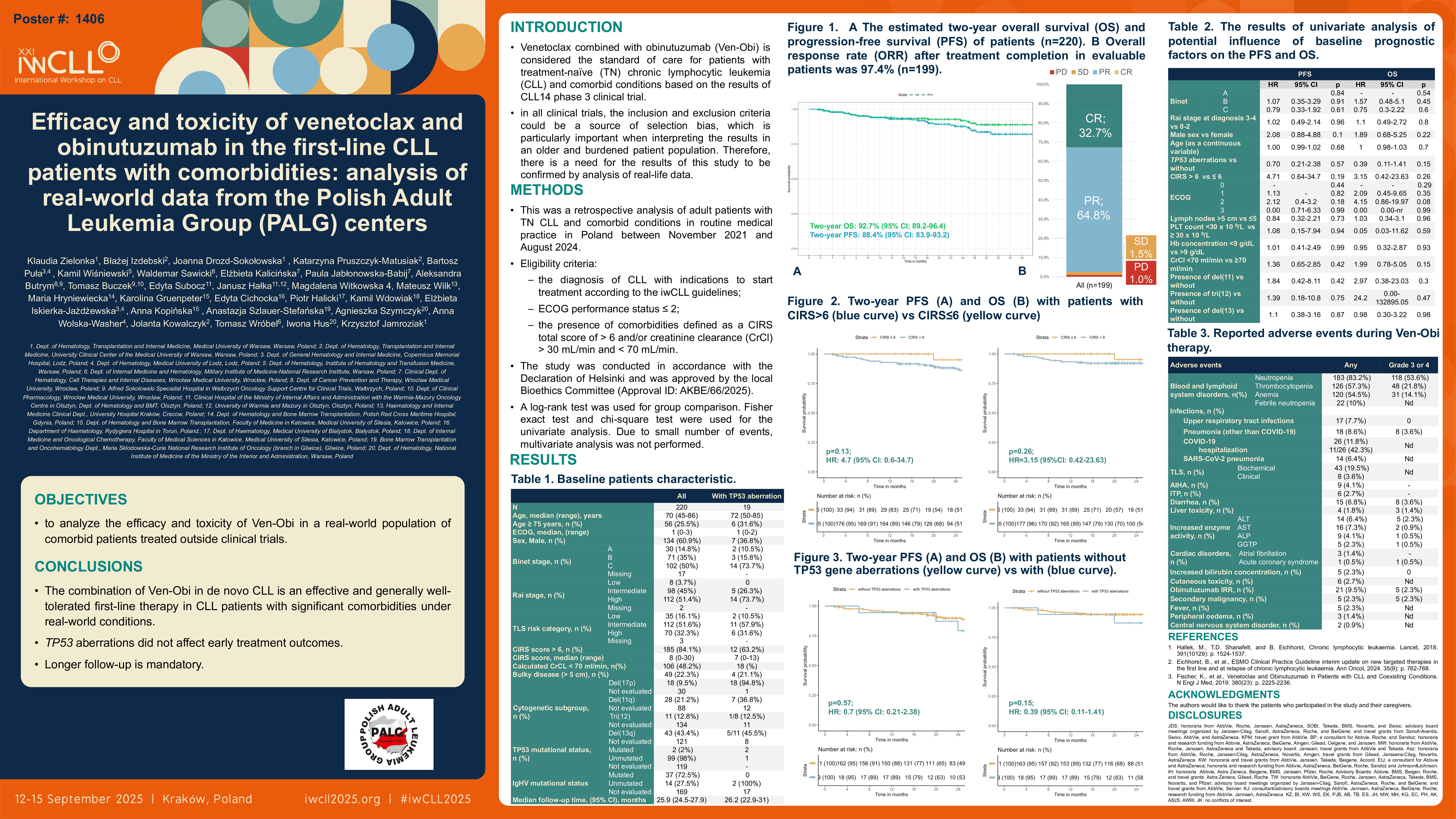
Venetoclax combined with obinutuzumab (VG) is regarded as the standard of care for patients with previously untreated chronic lymphocytic leukemia (CLL) and comorbid conditions, based on the results of the CLL14 study. Here, we present data on real-world patients treated with this combination at the centers of the Polish Adult Leukemia Group (PALG).The study aimed to analyze the efficacy and toxicity of VG in the first-line setting in CLL patients with comorbid conditions treated outside clinical trials.
Material and methods
This was a retrospective analysis of adult patients with untreated CLL and comorbid conditions defined as a Cumulative Illness Rating Scale (CIRS) total score of >6 or a creatinine clearance (CrCl) < 70mL/minute treated within CLL Therapeutic Programme of the Polish National Health Fund.
Results
A total of 220 CLL patients treated with first-line VG were included. The median age at VG commencement was 70 years (range: 45-86), and 134/220 (60.9%) were male. The median time between diagnosis and treatment initiation was 1.6 years (range: 0-19). The median ECOG was 1 (range: 0-3). The median CIRS score was 8 (range: 0-30), and 101 (45.9%) patients had CrCL < 70 ml/min. TP53 gene aberration (del17p and/or TP53 mutation) was detected in 19 (9.9%) patients out of 191 tested individuals. According to Rai, CLL stage was ≥ 3 in 111/220 (50.4%) patients. Tumor lysis syndrome (TLS) risk was intermediate in 102/203 (50.2%) and high in 69/203 (34%). Median time of observation was 26 months (95% CI: 24.5-27.9). Six (2.7%) patients were continuing treatment at the time of analysis, and 214/220 (97.3%) completed the therapy. In that group, 169/214 (79%) patients completed treatment as per protocol. The main reasons for treatment discontinuation were adverse events (AEs), most commonly liver toxicity, hematological toxicity, second primary malignancy (SPM), and infections. Clinical TLS was observed in 11/203 (5.4%) patients, while laboratory TLS was seen in 41/203 (20.2%) patients. The overall response rate according to iwCLL 2018 Response Criteria for evaluable patients was 97%. Estimated 24-month progression-free survival (PFS) was 88.9% (95% CI: 84.4-93.6), while estimated 24-month overall survival (OS) was 92.6% (95% CI: 89.1%-96.3%). Harboring del17p/TP53 gene mutation impacted neither PFS (p=0.525; HR: 1.487, 95% CI: 0.438-5.054) nor OS (p=0.156; HR: 2.521, 95% CI: 0.703-9.044). Alike, no differences were observed when comparing patients with comorbidities (CIRS>6 vs. CIRS < 6) and estimates for OS (p=0.274; HR: 3.078, 95% CI: 0.411-23.059) and PFS (p=0.142; HR: 4.469, 95 %CI: 0.606-32.941) did not significantly differ. Hematological toxicity of any grade was the most predominant, with 83.2% of patients developing neutropenia, 57.3% thrombocytopenia, and 54.5% anemia. The other most frequent AEs were SARS-CoV-2 infection (11.8%), febrile neutropenia (10%), obinutuzumab infusion-related reactions (9.5%), elevated liver enzyme activity (8.2%), pneumonia (8.6%), and upper respiratory tract infection (7.7%). Autoimmune phenomena occurred in 11 (5%) patients, comprising 9 autoimmune hemolytic anemias and 6 immune thrombocytopenias. There were 5 SPM in the analyzed cohort. Nineteen (8.6%) patients died. The leading causes of death were infections (5 patients), CLL progression (3 patients) and SPM (2 patients).
Conclusions
VG combination was effective and well-tolerated in patients with de novo CLL and comorbidities under real-world conditions. In our short observation TP53 aberrations do not seem to impact significantly the early treatment outcomes, though extended follow-up is mandatory.
Keywords : chronic lymphocytic leukemia; comorbidities; venetoclax
Please indicate how this research was funded. :
Please indicate the name of the funding organization.: