
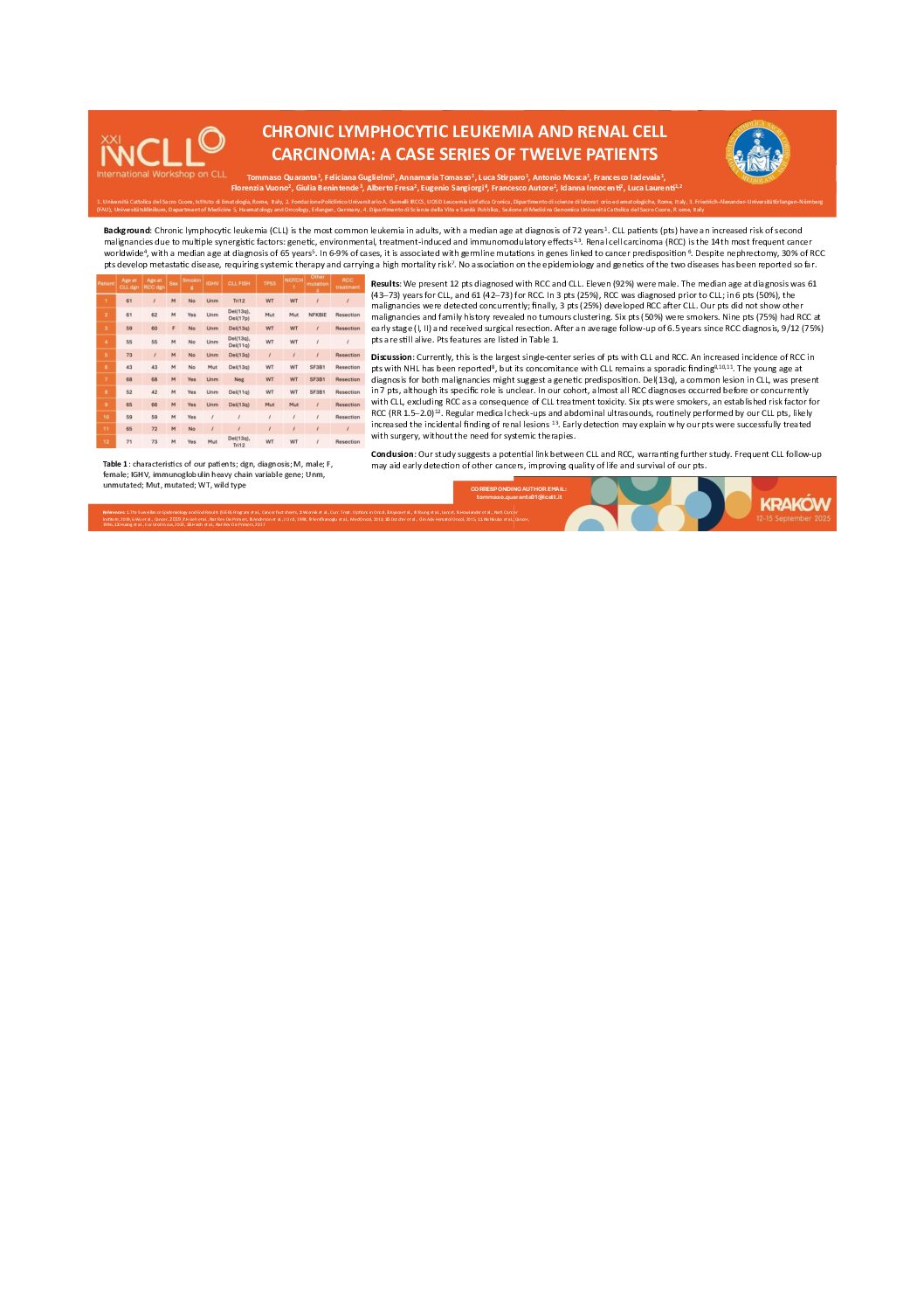
Chronic Lymphocytic Leukemia and Renal Cell Carcinoma: A Case Series of Twelve Patients (544kB pdf)
Authors
Tommaso Quaranta, Feliciana Guglielmi, Annamaria Tomasso, Luca Stirparo, Antonio Mosca, Francesco Iadevaia, Florenzia Vuono, Biologist, Giulia Benintende, Alberto Fresa, Eugenio Sangiorgi, Francesco Autore, Idanna Innocenti.
Background
Chronic lymphocytic leukemia (CLL) is the most common leukemia in adults, with a median age at diagnosis of 72 years (SEER Program, 2019). CLL patients (pts) have an increased risk of second malignancies due to multiple synergistic factors: genetic, environmental, treatment-induced and immunomodulatory effects (Wiernik, anno non specificato; Kyasa et al., 2004). Renal cell carcinoma (RCC) has an annual incidence of 14.9 per 100,000 people, with a median age at diagnosis of 65 years (Howlander et al., 2019). In 6-9% of cases, it is associated with germline mutations in genes linked to cancer predisposition (Wu et al., 2019). Despite nephrectomy, 30% of RCC pts develop metastatic disease, requiring systemic therapy and carrying a high mortality risk (Hsieh et al., 2017). No association on the epidemiology and genetics of the two diseases has been reported so far.
Results
Out of 740 CLL pts followed at our center in the last 25 years, we found 12 pts (1.62%) with a diagnosis of RCC (Table 1). Eleven (92%) were male. The median age at diagnosis was 61 (43–73) years for CLL, and 61 (42–73) for RCC. In 3 pts (25%), RCC was diagnosed prior to CLL; in 6 pts (50%), the malignancies were detected concurrently; finally, 3 pts (25%) developed RCC after CLL. Our pts did not show other malignancies and family history revealed no tumours clustering. Nine pts (75%) had RCC at early stage (I, II) and received surgical resection. After an average follow-up of 6.5 years since RCC diagnosis, 9/12 (75%) pts are still alive.
Discussion
Currently, this is the largest single-center series of pts with CLL and RCC. An increased incidence of RCC in pts with NHL has been reported (Anderson et al., 1998), but its concomitance with CLL remains a sporadic finding (Serefhanoglu et al., 2010; Dutcher & Wiernik, 2015; Nishikubo et al., 1996). The young age at diagnosis for both malignancies might suggest a genetic predisposition. Del(13q), a common lesion in CLL, was present in 7 pts, but its specific role is unclear. In our cohort, almost all RCC diagnoses occurred before or concurrently with CLL, excluding CLL treatment toxicity as a cause. Six pts were smokers, an established risk factor for RCC (RR 1.5–2.0) (Huang et al., 2022). Regular medical check-ups and abdominal ultrasounds, routinely performed by our CLL pts, likely increased the incidental finding of renal lesions (Hsieh et al., 2017). Early detection may explain why our pts were successfully treated with surgery, without the need for systemic therapies.
Conclusion
Our study suggests a potential link between CLL and RCC, warranting further study. Frequent CLL follow-up may aid early detection of other cancers, improving quality of life and survival of our pts.
Keywords : chronic lymphocytic leukemia, second malignancies, renal cell carcinoma
Please indicate how this research was funded. : The authors declare that this study was not funded by any source.
Please indicate the name of the funding organization.: The authors declare that this study was not funded by any source.