
Authors
Jose Luis Castaño, Víctor Arenas, Daniela Vallejo, Juan José Domínguez, Lucrecia Yáñez, and Carlos Pipaón.
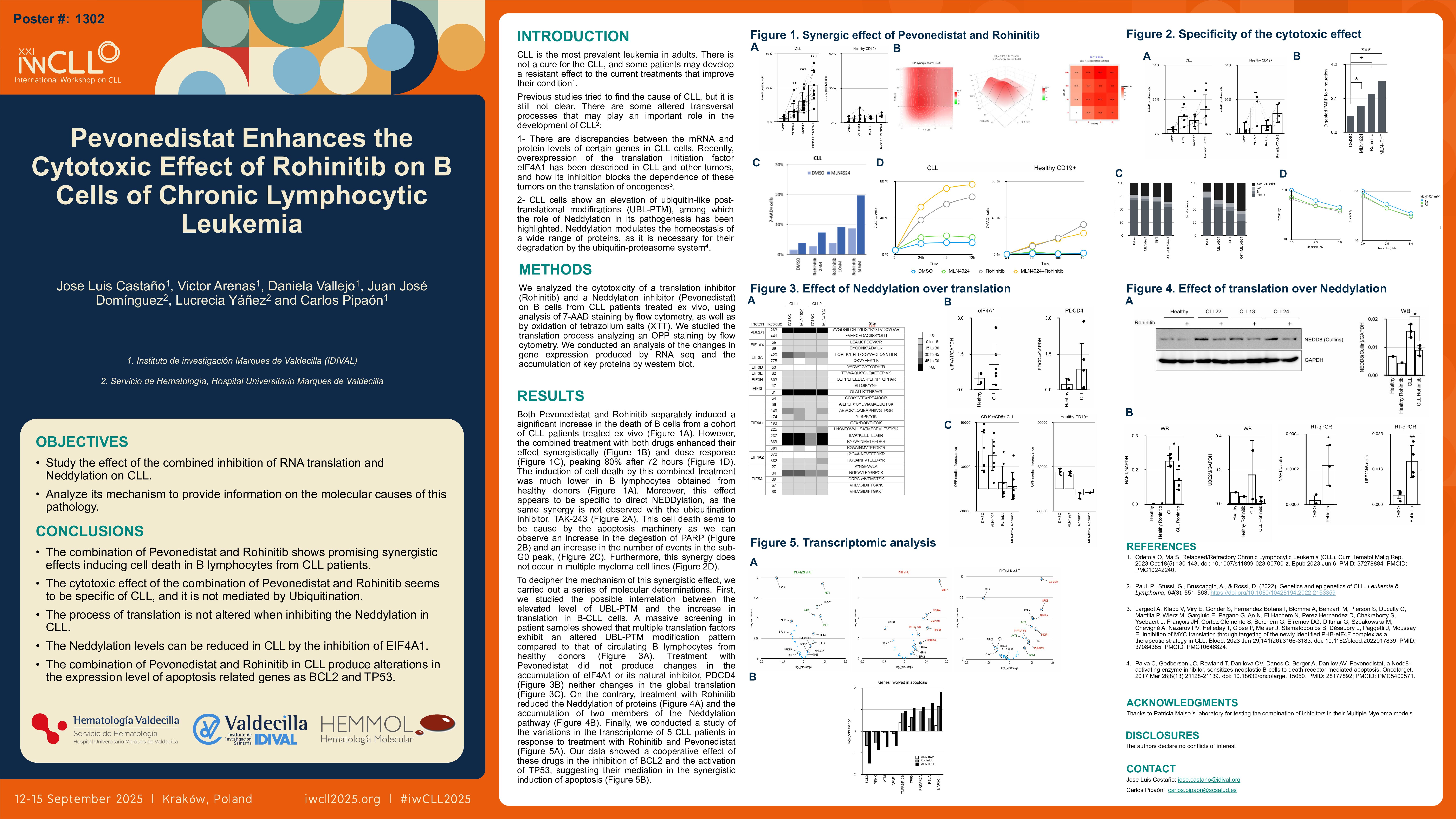
Pevonedistat Enhances the Cytotoxic Effect of Rohinitib on B Cells of Chronic Lymphocytic Leukemia
Introduction
It has long been known that there are discrepancies between the mRNA and protein levels of certain genes in CLL cells. Recently, overexpression of the translation initiation factor eIF4A1 has been described in CLL and other tumors, and how its inhibition blocks the dependence of these tumors on the translation of oncogenes.
On the other hand, CLL cells show an elevation of ubiquitin-like post-translational modifications (UBL-PTM), among which the role of NEDDylation in its pathogenesis has been highlighted. NEDDylation modulates the homeostasis of a wide range of proteins, as it is necessary for their degradation by the ubiquitin-proteasome system. However, the direct NEDDylation of other proteins does not affect their stability but does affect their function. An inhibitor of NEDDylation, Pevonedistat, has shown a cytotoxic effect on CLL cells, and results from a clinical study in combination with Ibrutinib have recently been published.
Objective
The aim of this work is to study the effect of the combined inhibition of RNA translation and NEDDylation on CLL and analyze its mechanism to provide information on the molecular causes of this pathology.
Methods
We analyzed the cytotoxicity of a translation inhibitor (Rohinitib) and a NEDDylation inhibitor (Pevonedistat) on B cells from CLL patients treated ex vivo, using analysis of 7-AAD staining by flow cytometry, as well as by oxidation of tetrazolium salts (XTT). We conducted an analysis of the changes in gene expression produced by RNAseq and the accumulation of key proteins by western blot.
Results
Both Pevonedistat and Rohinitib separately induced a significant increase in the death of B cells from a cohort of CLL patients treated ex vivo. However, the combined treatment with both drugs enhanced their effect synergistically, peaking 80% after 72 hours. The analysis of the cell cycle of CLL B cells under the different treatments showed an increase in the number of events in the sub-G0 peak, suggesting activation of the apoptosis machinery. The induction of cell death by this combined treatment was much lower in B lymphocytes obtained from healthy donors. Furthermore, this synergy does not occur in multiple myeloma cell lines. Moreover, this effect appears to be specific to direct NEDDylation, as the same synergy is not observed with the ubiquitination inhibitor, TAK-243.
To decipher the mechanism of this synergistic effect, we carried out a series of molecular determinations. First, we studied the possible interrelation between the elevated level of UBL-PTM and the increase in translation in B-CLL cells. A massive screening in patient samples showed that multiple translation factors exhibit an altered UBL-PTM modification pattern compared to that of circulating B lymphocytes from healthy donors. Treatment with Pevonedistat did not produce changes in the accumulation of eIF4A1 or its natural inhibitor, PDCD4. On the contrary, treatment with Rohinitib reduced the accumulation of two members of the NEDDylation pathway. Most interestingly, Rohinitib also affected the accumulation of the kinases BTK, SYK, LYN and PLCɣ2, suggesting a role of RNA translation in the constitutive BCR signaling in CLL. Finally, we conducted a study of the variations in the transcriptome of 5 CLL patients in response to treatment with Rohinitib and Pevonedistat. Our data showed a cooperative effect of these drugs in the inhibition of BCL2 and the activation of TP53, suggesting their mediation in the synergistic induction of apoptosis.
Conclusion
Our data demonstrate how the combined inhibition of two distinctive characteristics of CLL cells (their elevated RNA translation and ubiquitin-like post-translational modifications) induces a high and specific cell death of B-CLL cells treated ex vivo, suggesting its potential therapeutical use. In vivo experiments are currently ongoing.
Keywords : NEDDylation, RNA translation, ex-vivo
Please indicate how this research was funded. :
Please indicate the name of the funding organization.: