
Authors
Keri Yang, Swetha Challagulla, Po-Ya Chuang, Wesley Furnback, Sikander Ailawadhi.
Background
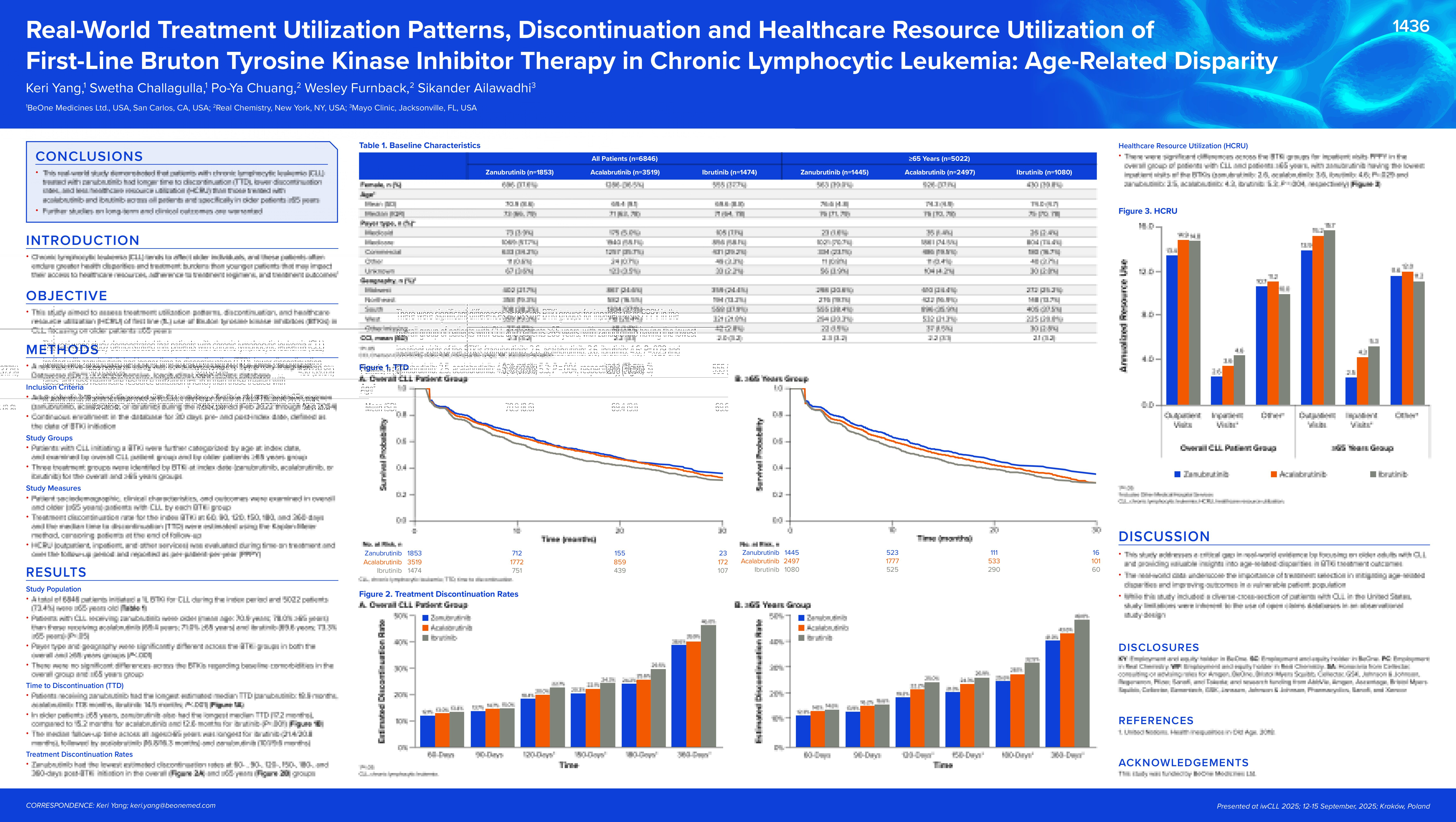
CLL tends to affect older individuals, and older patients often endure greater health disparities and treatment burdens that may impact their access to healthcare resources, adherence to treatment regimens and treatment outcomes (UN, Health Inequalities in Old Age). This study aimed to assess treatment utilization patterns, discontinuation, and healthcare resource utilization (HCRU) of 1L use of BTKi in CLL, focusing on older patients >65 years (yrs).
Methods
A retrospective observational study using the Symphony Integrated Dataverse was conducted to identify adult CLL patients initiating a 1L BTKi (zanubrutinib [ZANU], acalabrutinib [ACA] or ibrutinib [IBR]) treatment regimen from 02/2022 and 09/2024 (index period). Patients were required to have ≥30 days of continuous enrollment in the pre- and post-index periods. Patients initiating a BTKi were further categorized by age at index date. Patient sociodemographic, clinical characteristics, and outcomes were reported in overall and older (>65 yrs) CLL patients by each BTKi group. Treatment discontinuation rate was examined at 60, 90, 120, 150, 180, and 360 days, and by median time to discontinuation (TTD), estimated using the Kaplan-Meier method, censoring patients at the end of follow-up. HCRU (outpatient, inpatient, and other services) was evaluated during time on treatment and over the follow-up period and reported as per-patient-per-year (PPPY).
Results
A total of 6,846 patients initiated a 1L BTKi (ZANU: n=1,853; ACA: 3,519; IBR: 1,474) for CLL during the index period. Patients receiving ZANU were older (mean age: 70.9 yrs; 78% >65 yrs) than those receiving ACA (69.4 yrs; 71% >65 yrs) and IBR (69.6 yrs; 73% >65 yrs). Payer type and geography were significantly different across each BTKi group (P <.001). There were no significant differences across the BTKis regarding baseline comorbidities. ZANU patients had the longest estimated median TTD overall (ZANU: 18.9 months [m], ACA: 17.8 m, IBR: 14.5 m; P<.001) and in patients >65 yrs (ZANU: 17.2 m, ACA: 15.2 m, IBR: 12.6 m; P<.001). ZANU patients also had the lowest estimated discontinuation rates at 60- , 90-, 120-, 150-, 180-, and 360-days post BTKi initiation in the overall and >65 yrs groups. There were significant differences across the BTKi group for inpatient visits PPPY in all patients and >65 yrs with ZANU having the lowest visits of the BTKis (ZANU: 2.6, ACA: 3.6, IBR: 4.6; P=.029 and ZANU: 2.5, ACA: 4.3, IBR: 5.3; P=.004, respectively).
Conclusion
This real-world study demonstrated that CLL patients treated with ZANU had longer TTD, lower discontinuation rates, and less HCRU than ACA and IBR across all patients and specifically in older patients >65 yrs. Further studies on long-term and clinical outcomes are warranted.
Keywords : CLL, BTKi, age disparity
Please indicate how this research was funded.: BeOne Medicines Ltd.
Please indicate the name of the funding organization. : BeOne Medicines Ltd.