Authors
Stephen S. Opat, Constantine S. Tam, Mary Ann Anderson, Alessandra Tedeschi, Emma Verner, Masa Lasica, Alejandro Arbelaez, Stephan Stilgenbauer, Peter Browett, Sophie Leitch, Eva González-Barca, Mazyar Shadman, Jing-Zhou Hou, Herbert Eradat, David Westerman, Yiqian Fang, James Hilger, Sheel Patel, Chan Y. Cheah.
Background
Despite recent therapeutic advances, most treated patients with chronic lymphocytic leukemia/small lymphocytic lymphoma (CLL/SLL) experience disease relapse, necessitating further treatment with novel agents. B-cell lymphoma 2 (BCL2) inhibition is an established CLL/SLL therapeutic strategy, and adding Bruton tyrosine kinase (BTK) inhibition may be synergistic. Sonrotoclax (BGB-11417), a next-generation BCL2 inhibitor, is a more selective and pharmacologically potent inhibitor of BCL2 than venetoclax, with a shorter half-life and no drug accumulation. Zanubrutinib, a next-generation BTK inhibitor, is highly effective in CLL, including in patients with high-risk disease features, and has shown superior progression-free survival (PFS) with fewer cardiac adverse events (AEs) vs ibrutinib in a randomized study in patients with relapsed/refractory (R/R) CLL/SLL.
Aims
To report updated safety and efficacy data for sonrotoclax + zanubrutinib in patients with R/R CLL/SLL in the ongoing BGB-11417-101 (NCT04277637) study.
Methods
Patients with R/R CLL/SLL received zanubrutinib (320mg once daily [QD] or 160mg twice daily) 8-12 weeks before starting sonrotoclax (40, 80, 160, 320, or 640mg QD) with ramp-up to the target dose to prevent tumor lysis syndrome (TLS). Patients who previously progressed while on a BTK inhibitor were excluded from this cohort. Patients were treated until disease progression or unacceptable toxicity. The primary endpoint was safety per CTCAE v5.0; overall response rate (ORR) per iwCLL 2018 criteria and undetectable measurable residual disease (uMRD) in blood by standardized ERIC flow cytometry every 24 weeks (uMRD4) were secondary and exploratory endpoints, respectively.
Results
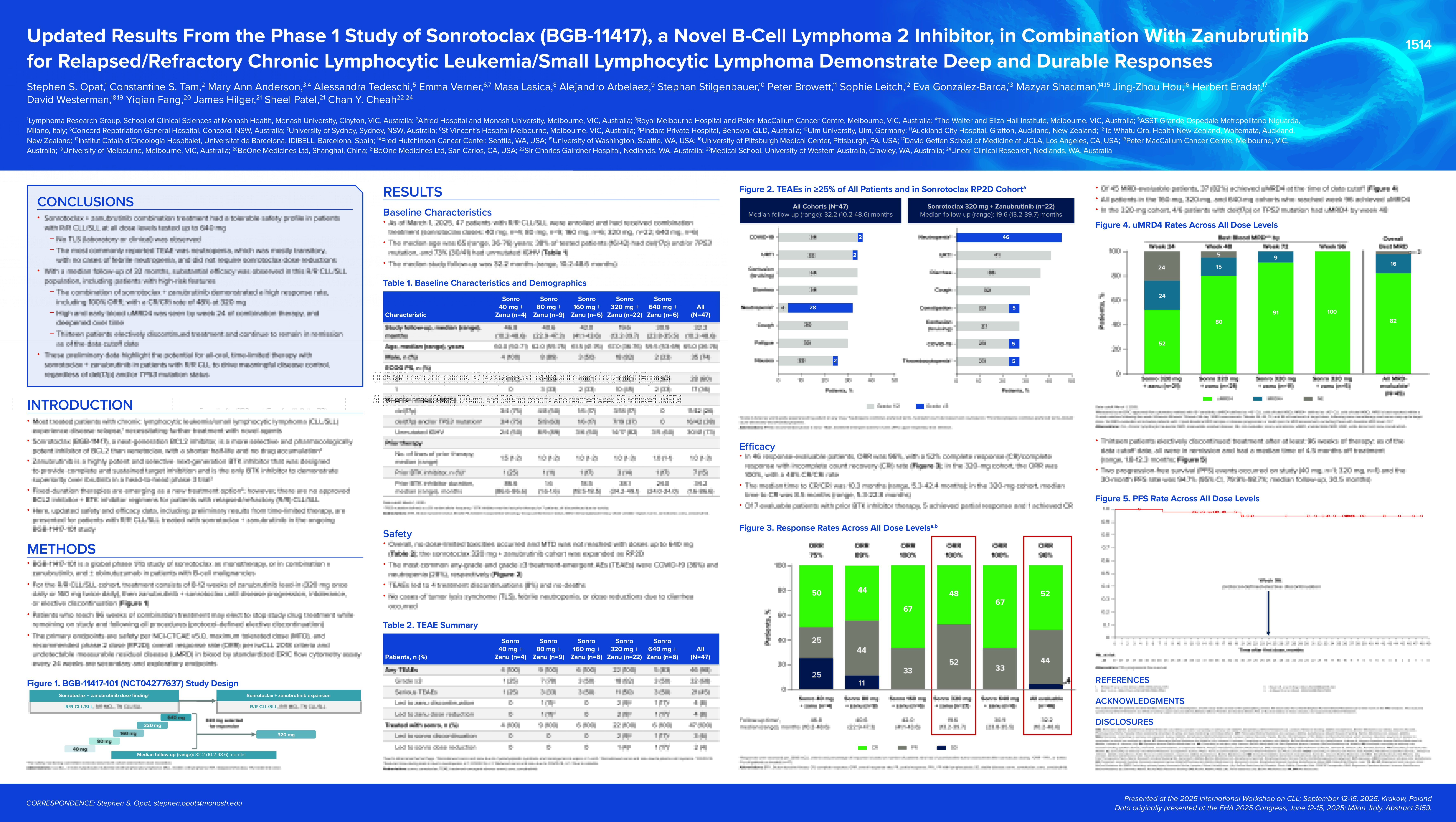
As of December 6, 2024, 47 patients with R/R CLL/SLL were enrolled and had received combination treatment (sonrotoclax doses: 40mg, n=4; 80mg, n=9; 160mg, n=6; 320mg, n=22; 640mg, n=6). Median age was 65 (range, 36-76) years; 26.2% of tested patients (11/42) had del(17p) and 73.2% (30/41) had unmutated IGHV. Median number of prior treatments was 1 (range, 1-3); 7 patients had a BTK inhibitor as their last prior therapy. Median follow-up was 29.4 (range, 10.2-45.8) months. No dose-limiting toxicities occurred; sonrotoclax maximum tolerated dose was not reached with doses up to 640mg. Dose expansion was completed with a recommended phase 2 dose of 320mg. The most common any-grade treatment-emergent AE (TEAE) was COVID-19 (n=17; 36.2%). Neutropenia was the most common grade ≥3 TEAE (n=13; 27.7%; no febrile neutropenia). No cases of TLS occurred. Four patients (8.5%) discontinued treatment due to TEAEs (myelodysplastic syndromes, meningococcal sepsis, plasma cell myeloma, and intracranial hemorrhage [discontinued zanubrutinib only]; n=1 each). No TEAEs led to death. In 46 response-evaluable patients, ORR was 95.7% (n=44; 2 patients [40 and 80mg] had stable disease); complete response (CR) rate was 50.0% (320mg, n=10 [47.6%]; 640mg, n=3 [50.0%]). Median time to CR was 10.2 (range, 5.3-42.4) months. Of 7 response-evaluable patients with prior BTK inhibitor treatment, 6 achieved partial response (n=5) or CR (n=1). Of 45 MRD-evaluable patients, 36 (80.0%) achieved uMRD4, with evidence of responses deepening over time. All patients treated with sonrotoclax 160, 320, or 640mg + zanubrutinib who reached week 96 (n=14) achieved uMRD4, indicating deep and durable responses. One patient converted from uMRD to MRD4+ 6 months after elective treatment discontinuation and still remains in CR. With a median study follow-up of 29.4 months, only 2 PFS events occurred (40mg, n=1; 320mg, n=1) and the 24-month PFS rate was 94.5%.
Conclusion
Sonrotoclax + zanubrutinib combination treatment demonstrated a tolerable safety profile across all dose levels tested. Antitumor activity of this combination is encouraging, with a 95.7% ORR, deep responses, and uMRD observed in patients with R/R CLL/SLL, including those previously treated with a BTK inhibitor.
Keywords : Relapsed/Refractory CLL, sonrotoclax, zanubrutinib
Please indicate how this research was funded.:
Please indicate the name of the funding organization. : BeOne Medicines Ltd