
Other Cancers in Patients with Chronic Lymphocytic Leukemia/Small Lymphocytic Lymphoma (573kB pdf)
Authors
Helen Ma, Kari Rabe, Edward Ratner, Sam Kosydar, Roberta Santos Azevedo, Pankaj Gupta, Susan O’Brien, Paul Hampel, Lindsey Roeker, Yucai Wang, Susan Slager, Sameer A. Parikh, Alessandra Ferrajoli.
Introduction
Patients diagnosed with chronic lymphocytic leukemia or small lymphocytic lymphoma (CLL/SLL) exhibit an elevated risk of developing other cancers (OC) relative to the general population. Historically, chemoimmunotherapy (CIT) represented the cornerstone of CLL/SLL management. A systematic review of clinical trials of CIT for CLL that included 28 studies reported 352/3297 (12.6%) patients developed OC (Csanadi 2022). The introduction of targeted agents beginning in the mid-2010’s, including Bruton tyrosine kinase inhibitors (BTKi) and BCL2 inhibitors, has shifted the standard of care toward these novel therapies. In this study, we determined the risk of OC in newly diagnosed CLL/SLL patients cared for at the US Department of Veteran Affairs (VA) and Mayo Clinic in Rochester, MN.
Methods
We identified patients with newly diagnosed CLL/SLL after 1/1/2016 using the VA Central Cancer Registry and the Mayo Clinic CLL Database. The baseline clinical characteristics, CLL treatments, and the occurrence of OC were abstracted by electronic health record (EHR) review. Receipt of CLL directed therapy was categorized into: a) CIT only; b) targeted therapy only; c) CIT and targeted therapy; and d) other (including monotherapy with monoclonal antibody therapy, etc). The occurrence of OC was modeled using CLL treatment as a time-dependent variable. Prior and concurrent OC diagnosed within 3 months of CLL/SLL were excluded from analyses, to reduce ascertainment bias.
Results
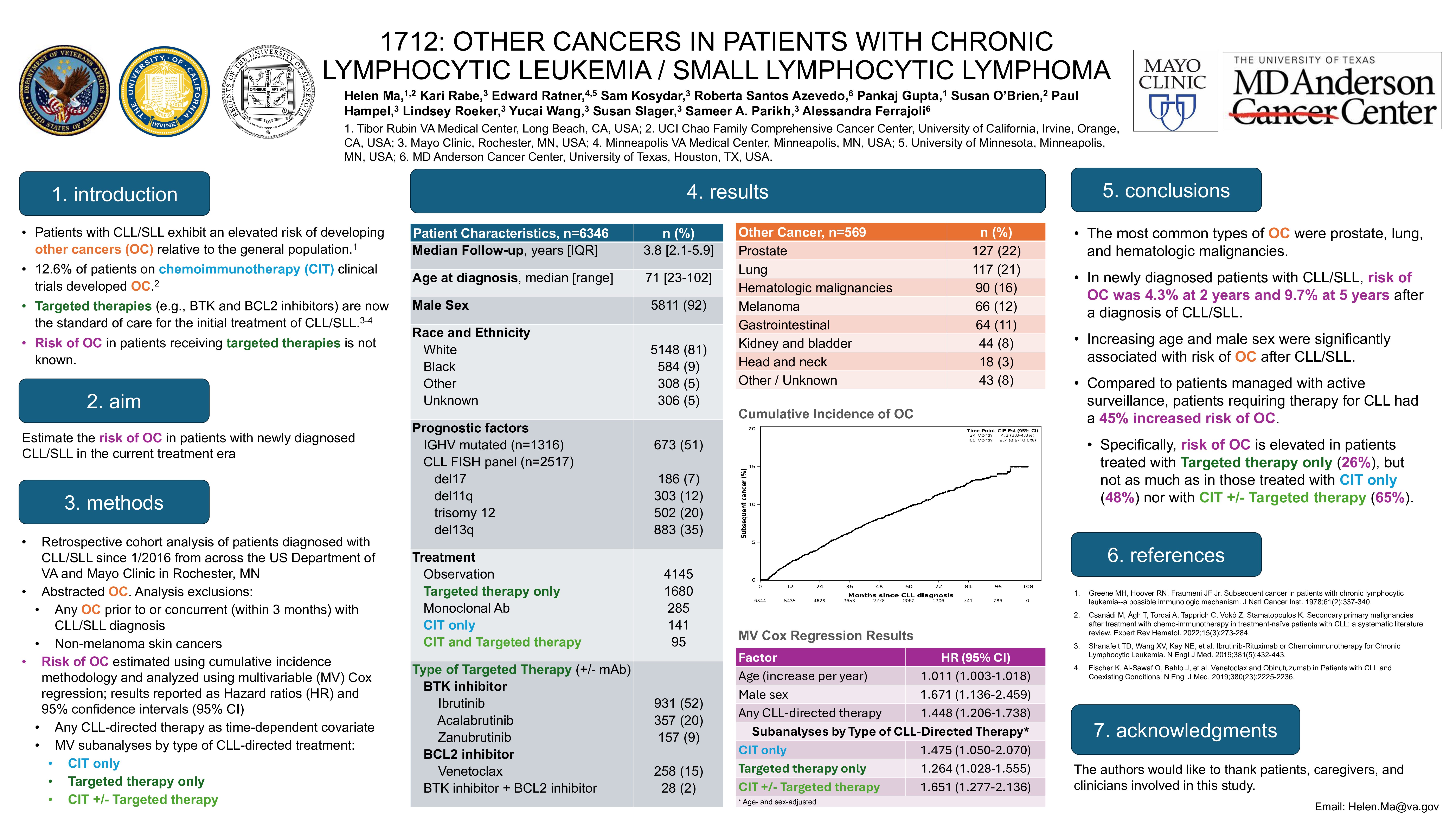
We identified 6346 patients with CLL/SLL who met inclusion criteria. Median follow up was 3.8 years (interquartile range [IQR] 2.1-5.9). The median age at diagnosis of CLL/SLL was 71 years (range, 23 – 102) and most patients were white (81%) and male (92%). Although many patients had missing values, among those with available information, IGHV genes were unmutated in 673 (51%), CLL FISH panel showed del17 in 186 (7.3%), del11q in 329 (13%), trisomy 12 in 578 (23%), and del13q in 1249 patients (50%). A total of 2201 patients received CLL directed therapy during follow-up: 285 (12.9%) received CIT only, 1680 (76.3%) received targeted therapy only, 95 (4.3%) received CIT and targeted therapy, and 141 (6.4%) monoclonal antibody therapy. Among patients treated with targeted therapies, 931 (52%) received ibrutinib,357 (20%) received acalabrutinib, 157 (9%) received zanubrutinib, and 258 (15%) received venetoclax. Other treatments included combination of a covalent BTKi (cBTKi) and BCL2i in 28 (2%) patients, among others.
Five hundred seventy patients were diagnosed with OC during the study period. Types of OC observed included neoplasms of the prostate (n=127, 22.3%), lung (n=117, 20.5%), hematologic malignancies (n=90, 15.8%), melanoma (n=66, 11.6%), gastrointestinal tract (n=56, 9.8%), kidney and bladder (n=44, 7.7%), head and neck (n=19, 3.3%), and other/unknown (n=51, 8.9%). Estimated risk of occurrence of OC was 4.3% at 24 months and 9.7% at 60 months after a diagnosis of CLL/SLL.
Multivariable analyses demonstrated that older age (HR: 1.011, 95% CI: 1.003 – 1.018), male sex (HR: 1.7, 95% CI: 1.1 – 2.5), and receipt of CLL directed therapy (HR: 1.4, 95% CI: 1.2 – 2.7) were associated with an increased risk of OC. When considering different types of CLL directed treatments, those who received both CIT and targeted therapies had the highest risk of development of OC (HR: 1.7, 95% CI: 1.3 – 2.1), compared to those who received CIT only (HR: 1.5, 95% CI: 1.1 – 2.1) and those who received targeted treatments alone (HR: 1.26, 95% CI: 1.03 – 1.56).
Conclusion
In this large dataset of newly diagnosed patients with CLL/SLL in the past decade, approximately 10% patients developed OC at 5 years. Receipt of CLL directed therapy was associated with a 40% increased risk of development of OC compared to those patients who did not receive therapy. The risk was highest among patients who received CIT+targeted therapy compared to those who received CIT only or those who received targeted therapy alone.
Keywords : secondary neoplasms, therapy-related cancer, survivorship
Please indicate how this research was funded. :
Please indicate the name of the funding organization.: