
Authors
Yuting Yan, Yin Liu, Tonglu Qiu, Fan Yang, Jiamei Liu, Yanfei, Chen, Ying Yu,Wenjie Xiong, Tingyu Wang, Zhijian Xiao, Jianxiang Wang, Thomas J. Kipps, Robert Peter Gale, Jianyong Li, Jifang Zhou and Shuhua Yi.
Background
Chronic lymphocytic leukaemia (CLL) is considerably more common in Americans compared with Asians. The bases for these differences and implications for therapy outcomes are controversial and mostly unknown.
Methods
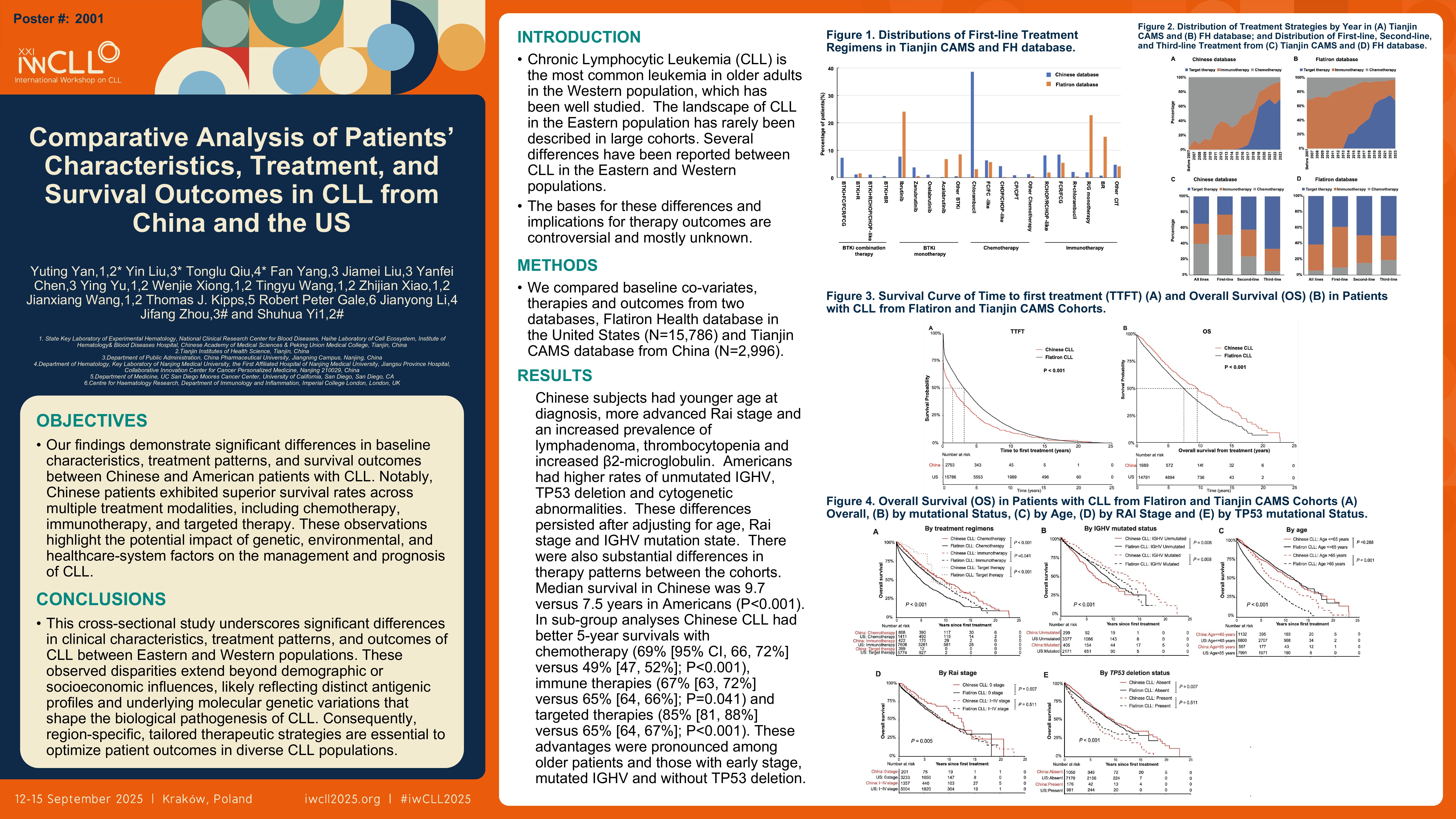
We compared baseline co-variates, therapies and outcomes from two databases, Flatiron Health database in the United States (N=15,786) and Tianjin CAMS database from China (N=2,996).
Results
Chinese subjects had younger age at diagnosis, more advanced Rai stage and an increased prevalence of lymphadenoma, thrombocytopenia and increased β2-microglobulin. Americans had higher rates of unmutated IGHV, TP53 deletion and cytogenetic abnormalities. These differences persisted after adjusting for age, Rai stage and IGHV mutation state. There were also substantial differences in therapy patterns between the cohorts. Median survival in Chinese was 9.7 versus 7.5 years in Americans (P < 0.001). In sub-group analyses Chinese CLL had better 5-year survivals with chemotherapy (69% [95% CI, 66, 72%] versus 49% [47, 52%]; P< 0.001), immune therapies (67% [63, 72%] versus 65% [64, 66%]; P=0.041) and targeted therapies (85% [81, 88%] versus 65% [64, 67%]; P< 0.001). These advantages were pronounced among older patients and those with early stage, mutated IGHV and without TP53 deletion.
Conclusion
This cross-sectional study identifies significant clinical and treatment outcome disparities in CLL between Eastern and Western populations, attributed to distinct genetic and molecular profiles.
Keywords : Chronic lymphocytic leukaemia, China, Comparative analysis
Please indicate how this research was funded. :
Please indicate the name of the funding organization.: