
Authors
Prasanta Paul, Cheryl Peltier, Eileen McMilllan Ward, Maxim Skorondinsky, Ying Lao, Vic Spicer, Subir Roy Chowdhury, Athanasios Zovoilis, Yale Michaels, Rene Zahedi and Versha Banerji.
Objective
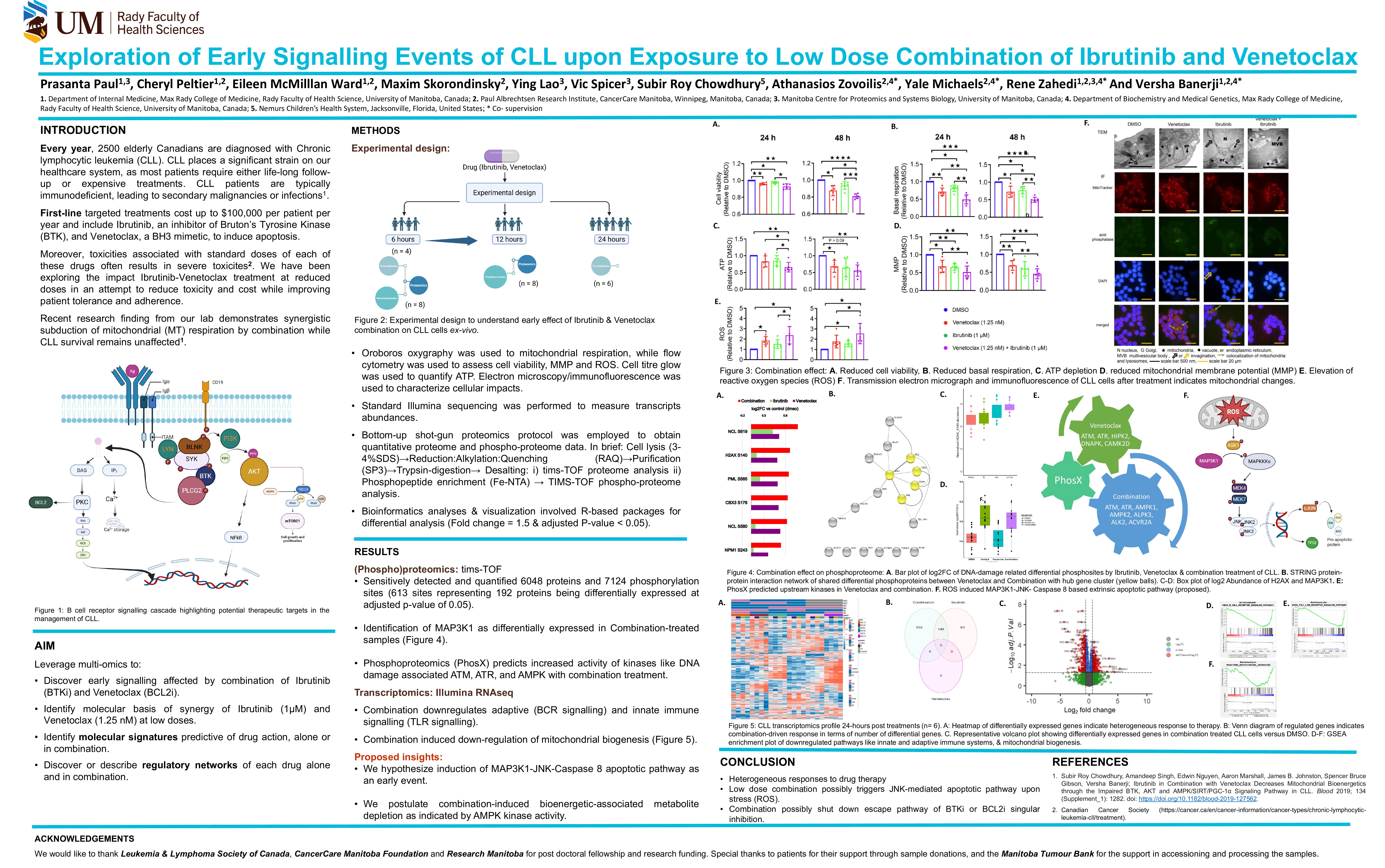
Every year, 2500 elderly Canadians are diagnosed with Chronic lymphocytic leukemia (CLL). CLL places a significant strain on our healthcare system, as most patients require either life-long follow-up or expensive treatments. CLL patients are typically immunodeficient, leading to secondary malignancies or infections. First-line targeted treatments cost up to $100,000 per patient per year and include ibrutinib, an inhibitor of Bruton’s Tyrosine Kinase (BTK) as well as Venetoclax, a BH3 mimetic to induce apoptosis. Moreover, toxicities associated with standard doses of each of these drugs often results in patient withdrawal. We have been exploring the therapeutic synergy of combined Ibrutinib-Venetoclax treatment at reduced doses, which leads to reduced toxicity and cost while improving patient compliance. Here, we aim to identify the molecular basis for the observed synergy as well as obtain insights on signaling pathways affected upon short exposure to IB-Ven combination.
Methods
Transcriptome (at 6 and 24 hours) and Proteome/Phosphoproteome (at 6 and 12 hours) profiles of primary CLL cells treated with ibrutinib, venetoclax, their combination, or DMSO (controls) were obtained using standard Illumina bulk RNA sequencing and nano-LC-MS/MS, respectively. Platform-specific data preprocessing was applied for bioinformatics analysis. Unsupervised dimensionality reduction tools, including principal component analysis (PCA) and multi-dimensional scaling (MDS) were employed to identify treatment specific sample clusters and potential genes/proteins/phosphosites. Pathway analysis of DEGs, DEPs or Phosphosites were analysed by using GSEA, MSigDB and PhosphoSitePlus database resources. Statistical significance of DEGs/DEPs/Phosphosites had a threshold of adjusted p-value (BH) < 0. 05 and fold change of 1.5.
Results
While Venetoclax treatment showed no significant DEGs compared to controls (q-value < 0.05), Ibrutinib and combination treatment showed 211 and 680 DEGs, respectively, indicating a stronger impact on CLL cells through combination treatment at the transcription level, despite using a lower dosage than current standard of care. The combined proteomics data analysis identified MEKK1 as the sole DEP only in combination treated group compared to control indicating its potential role in autophagy and apoptosis. Differential Phosphosites due to combination treatment are reportedly implicated in DNA damage response (like H2AX S140), cytoskeleton remodeling (SPTBN1 S1447, TUBA1B S439) and spliceosome activity.
Conclusion
Our results indicate early molecular events upon exposure to low dose combination of Ibrutinib and Venetoclax implying disruption of CLL cells at multiple levels to achieve synergy, most prominently against CLL proliferation, differentiation, and mitochondria-mediated apoptosis and apparent CLL senescence.
Keywords : Ibrutinib, Venetoclax, low-dose-combination
Please indicate how this research was funded. :
Please indicate the name of the funding organization.: CancerCareManitoba, Paul Albrechtsen Research Institute, Research Manitoba