
Authors
Paulina Własiuk, Monika Szelest, Magdalena Paziewska, Agnieszka Karczmarczyk, Sylwia Czekalska, Magdalena Zawada, Malwina Hut, Oskar Przybyszewski, Michał Soin, Marzena Wojtaszewska, Monika Pępek, Agnieszka Kwak, Małgorzata Pokrywka, Piotr Wójcik, Aleksandra Leszczyńska, Justyna Bukowicz, Wiktoria Szyca, Ewelina Nowak-Ozimek, Artur Kowalik, Iwona Solarska, Magdalena Wojtas, Emilia Jaskuła, Anna Sobczyńska-Konefał, Klaudia Paruzel, Agnieszka Chudy, Tomasz Stokłosa, Krzysztof Giannopoulos.
Introduction
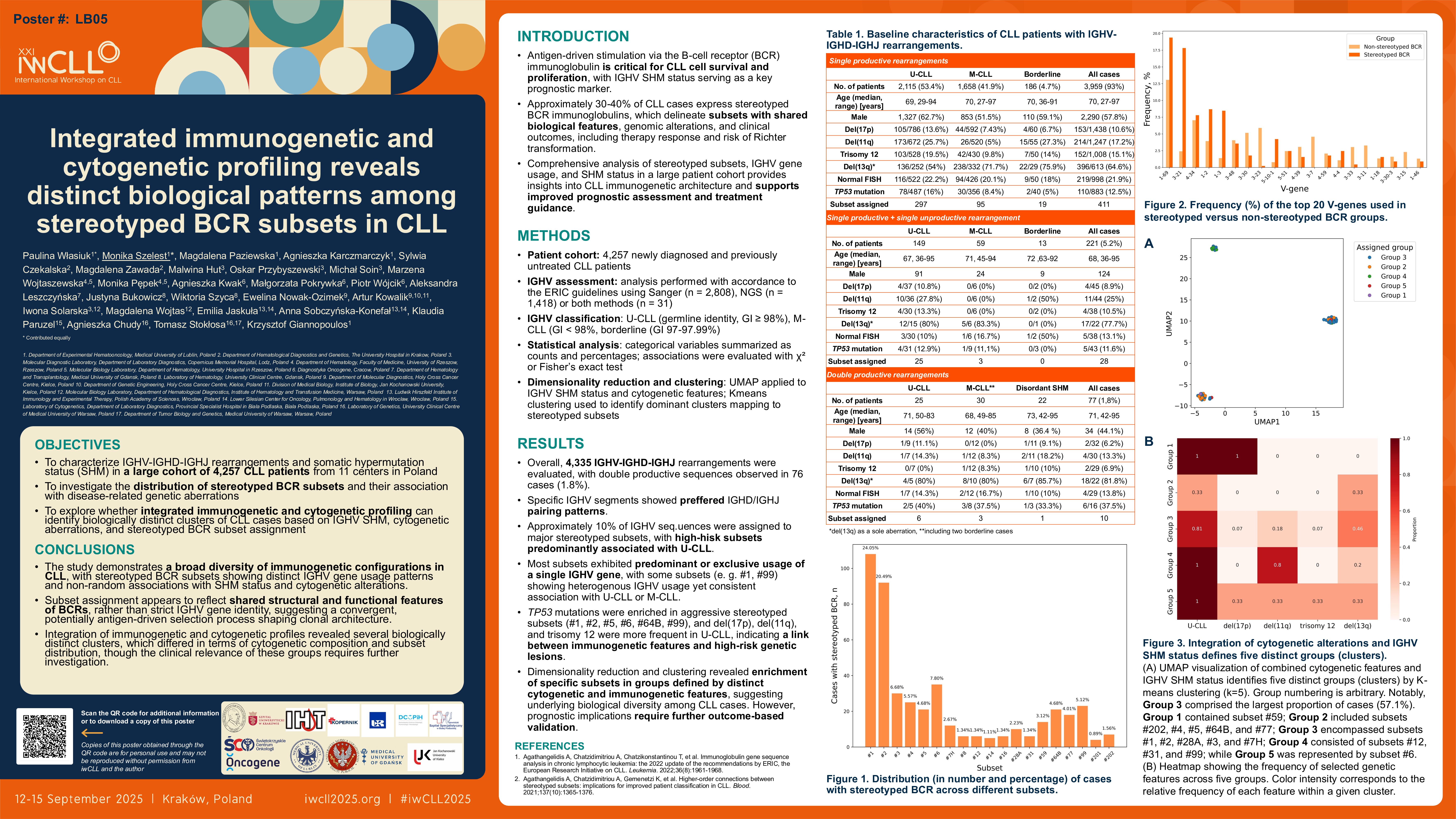
Chronic lymphocytic leukemia (CLL) is characterized by the presence of stereotyped B-cell receptor (BCR) immunoglobulins. The presence of major stereotyped subsets, often associated with significantly conserved clinicobiological features, underscores their relevance in the context of risk stratification and therapeutic decision-making. In this study, we investigated clonotypic IGHV-IGH-IGHJ rearrangements in a cohort of 4,257 CLL patients, representing the largest CLL immunogenetic dataset analyzed in Poland to date.
Methods
Newly diagnosed CLL patients from 11 collaborating institutes in Poland were included. IGHV SHM status was assessed according to ERIC guidelines using Sanger sequencing (n=2,808), next generation sequencing (NGS, n=1,418) or both (n=31). To develop a signature for identifying cytogenetic profiles associated with stereotyped BCR subsets, a dimensionally reduction analyses were performed using UMAP approach, followed by KMeans clustering (k=5).
Results
In total, 4,335 productive V-D-J rearrangements were analyzed. Stereotyped BCRs were assigned to 449 (10.5%) cases. Stereotypy was significantly more common in U-CLL than in M-CLL (p < 0.001), whereas subset #2 was more prevalent in M-CLL (p < 0.001). Furthermore, 18 out of 19 cases with borderline SHM status (IGHV germline identity between 97-97.99%) were assigned to subset #2. Among U-CLL patients with assigned subsets, 69.1% had 100% GI. Most stereotyped subsets (14/19, 73.7%) showed predominant or exclusive usage of a single IGHV gene. Among samples tested for TP53 status, TP53 mutations were found in 15.5% (15/97) of cases with stereotyped BCR sequences. Among them, 14 (93%) belonged to stereotyped subsets previously associated with aggressive clinical behaviour (#1, #2, #5, #6, #64B, and #99). Of note, subsets #1 and #99, which share a high degree of immunogenetic similarity, exhibited a significant enrichment of TP53 mutations compared to unassigned cases (p=0.032). Dimensionality reduction using UMAP followed by clustering revealed high-risk subsets (#1, #8, #31, #59) enriched in clusters characterized by unmutated IGHV and del(11q), whereas indolent subsets (#4, #16, #77, #201) mapped to a genomically stable cluster dominated by mutated IGHV and isolated del(13q). Notably, subset #2 – despite its higher prevalence in M-CLL and tendency to associate with isolated del(13q) – was predominantly localized within UMAP-defined clusters characterized by unmutated IGHV and enriched for del(11q).
Conclusion
This comprehensive analysis confirms substantial biological heterogeneity among CLL subsets, emphasizing the importance of integrated molecular profiling for improved patient stratification.
Keywords : IGHV, NGS, BCR
Please indicate how this research was funded. :
Please indicate the name of the funding organization.: