
Authors
Yi Miao, Jing Zhang, Yilian Yang, Lei Fan, Jianyong Li.
Introduction
Socioeconomic factors has been demonstrated to impact the outcomes of several malignancies. The prognostic role of socioeconomic factors in chronic lymphocytic leukemia/small lymphocytic lymphoma (CLL/SLL) has not been systematically investigated.
Methods
We identified 67238 patients diagnosed with CLL/SLL from the Surveillance, Epidemiology, and End Results database. In addition to survival data, the following variables were collected: age, gender, race, year of diagnosis, subsequent malignancies (defined by total number of in situ/malignant tumors for patient), marital status, median household income, rural-urban difference (defined by rural-urban continuum code). The patients were randomly divided into the training (n=47066) and validation (n=20172) cohorts in a 7:3 fashion. The univariate and multivariate Cox regression analyses were performed to screen the predictors for overall survival (OS). The nomograms were developed and validated by the C-index, calibration curve, receiver operating characteristic curve, and decision curve analysis.
Results
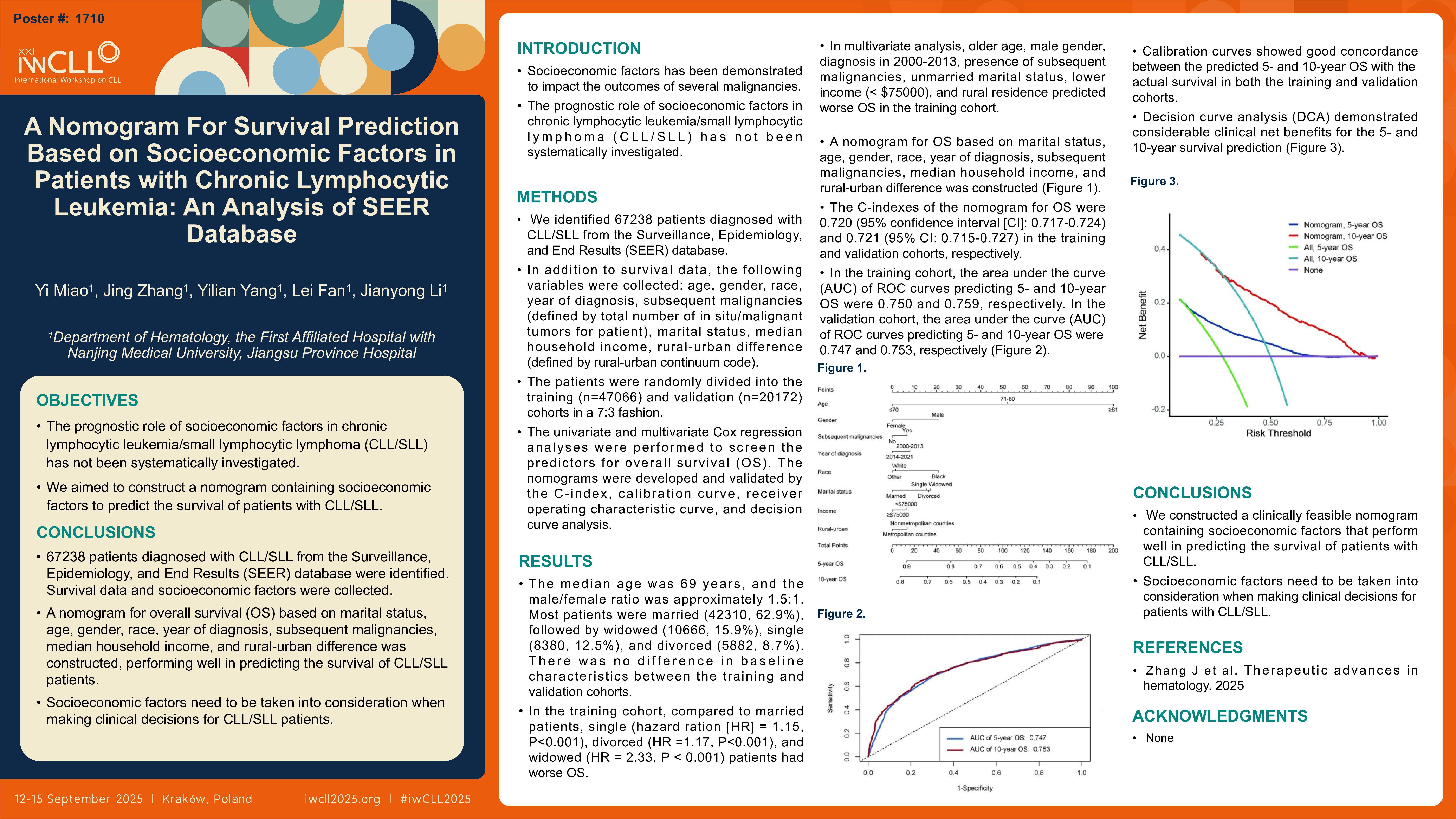
The median age was 69 years, and the male/female ratio was approximately 1.5:1. Most patients were married (42310, 62.9%), followed by widowed (10666, 15.9%), single (8380,12.5%), and divorced (5882, 8.7%). There was no difference in baseline characteristics between the training and validation cohorts. In the training cohort, compared to married patients, single (harzard ration [HR] = 1.15, P < 0.001), divorced (HR = 1.17, P < 0.001), and widowed (HR = 2.33, P < 0.001) patients had worse OS. In multivariate analysis, older age, male gender, diagnosis in 2000-2013, presence of subsequent malignancies, unmarried marital status, lower income ( < $75000), and rural residence predicted worse OS in the training cohort. A nomogram for OS based on marital status, age, gender, race, year of diagnosis, subsequent malignancies, median household income, and rural-urban difference was constructed. The C-indexes of the nomogram for OS were 0.720 (95% confidence interval [CI]: 0.717-0.724) and 0.721 (95% CI: 0.715-0.727) in the training and validation cohorts, respectively. In the training cohort, the area under the curve (AUC) of ROC curves predicting 5- and 10-year OS were 0.750 and 0.759, respectively. In the validation cohort, The AUC of ROC curves predicting 5- and 10-year OS were 0.747 and 0.753, respectively. Calibration curves showed good concordance between the predicted 5- and 10-year OS with the actual survival in both the training and validation cohorts. Decision curve analysis (DCA) demonstrated considerable clinical net benefits for the 5- and 10-year survival prediction.
Conclusions
We constructed a clinically feasible nomogram containing socioeconomic factors that perform well in predicting the survival of patients with CLL/SLL. Socioeconomic factors need to be taken into consideration when making clinical decisions for patients with CLL/SLL.
Keywords : chronic lymphocytic leukemia, socioeconomic factors, survival
Please indicate how this research was funded. :
Please indicate the name of the funding organization.: