
Authors
Sorcini D, Stella A, Adamo F.M, De Falco F, Arcaleni R, Gurrieri F, Dorillo E, Esposito A, Valmarini L, Bigerna B, Martelli M.P, Sportoletti P.
Background
Chronic lymphocytic leukemia (CLL) is a hematological malignancy characterized by the accumulation of CD19+CD5+ cells that are resistant to apoptosis due to genetic lesions and microenvironmental stimuli. Despite recent advances in treatment, CLL remains incurable, underscoring the need to better understand the pathways supporting leukemic cell survival and to identify novel therapeutic targets.
Within the genetic diversity of CLL, disruptive mutations of the BCL6 co-repressor (BCOR) occur in up to 2% of cases and are considered disease-driving events. BCOR mutations often co-occur with unmutated IGHV, trisomy 12, and NOTCH1 mutations (Sportoletti et al., Blood 2021). BCOR is a known tumor suppressor in B cells, and its loss enhances NOTCH1 transactivation. In the TCL1 mouse model, we recently demonstrated that B-cell-specific BCOR inactivation promotes Richter Transformation (Rompietti et al., Leukemia 2025). However, no mouse model has yet demonstrated whether BCOR loss in B cells alone is sufficient to initiate CLL, highlighting a gap in our understanding.
Aims: To develop and characterize a novel mouse model with B-cell-specific BCOR deletion and evaluate its ability to spontaneously develop a CLL-like disease with aging.
Methods
We generated a conditional knockout mouse model by crossing Bcorflox/flox female and Bcorflox/y male mice with CD19-Cre+ transgenic mice to achieve Bcor deletion specifically in CD19+ B cells (Hereafter, homozygous Bcorflox/flox;Cre+ and hemizygous Bcorflox/Y;Cre+ will be referred as CD19Bcor−/−). Mice were longitudinally monitored, and peripheral blood (PB), bone marrow (BM), and spleen were systematically analyzed through complete blood counts, multiparametric flow cytometry, histopathological examination, and immunophenotyping. To assess clonality, CD19+CD5+ splenic B cells were sorted and analyzed for immunoglobulin heavy chain (IGH) gene rearrangements. To evaluate disease transplantability, 107 splenic cells from aged CD19Bcor-/- mice were injected intravenously into NSG recipient mice.
Results
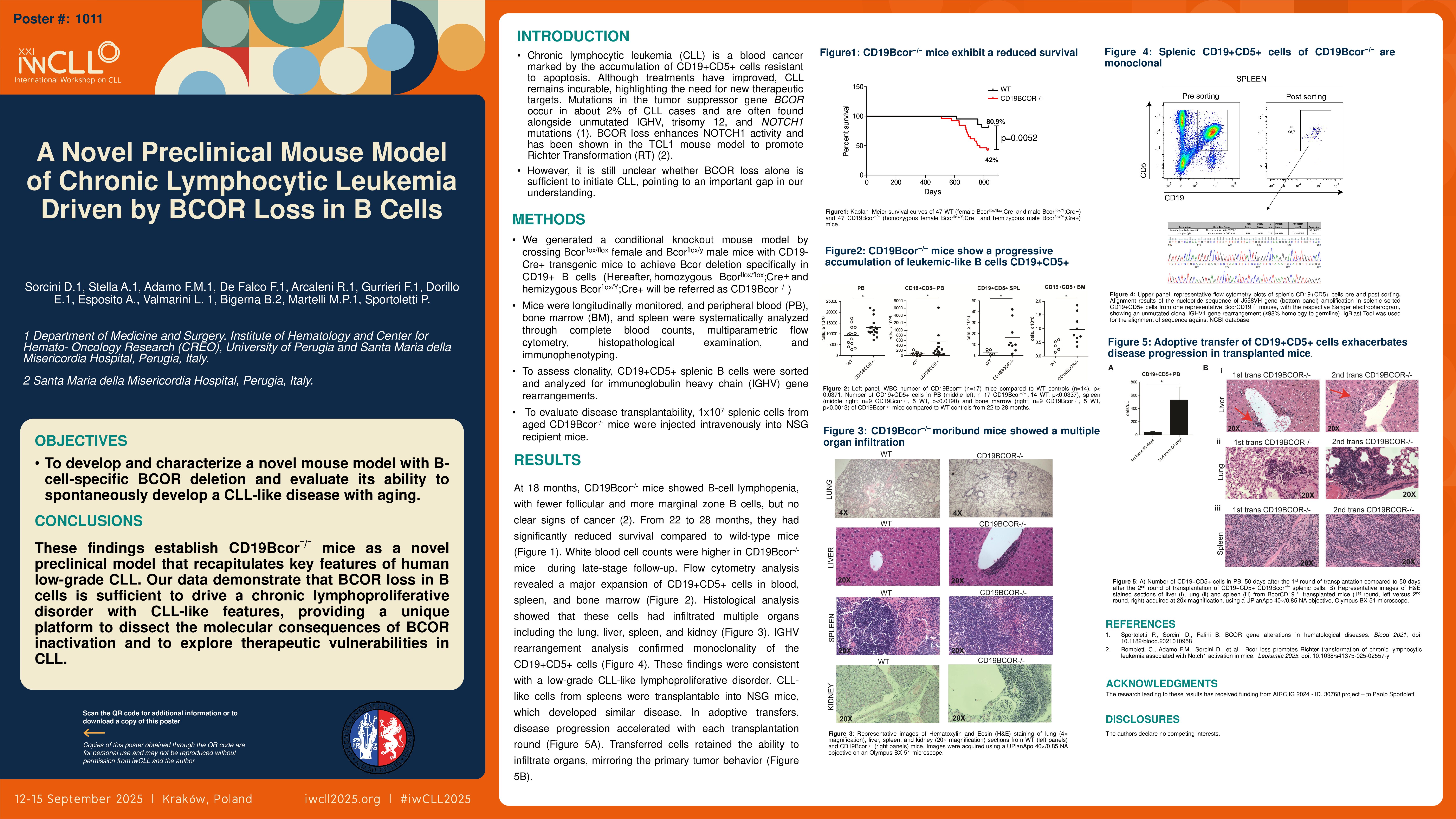
At 18 months, CD19Bcor-/- mice exhibited B-cell lymphopenia with decreased follicular (Fo) and increased marginal zone (MZ) B cells, and reduced mature recirculating BM B cells, but no overt lymphoproliferative disease.
With extended follow-up of 28 months, CD19Bcor-/- mice showed reduced survival (median survival of 762.5 days; range from 510 to 821 days) compared to wild type (WT) mice (undefined) as control (Bcorflox/flox;Cre- and Bcorflox/Y;Cre− indicated as WT).
In CD19Bcor-/- mice, blood count analysis revealed elevated white blood cell levels compared to WT controls (12910 ±995.8 N=17 vs. 9162 ±1204 N=14 cells/μL) during the 22 to 28-month follow-up period. Flow cytometric analysis of PB, spleen, and BM revealed a marked expansion of CD19+CD5+ cells in CD19Bcor-/- mice compared to WT controls (538.1 ±351.3 N=17 vs 63.41 ±16.76 N=14 cells/μL in PB; 16.35×10⁶ ±4.728 N=9 cells vs. 3.237×10⁶ ±0.9909 N=5 cells in spleen; 1.913 ×10⁶ ±0.7439 N=9 cells vs. 0.3721 ×10⁶ ±0.08494 N=5 cells in BM, respectively).
Histological analysis of CD19Bcor-/- moribund mice showed a multiple organ infiltration (including lung, liver, spleen and kidney) of a lymphoid cell population co-expressing CD19 and CD5. To have a proof of clonality of the lymphoproliferations highlighted by flow cytometry, we conducted an analysis of IGHV rearrangements in splenic sorted CD19+CD5+ cells, revealing monoclonality with a perfect match of 100% to the IGHV germline sequences. Immunophenotyping and molecular data were consistent with the diagnosis of a lymphoproliferative disorder, mimicking low-grade CLL.
The CLL cells derived from the spleen were also transplantable into secondary NSG recipients, which developed CLL exhibiting phenotypic characteristics similar to those of the primary tumor. Adoptive transfer experiments of CD19Bcor-/- cells was performed to induce a disease with accelerated kinetics. Following the first round of transplantation, 38.55 ±12.30 (N=4) CD19+CD5+ cells/μL were detected in peripheral blood after 60 days. In contrast, the second round resulted in a marked increase, with 532.3 ±192.8 (N=4) CD19+CD5+ cells/μL observed after 50 days. These cells, similar to the primary tumor, were capable of infiltrating peripheral organs such as the spleen and liver.
Conclusions
These findings establish CD19Bcor⁻/⁻ mice as a novel preclinical model that recapitulates key features of human low-grade CLL. Our data demonstrate that BCOR loss in B cells is sufficient to drive a chronic lymphoproliferative disorder with CLL-like features, providing a unique platform to dissect the molecular consequences of BCOR inactivation and to explore therapeutic vulnerabilities in CLL.
Keywords : CLLvBCOR MOUSE MODEL
Please indicate how this research was funded. : This work was supported by the Associazione Italiana per la Ricerca sul Cancro (AIRC) IG2024-ID. 30768 and IG2018-ID. 21352 to PS;
Please indicate the name of the funding organization.: Associazione Italiana per la Ricerca sul Cancro (AIRC)