
Authors
Rebecca Oliver, Frankie F Brown, Adam J Causer, Annabelle Emery, Harrison D Collier-Bain, Francoise Koumanov, James E Turner, James Murray, John P Campbell.
There is increasing evidence that adipocytes play an active role in the microenvironment of many cancers, including leukaemias. High body mass index (BMI) is a major contributor for CLL-related mortality (Yao et al., Biomed Eng, 2022) and obesity is associated with poorer response to first-line therapy and decreased progression-free survival (Furstenau et al., Leuk, 2020). It is unknown however if CLL cells accumulate within abdominal subcutaneous adipose tissue (AT) or indeed whether CLL cells interact with adipocytes within that microenvironment. We examined whether clonal cells were present within the AT stromal vascular fraction (SVF) of patients with CLL, and whether interaction between adipocytes and CLL cells in vitro affected CLL cell survival and migration.
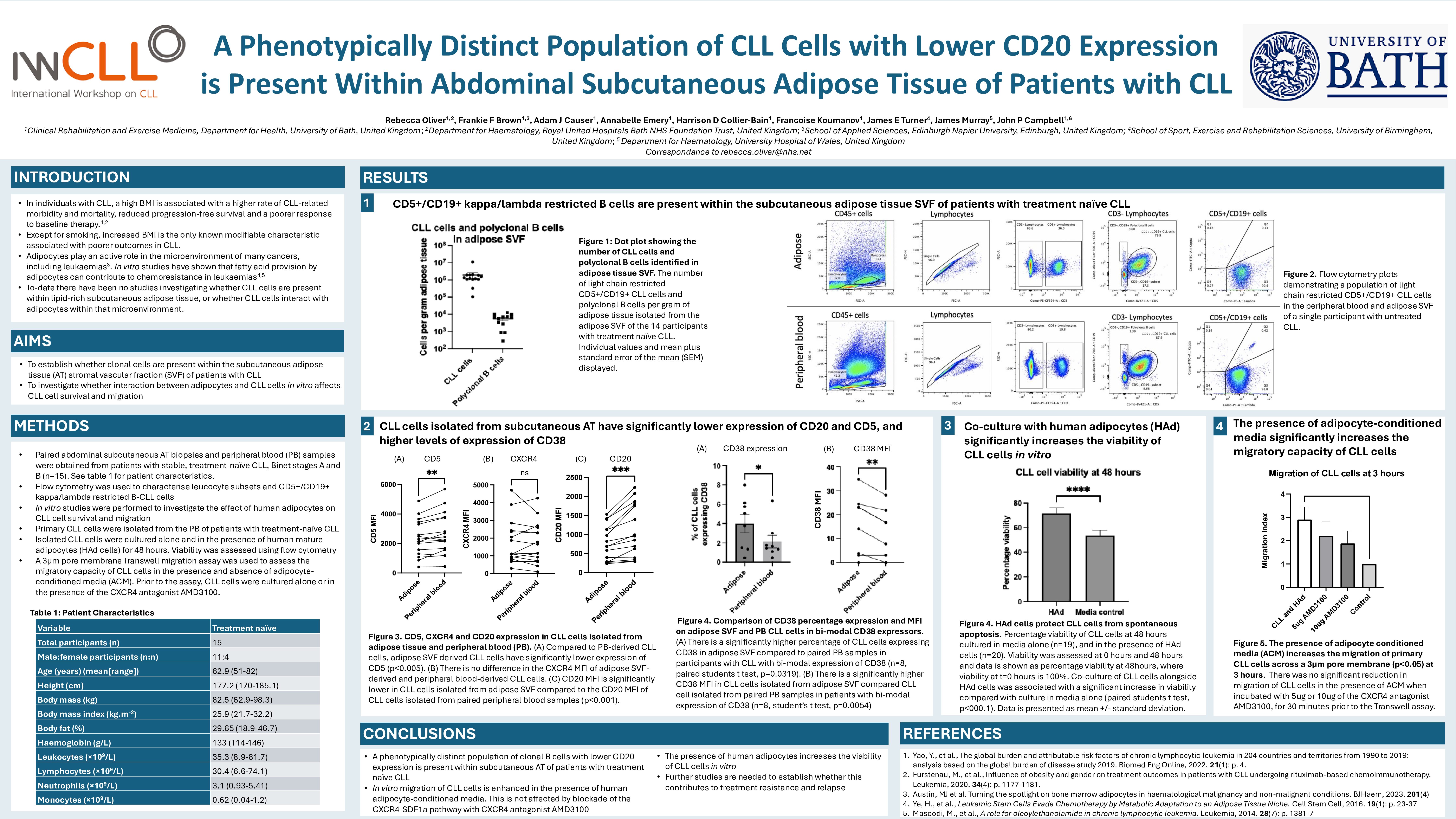
Paired abdominal subcutaneous AT biopsies and peripheral blood (PB) samples were obtained from patients with stable, treatment naïve CLL, Binet stages A and B (n=15 [male=11, female=4]). An automated haematology analyser was used to enumerate leukocyte subsets in blood and AT, and leukocyte subsets were immunophenotyped by flow cytometry. Blood contamination of AT samples was excluded via monitoring of erythrocyte counts. CD5+CD19+ kappa/lambda restricted B-CLL cells were identified in subcutaneous AT of all 15 participants with untreated CLL (range 0.230×10⁶ – 14.903×10⁶ CLL cells per gram AT, median 0.133×10⁶). CLL cells isolated from AT demonstrated lower expression of CD20 (p < 0.001) and CD5 (p < 0.005) compared with those in PB, but no significant difference was seen in CXCR4 expression. In patients with bi-modal CD38 expression a significantly higher proportion of CLL cells isolated from AT expressed CD38 (n=8, p=0.0319), a marker associated with enhanced migration, compared to PB. No difference was seen in the percentage expressing sIgM or CD49d.
There was a trend towards the number of CLL cells (per gram AT) present in adipose SVF being positively associated with the number of CLL cells per uL present in PB, however this did not reach statistical significance (Pearson r=0.5228, p=0.0551). The number of macrophages per gram AT was positively correlated with body fat percentage, as assessed by DEXA scan, (Pearson r=0.7929, p=0.0062) in keeping with data from healthy participant studies. However, no correlation was found between AT CLL counts and either body fat percentage or number of macrophages per gram AT.
We undertook in vitro studies to investigate the effect of adipocyte and CLL cell interaction on CLL survival and migration. Primary CLL cells isolated from PB were cultured alone and in the presence of mature human subcutaneous adipocytes (HAd). Culture of primary CLL cells (n=20) in the presence of HAd significantly increased the percentage viability of CLL cells at 48 hours compared to those cultured in media alone (p < 0.0001). We assessed the impact of HAd on the migratory capacity of CLL cells using a Transwell migration assay (n=6). The presence of adipocyte conditioned media (ACM) increased migration of primary CLL cells across a 3µm pore membrane (p < 0.05) at 3 hours. ELISA analysis of the ACM demonstrated the presence of SDF1-α, the primary chemokine responsible for migration of CLL cells in vivo. To investigate whether SDF1-α contributed to increased CLL cell migration in the presence of ACM, we incubated CLL cells with the CXCR4 antagonist AMD3100 (5 or 10µg/ml) prior to the Transwell assay (n=6). AMD3100 did not significantly reduce the migration of CLL cells in response to ACM, suggesting that chemotaxis associated with HAd may additionally involve pathways other than CXCR4/SDF1-α.
Our study demonstrates that a phenotypically distinct population of clonal B cells with lower CD20 expression is present within subcutaneous AT of patients with treatment naïve CLL. We show that the presence of subcutaneous HAd cells increases the survival of primary CLL cells in vitro, and that primary CLL cells migrate towards ACM in vitro. Collectively, our findings raise the possibility that AT provides an advantageous microenvironment niche for CLL cells in vivo, with further studies needed to establish whether this contributes to treatment resistance and relapse.
Keywords : CLL, adipocytes
Please indicate how this research was funded. :
Please indicate the name of the funding organization: