
Authors
Tingyu Wang, Yuting Yan, Ying Yu, Wenjie Xiong, Rui Lv, Tengteng Yu, Wei Liu, Yan Xu, Weiwei Sui, Wenyang Huang, Shuaishuai Zhang, Qi Wang,Liang Huang, Dehui Zou, Gan An, Lugui Qiu, Shuhua Yi.
Background
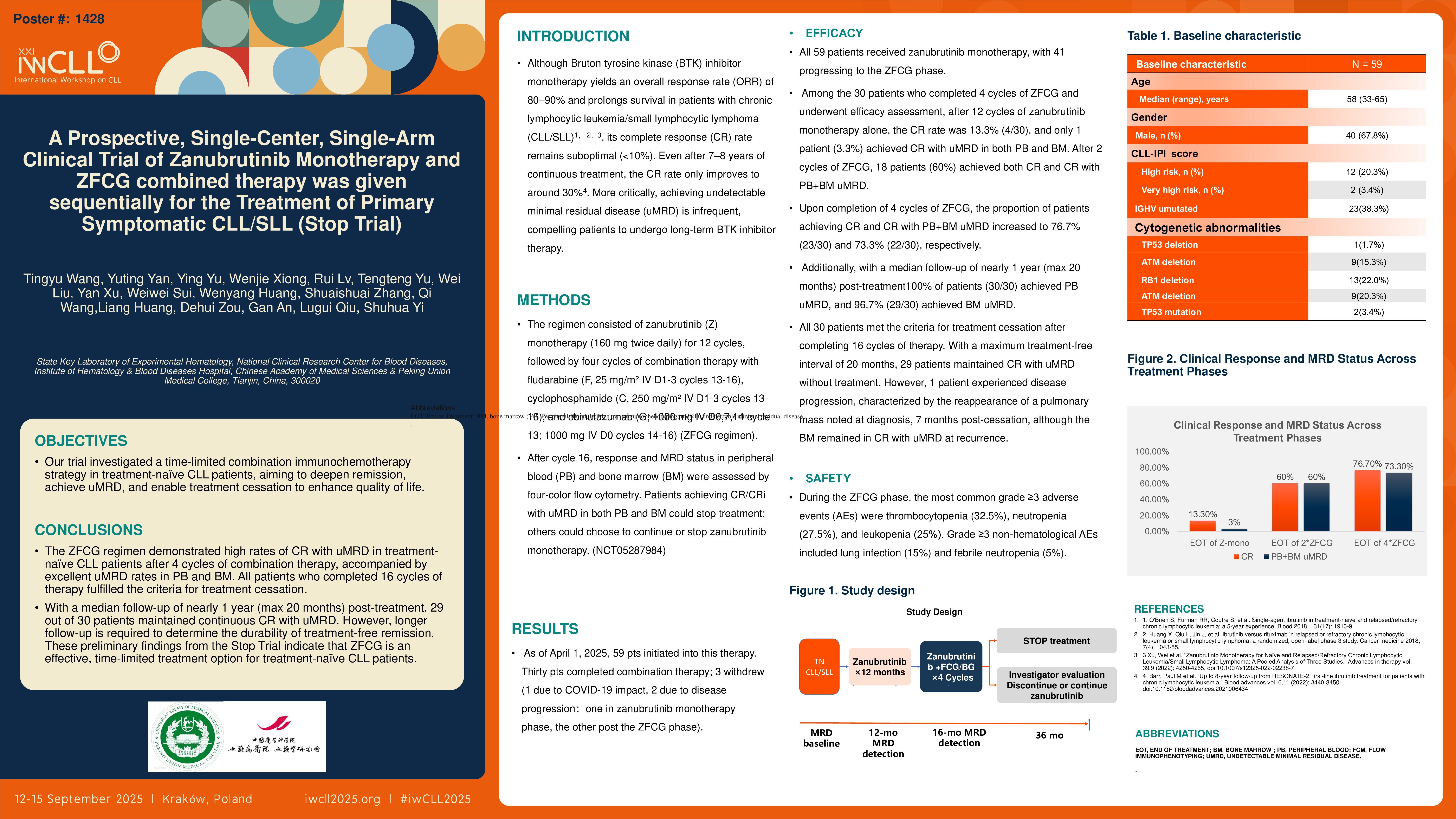
Although Bruton tyrosine kinase (BTK) inhibitor monotherapy yields an overall response rate (ORR) of 80–90% and prolongs survival in patients with chronic lymphocytic leukemia/small lymphocytic lymphoma (CLL/SLL), its complete response (CR) rate remains suboptimal ( < 10%). Even after 7–8 years of continuous treatment, the CR rate only improves to around 30%. More critically, achieving undetectable minimal residual disease (uMRD) is infrequent, compelling patients to undergo long-term BTK inhibitor therapy. To address these limitations, our trial investigated a time-limited combination immunochemotherapy strategy in treatment-naïve CLL patients, aiming to deepen remission, achieve uMRD, and enable treatment cessation to enhance quality of life.
Methods
Eligible pts were treatment-naïve CLL/SLL patients aged ≤65 years. The regimen consisted of zanubrutinib (Z) monotherapy (160 mg twice daily) for 12 cycles, followed by four cycles of combination therapy with fludarabine (F, 25 mg/m² IV D1-3 cycles 13-16), cyclophosphamide (C, 250 mg/m² IV D1-3 cycles 13-16), and obinutuzumab (G, 1000 mg IV D0,7,14 cycle 13; 1000 mg IV D0 cycles 14-16) (ZFCG regimen). After cycle 16, response and MRD status in peripheral blood (PB) and bone marrow (BM) were assessed by four-color flow cytometry. Patients achieving CR/CRi with uMRD in both PB and BM could stop treatment; others could choose to continue or stop zanubrutinib monotherapy.(NCT05287984)
Results
As of April 1, 2025, 59 pts initiated therapy. Thirty pts completed combination therapy; 3 withdrew (1 due to COVID-19 impact, 2 due to disease progression:one in zanubrutinib monotherapy phase, the other post the ZFCG phase). Baseline characteristics: median age 58 years (range 33-65); 67.8% male. High-risk and very-high-risk CLL-IPI scores were present in 20.3% and 3.4% of pts, respectively. IGHV was unmutated in 38.3%. Cytogenetic abnormalities included TP53 deletion (del) (1.7%), ATM del (15.3%), RB1 del (22.0%), and trisomy 12 (20.3%). TP53 mutation was detected by NGS in 3.4%.
All 59 patients received zanubrutinib monotherapy, with 41 progressing to the ZFCG phase. Among the 30 patients who completed 4 cycles of ZFCG and underwent efficacy assessment, after 12 cycles of zanubrutinib monotherapy alone, the CR rate was 13.3% (4/30), and only 1 patient (3.3%) achieved CR with uMRD in both PB and BM. After 2 cycles of ZFCG, 18 patients (60%) achieved both CR and CR with PB+BM uMRD. Upon completion of 4 cycles of ZFCG, the proportion of patients achieving CR and CR with PB+BM uMRD increased to 76.7% (23/30) and 73.3% (22/30), respectively. Additionally, 100% of patients (30/30) achieved PB uMRD, and 96.7% (29/30) achieved BM uMRD. All 30 patients met the criteria for treatment cessation after completing 16 cycles of therapy. With a maximum treatment-free interval of 20 months, 29 patients maintained CR with uMRD without treatment. However, 1 patient experienced disease progression, characterized by the reappearance of a pulmonary mass noted at diagnosis, 7 months post-cessation, although the BM remained in CR with uMRD at recurrence.
During the ZFCG phase, the most common grade ≥3 adverse events (AEs) were thrombocytopenia (32.5%), neutropenia (27.5%), and leukopenia (25%). Grade ≥3 non-hematological AEs included lung infection (15%) and febrile neutropenia (5%).
Conclusion
The ZFCG regimen demonstrated high rates of CR with uMRD in treatment-naïve CLL patients after 4 cycles of combination therapy, accompanied by excellent uMRD rates in PB and BM. All patients who completed 16 cycles of therapy fulfilled the criteria for treatment cessation. With a median follow-up of nearly 1 year (max 20 months) post-treatment, 29 out of 30 patients maintained continuous CR with uMRD. However, longer follow-up is required to determine the durability of treatment-free remission. These preliminary findings from the Stop Trial indicate that ZFCG is an effective, time-limited treatment option for treatment-naïve CLL patients.
Keywords : Zanubrutinib, Chronic Lymphocytic Leukemia/Small Lymphocytic Lymphoma (CLL/SLL), Combined Therapy
Please indicate how this research was funded.: This work was supported by grants from the National Nature Science Foundation of China (82200215, 82170193, 82170194, 82370197), the Chinese Academy of Medical Sciences Innovation Fund for Medical Sciences (2022-I2M-1-022) and Beijing Xisike Clinical Oncology Research Foundation (Y-2024AZ(BTK)ZD–0074).
Please indicate the name of the funding organization. : National Nature Science Foundation of China (82200215, 82170193, 82170194, 82370197), the Chinese Academy of Medical Sciences Innovation Fund for Medical Sciences (2022-I2M-1-022) and Beijing Xisike Clinical Oncology Research Foundation (Y-2024AZ(BTK)ZD–0074)