Authors
Lydia Scarfò, Georgina Tickler, Lianne Barnieh, Jennifer Fitzgerald, Silvy Mardiguian, Jan Rynne, Gereon Maenzel, Christina Karamanidou, Sara Savar, Jacqui Bernarde, Kate Williams, Talha Munir.
Background
Bruton tyrosine kinase (BTK) inhibitors, including first-generation (ibrutinib) and next-generation (zanubrutinib and acalabrutinib), are novel therapies that have greatly improved treatment outcomes in patients with chronic lymphocytic leukemia (CLL). While side effects of BTK inhibitors are documented in their respective clinical trials, there is limited data on the impact of these side effects on patient lives. Furthermore, the relevance and importance of these side effects may be viewed differently by clinicians and patients, impacting the clinician and patient experience. There is also limited research on the extent to which treatment-related side effects impact the lives of care partners, who support a patient’s journey in CLL.
Aims
The aim of this study is to explore the experiences and relative importance of side effects associated with the use of continuous covalent monotherapy BTK inhibitors from the perspectives of patients, care partners, and clinicians. The study will also examine the impact of side effects on the daily activities of individuals with CLL and their care partners and the experience of treating CLL with continuous covalent monotherapy BTK inhibitors from the clinician perspective. Exploratory objectives include assessing the similarities and differences in the patient experience with different covalent BTK inhibitors.
Methods
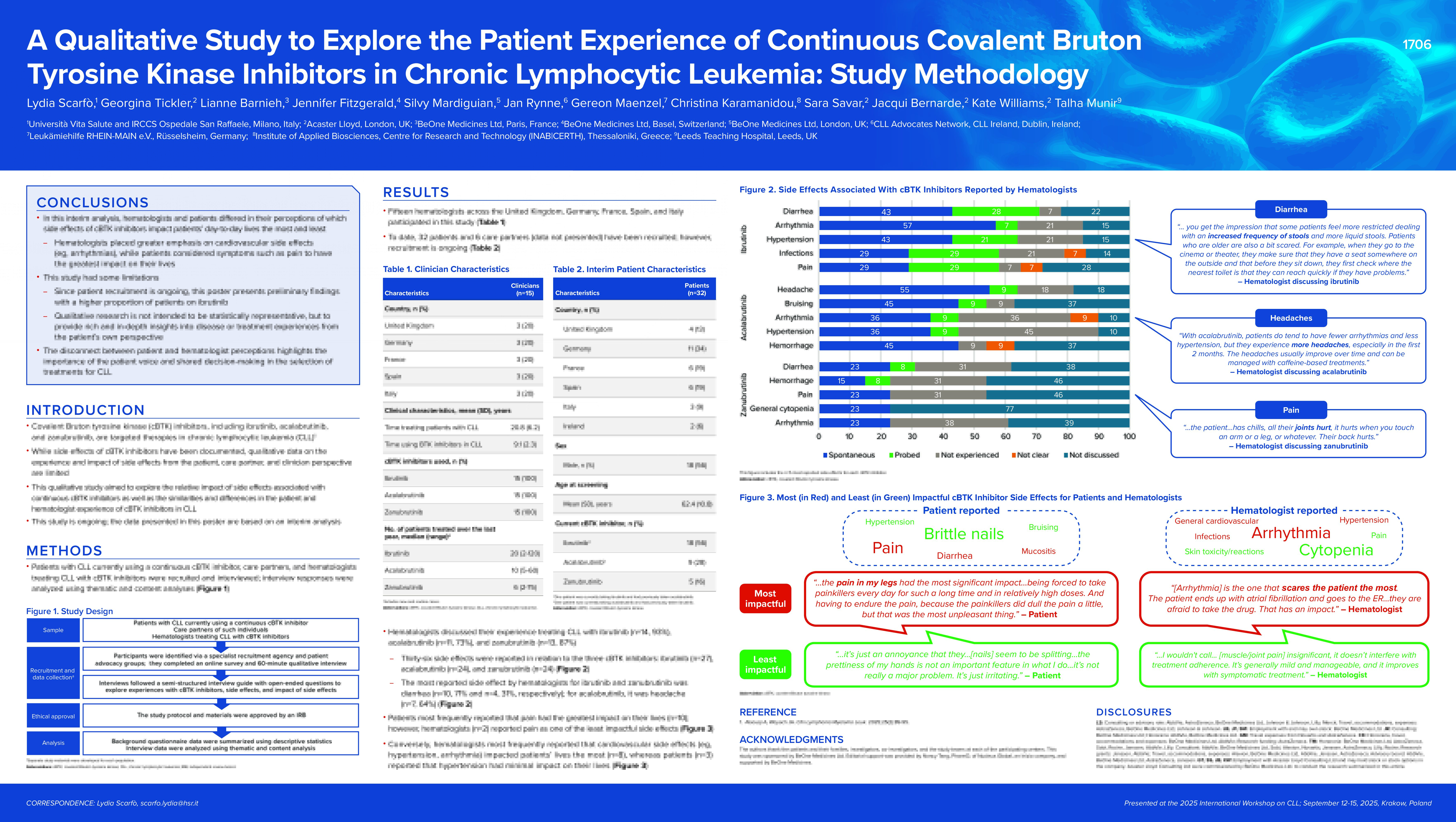
This is a non-interventional, qualitative interview study. Participants include individuals diagnosed with CLL currently taking a continuous covalent BTK inhibitor as a monotherapy for ≥6 months, care partners of such individuals, and clinicians with experience treating patients with CLL with continuous BTK inhibitors. Participants are being recruited across the UK, Germany, France, Italy, Ireland and Spain and are identified via a specialist recruitment agency; eligibility is confirmed via a screening questionnaire. Upon confirmation of eligibility, participants first complete an online background questionnaire followed by a 60-minute qualitative interview conducted via teleconference in the relevant participant language. Interviews follow a semi-structured interview guide and include open-ended questions to explore experiences with continuous BTK inhibitors, including side effects and related impacts on patients and care partners. Participants are also asked about the most and least impactful side effects and any experience they may have had with fixed duration therapies.
The target sample for this study is 60 patients, 15 care partners, and 15 clinicians. The best practice in qualitative research is to keep collecting data until data saturation is reached (the point at which no new insights are obtained from conducting further interviews). The data collected during interviews will be analyzed using a combination of both content (summary of responses to specific interview questions) and thematic (identifying, analyzing and reporting themes) analyses. This study was reviewed and approved by the WIRB-Copernicus Group independent review board (tracking number: 20244460).
Results
Recruitment is ongoing and nearly complete with all clinicians, most care partners and half the patients recruited. The results of this study will be summarized by concept relating to covalent BTK inhibitor side effects, related impacts on patients and care partners, and the relative importance of different side effects to patients, clinicians, and care partners. Descriptions will be illustrated with participant quotes.
Conclusion
Qualitative research can provide rich insight into the patient, care partner, and clinician experience. This study will provide valuable insights into the patient experience of side effects associated with covalent BTK inhibitors and potentially identify discrepancies in how these side effects are viewed by patients and clinicians. Ultimately, these findings will empower patients to know what to expect from their treatment and facilitate shared decision-making between patients and clinicians on the best treatment options.
Keywords : Bruton tyrosine kinase inhibitors, CLL, patient experience
Please indicate how this research was funded.:
Please indicate the name of the funding organization. : BeOne Medicines Ltd