
ApoliproteinE induces ferroptosis in chronic lymphocytic leukaemia cells (652kB pdf)
Authors
Nardi F, Del Prete R, Drago R, Di Rita A, Vallone FE, Ciofini S, Malchiodi M, Pezzella L, Tinti L, Cicaloni V, Salvini L, Licastro D, Pezacki AT, Chang CJ, Marotta G, Naldini A, Deaglio S3, Vaisitti T, Gozzetti A, Bocchia M, Kabanova A.
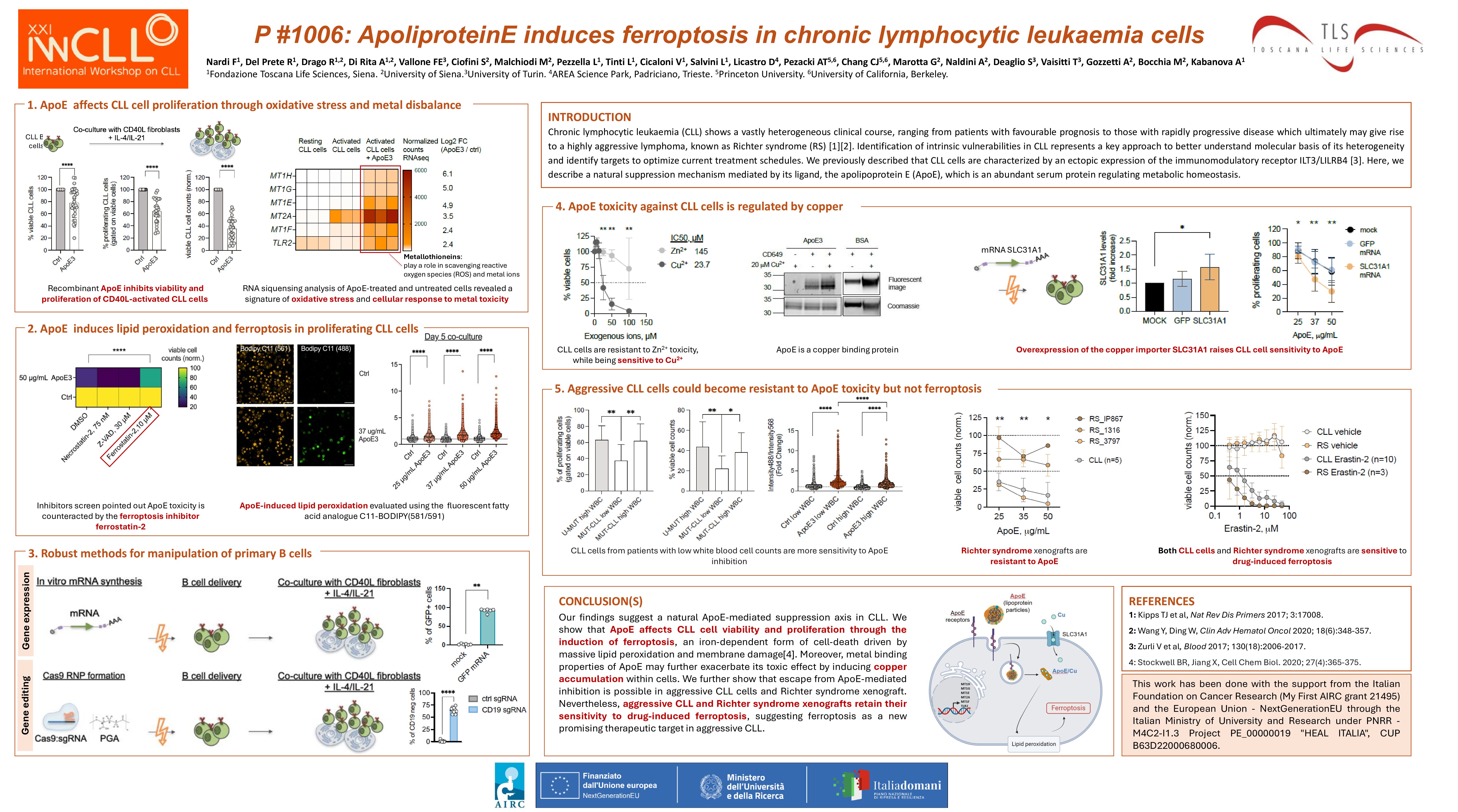
Chronic lymphocytic leukaemia (CLL) is characterized by a heterogeneous clinical course, ranging from patients with indolent disease to others with progressive disease that may ultimately evolve into the Richter syndrome (RS). Understanding the molecular mechanisms driving CLL heterogeneity and identifying specific vulnerabilities in CLL cells represent promising strategies to develop targeted therapies with higher efficacy, particularly for aggressive CLL and RS.
Here, we identified a novel regulatory mechanism active in CLL cells that involves Apolipoprotein E (ApoE). ApoE is an abundant serum protein primarily known for its role in lipid transport and homeostasis. Beyond its canonical functions, ApoE has been implicated in signal transduction and in the pathogenesis of inflammatory and neurological disorders, including Alzheimer’s disease and atherosclerosis (Huang YWA, et al. Cell, 2017).
Our results demonstrate that recombinant ApoE reduces CLL cell viability and proliferation triggered by CD40L stimulation. Functional analyses revealed that ApoE induces lipid peroxidation in proliferating CLL cells. This ultimately leads to ferroptosis, a type of non-apoptotic cell death characterized by the accumulation of toxic lipid peroxides damaging cellular membranes and organelles. Notably, we also found that ApoE is a copper-binding protein and that its cytotoxicity is further promoted by elevated intracellular copper levels.
Interestingly, our findings indicate that aggressive CLL cells are less sensitive to ApoE inhibition, while resistance to ApoE can be possible in RS cells. Nevertheless, both aggressive and RS cells remain susceptible to ferroptosis-inducing drugs.
In conclusion, this study uncovers a previously unrecognized role for ApoE in inducing ferroptosis in CLL cells. Importantly, although ApoE toxicity is less pronounced in aggressive disease forms, leukemic B cells from these patients can still be effectively targeted using ferroptosis-inducing agents. These findings offer new insights into the molecular mechanisms underlying CLL and suggest potential avenues for the development of targeted therapies.
Keywords : CLL, cancer vulnerabilities, ferroptosis.
Please indicate how this research was funded. : This work was carried out with the support of Italian Association for Cancer Research (AIRC), grant MFAG-21495 to Anna Kabanova, the support of Fondazione Toscana Life Sciences and the European Union – NextGenerationEU through the Italian Ministry of University and Research under PNRR – M4C2-I1.3 Project PE_00000019 “HEAL ITALIA” CUP B63D22000680006
Please indicate the name of the funding organization.: AIRC, Italian Ministry of University and Research