
Authors
David Lavie, Muhit Ozcan, Arvind Chaudhry, Xuan Zhou4, Ima Paydar, Mohammed Z. H. Farooqui, Paolo Ghia.
Background
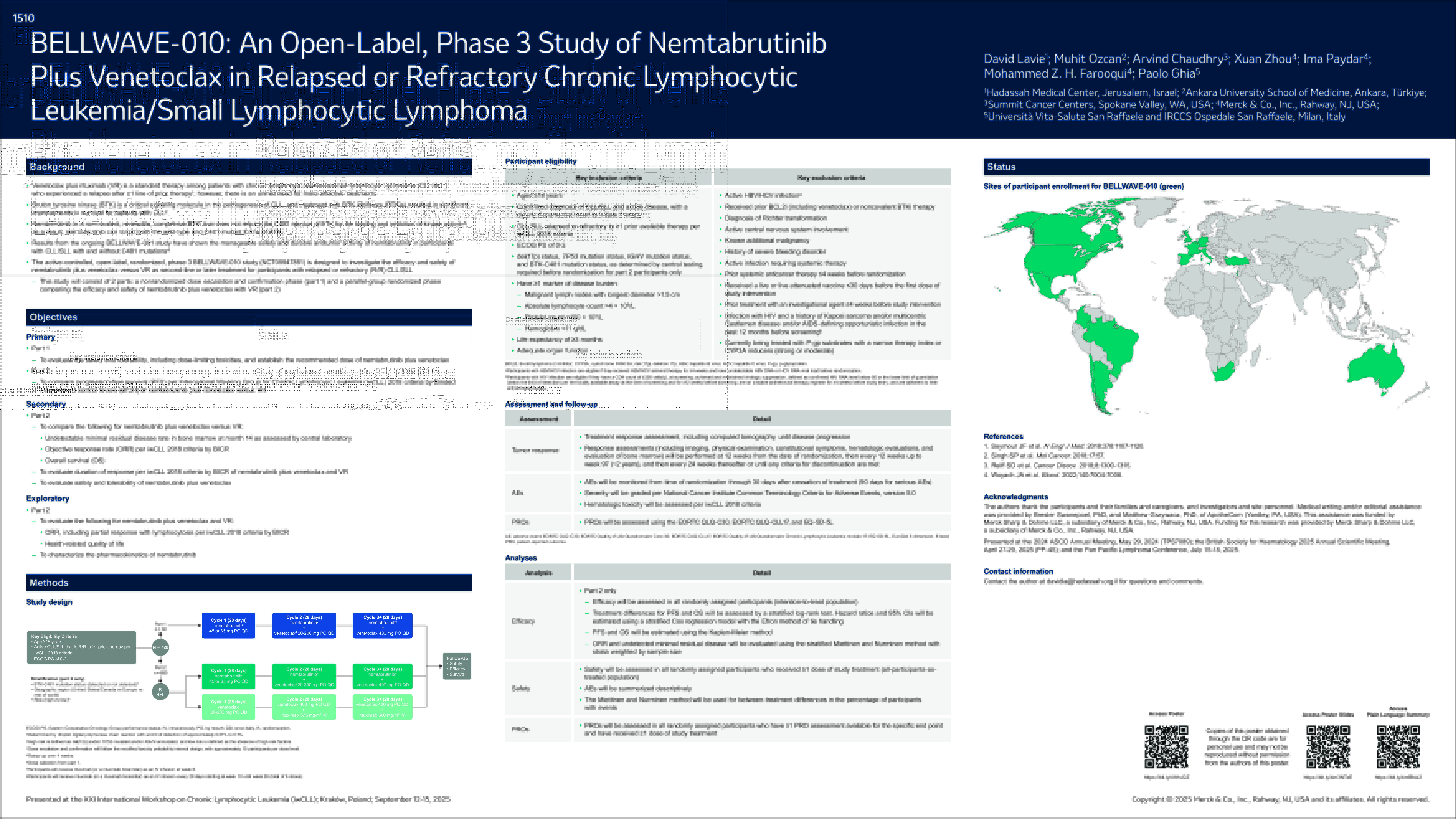
Venetoclax plus rituximab is the standard therapy for relapsed or refractory (R/R) chronic lymphocytic leukemia/small lymphocytic lymphoma (CLL/SLL). However, patients with genetic high-risk disease may experience shorter durations of response. Nemtabrutinib, a reversible, noncovalent, competitive inhibitor of wild type and C481-mutant Bruton tyrosine kinase (BTK), showed manageable safety and durable antitumor activity regardless of C481 mutation status in the BELLWAVE-001 study of participants with R/R CLL/SLL. In the randomized, active-controlled, open-label, phase 3 BELLWAVE-010 study (NCT05947851), safety and efficacy of nemtabrutinib plus venetoclax will be compared with venetoclax plus rituximab as second-line or later treatment for participants with R/R CLL/SLL.
Methods
Eligible participants are aged ≥18 years with active R/R CLL/SLL following at least 1 previous therapy per International Workshop on Chronic Lymphocytic Leukemia (iwCLL) 2018 criteria and have an Eastern Cooperative Oncology Group performance status of 0 to 2. Exclusion criteria include participants diagnosed with Richter transformation and those who received prior treatment with a noncovalent BTK inhibitor therapy or previous systemic anticancer therapy at least 4 weeks before study intervention. The study consists of 2 phases. Phase 1 (n≈30) is a nonrandomized dose-escalation and confirmation phase to determine safety, tolerability, and recommended dose of nemtabrutinib plus venetoclax using a modified toxicity probability interval design. Nemtabrutinib will be administered at 2 doses (45 mg escalating to 65 mg by mouth once daily) for 4 weeks, then nemtabrutinib plus venetoclax (20-400 mg by mouth once daily escalating over 28 days). Phase 2 (n≈690) is a parallel-group, randomized phase to compare safety and efficacy of nemtabrutinib plus venetoclax with venetoclax plus rituximab. Randomly assigned participants (1:1) will receive nemtabrutinib for 4 weeks then nemtabrutinib plus venetoclax (dosing consistent with part 1) or venetoclax (20-200 mg) for 4 weeks then venetoclax (400 mg) plus rituximab (375 mg/m2 intravenously at week 6, then 500 mg/m2 every 28 days during weeks 10-26). Treatment will be administered for ~2 years until any discontinuation criteria are met. Randomization will be stratified by BTK C481 mutation status (detected vs not detected), risk (high vs low), and geographic region (United States/Canada vs Europe vs rest of the world). Responses will be evaluated every 12 weeks until week 97, then every 24 weeks. Adverse events will be graded per National Cancer Institute Common Terminology Criteria for Adverse Events version 5.0. Hematologic toxicity will be graded using iwCLL 2018 criteria. The primary end points for part 1 are safety and tolerability. The primary end point for part 2 is progression-free survival per iwCLL 2018 criteria by blinded independent central review. The secondary end points for part 2 include undetectable minimal residual disease in bone marrow at month 14 (assessed by central laboratory), objective response rate and duration of response per iwCLL 2018 criteria, overall survival, and safety and tolerability. Recruitment is ongoing. ©2024 American Society of Clinical Oncology, Inc. Reused with permission. This abstract was accepted and previously presented at the 2024 ASCO Annual Meeting. All rights reserved.
Keywords : Chronic lymphocytic leukemia/small lymphocytic lymphoma, relapsed or refractory, nemtabrutinib
Please indicate how this research was funded.: Merck Sharp & Dohme LLC, a subsidiary of Merck & Co., Inc., Rahway, NJ, USA
Please indicate the name of the funding organization. : Merck Sharp & Dohme LLC, a subsidiary of Merck & Co., Inc., Rahway, NJ, USA