
Authors
Gao Ling, Zhang Jiaojiao, Liu Xiaoqian, Sheng Lixia, Qiu Tonglu, Zhang Wei, Yu Minjie, Dailuo Mengjia, Zhou Ziyuan, Fan Lei, Xia Yi, Li Jianyong, Zhu Huayuan.
Background
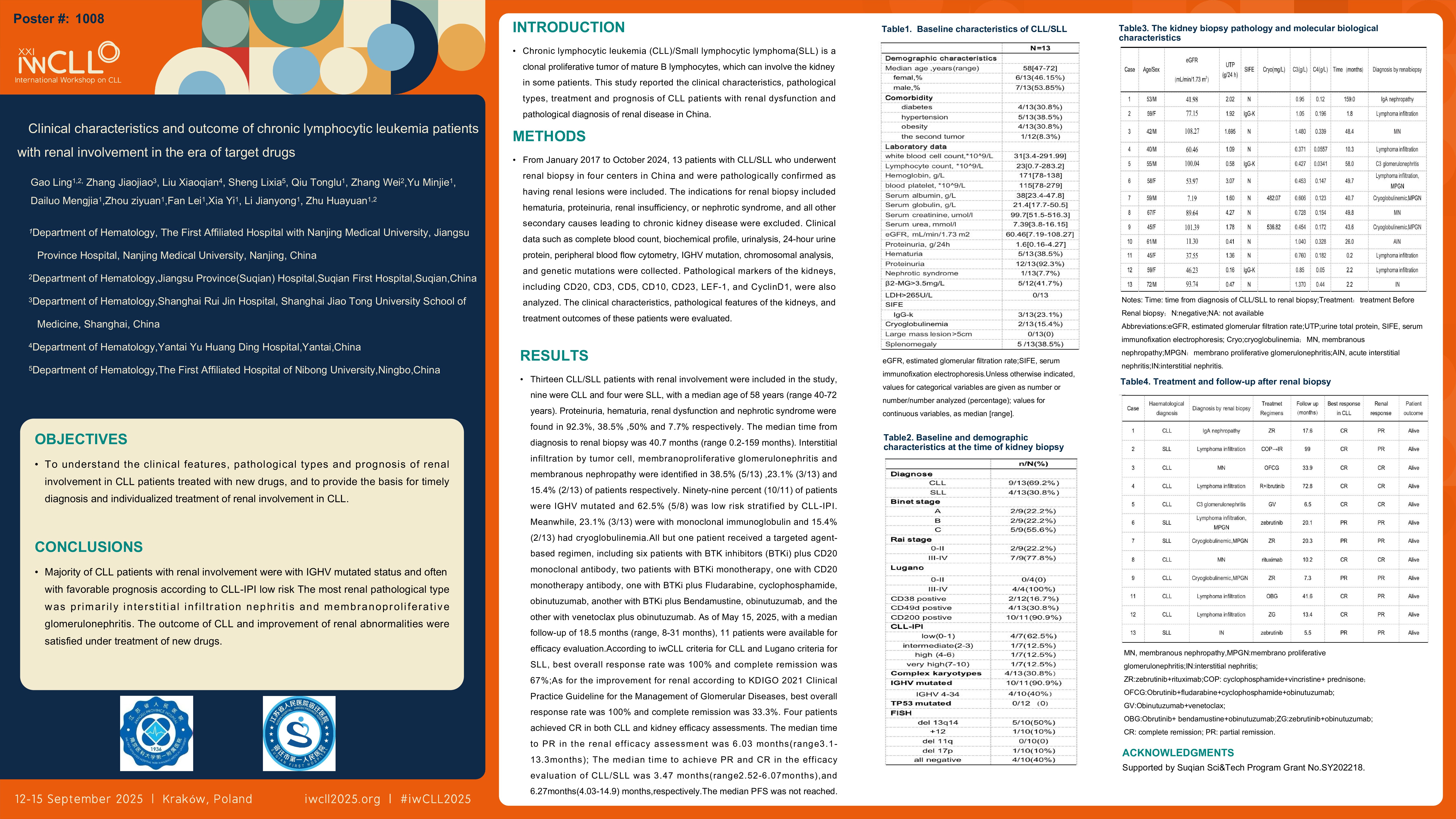
Chronic lymphocytic leukemia (CLL) is a mature B lymphocyte clonal proliferative tumor, and some patients may involve the kidneys. This study reports on the clinical characteristics, pathological types, treatment and outcomes in the new drug era of CLL patients with renal dysfunction and pathological diagnosis of concomitant kidney disease in multiple centers in China.
Methods
From January 2017 to October 2024, 13 patients with CLL who underwent renal biopsy in four centers in China and were pathologically confirmed as having renal lesions were included. The indications for renal biopsy included hematuria, proteinuria, renal insufficiency, or nephrotic syndrome, and all other secondary causes leading to chronic kidney disease were excluded. Clinical data such as complete blood count, biochemical profile, urinalysis, 24-hour urine protein, peripheral blood flow cytometry, IGHV mutation, chromosomal analysis, and genetic mutations were collected. Pathological markers of the kidneys, including CD20, CD3, CD5, CD10, CD23, LEF-1, and CyclinD1, were also analyzed. The clinical characteristics, pathological features of the kidneys, and treatment outcomes of these patients were evaluated.
Results
Thirteen patients with CLL/SLL with renal involvement were included, nine were CLL and four were SLL, with a median age of 58 years (range 40-72 years). Proteinuria, hematuria, renal dysfunction and nephrotic syndrome were found in 92.3%, 38.5% ,50% and 7.7% respectively. The median time from diagnosis to renal biopsy was 40.7 months (range 0.2-159 months), twelve patients were treatment naïve before renal biopsy and the other had undergone alkylating agents and chemotherapy previously. Interstitial infiltration by tumor cell, membranoproliferative glomerulonephritis and membranous nephropathy were identified in 38.5% (5/13) ,23.1% (3/13) and 15.4% (2/13) of patients respectively. Ninety percent (10/11) of patients were IGHV mutated and 62.5% (5/8) was low risk stratified by CLL-IPI. Meanwhile, 23.1% (3/13) were with monoclonal immunoglobulin and 15.4% (2/13) had cryoglobulinemia.. All patients exclude one received target drugs-based regimen after biopsy, including six patients with BTK inhibitors (BTKi) plus CD20 monoclonal antibody, two patients with BTKi monotherapy, one with CD20 monotherapy antibody, one with BTKi plus Fludarabine, cyclophosphamide, obinutuzumab, another with BTKi plus Bendamustine, obinutuzumab, and the other with venetoclax plus obinutuzumab. As of May 15,2025, the median follow-up was 18.5 months (range 8-31 months), with 11 patients were available for efficacy evaluation. According to iwCLL criteria for CLL and Lugano criteria for SLL, best overall response rate was 100% and complete remission was 67%;As for the improvement for renal according to KDIGO 2021 Clinical Practice Guideline for the Management of Glomerular Diseases, best overall response rate was 100% and complete remission was 33.2%. Four patients achieved CR in both CLL and kidney efficacy assessments. The median time to PR in the renal efficacy assessment was 6.03 months(range3.1-13.3months); The median time to achieve PR in the efficacy evaluation of CLL/SLL was 3.47 months(range2.52-6.07months), and the median time to achieve CR was 6.27months(4.03-14.9) months.The median PFS was not reached.
Conclusion
Majority of CLL patients with renal involvement were with IGHV mutated status and often with favorable prognosis according to CLL-IPI low risk The most renal pathological type was primarily interstitial infiltration nephritis and membranoproliferative glomerulonephritis. The outcome of CLL and improvement of renal abnormalities were satisfied under treatment of new drugs.
Keywords : chronic lymphocytic leukemia, renal involvement, targeted drugs
Please indicate how this research was funded. :
Please indicate the name of the funding organization.: