
Authors
Jitka Malcikova, Karla Plevova, Veronika Navrkalova, Anna Panovska, Tomas Arpás, Adela Prchlikova, Yvona Brychtova, Kristyna Tausova, Eva Zapletalova, Jakub Pawel Porc, Eva Ondrouskova, Barbara Dvorackova, Jana Kopecna, Natalie Kazdova, Marcela Zenatova, Sarka Pospisilova, Michael Doubek, Sarka Pavlova.
Background
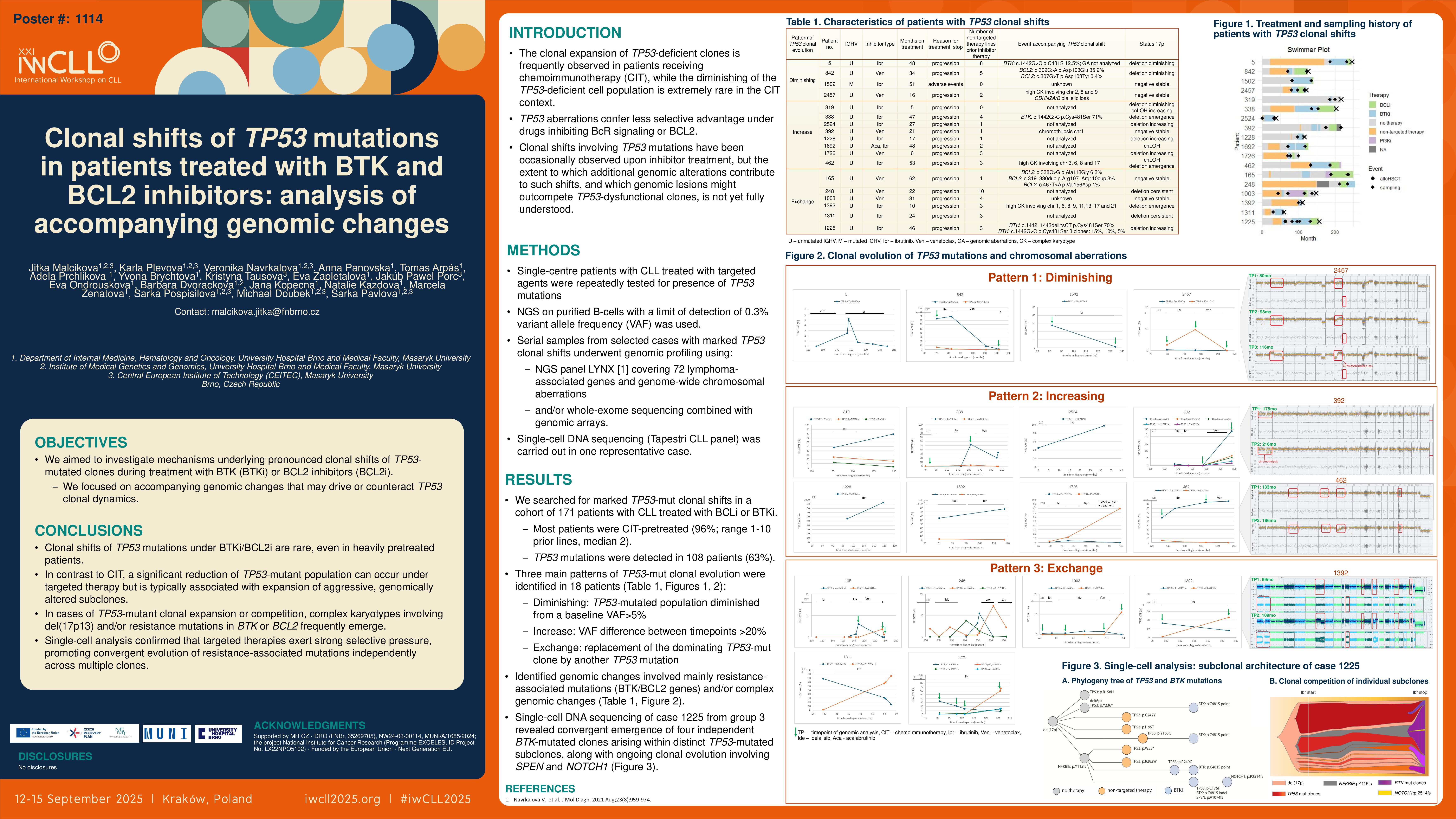
The selective advantage of TP53-deficient clones is unambiguous in patients receiving chemoimmunotherapy (CIT), where minor TP53-mutated subclones frequently undergo expansion. In contrast, the diminishing of the TP53-deficient cell population is extremely rare in the CIT context. Drugs inhibiting BcR signaling or BCL2 are efficient even in patients with disrupted p53 pathway. Although TP53 remains a marker of aggressive disease, its aberrations confer less selective advantage under these treatments. Still, clonal shifts involving TP53 mutations have been occasionally observed. The extent to which additional genomic alterations contribute to such shifts, and which genomic lesions might outcompete TP53-dysfunctional clones, is not yet fully understood.
Objectives
We aimed to investigate mechanisms underlying pronounced clonal shifts of TP53-mutated clones during treatment with BTK (BTKi) or BCL2 inhibitors (BCL2i), with the focus on accompanying genomic changes that may drive or counteract TP53 clonal dynamics.
Methods
In a single-center cohort of 171 patients with CLL treated with targeted agents, TP53 mutations were repeatedly tested using NGS on purified B-cells with a limit of detection of 0.3% variant allele frequency (VAF). Most patients previously received chemo(immuno)therapy (96%; range 1-10 prior lines, median 2). TP53 mutations were detected in 108 patients (63%). Serial samples from selected cases with marked TP53 clonal shifts underwent genomic profiling using the NGS panel LYNX (PMID: 34082072) covering 72 lymphoma-associated genes and genome-wide chromosomal aberrations, and/or whole-exome sequencing (WES) combined with genomic arrays. Single-cell DNA sequencing (Tapestri CLL panel) was carried out in one representative case.
Results
Three main patterns of clonal evolution, i.e., diminishing, increase, and exchange of TP53-mut clone, were identified in 18 patients. The first group included four cases in which the TP53 mutated population diminished from a baseline VAF>5% (BTKi n=2; BCL2i n=2). In two out of three cases with available detailed analysis, the outcompeting wt-TP53 population carried alterations previously associated with CLL progression and treatment resistance, i.e., highly complex karyotype with CDKN2A/B biallelic loss in one case, and BCL2 mutation the other. The cause of TP53-mut clone regression in the third case (VAF decrease from 28% to 1%) remained unexplained.
The second group involved eight patients with a significant increase of TP53 mutation (VAF_timepoint2 – VAF_timepoint1 >20%; BTKi: n=6; BCL2i: n=2). In three cases with detailed analysis, one showed an acquired BTK resistance mutation within the expanding TP53-mutant clone, while two others developed complex genomic alterations: chromothripsis of chromosome arm 1q and a highly complex karyotype with del(17p13), respectively.
The third group comprised six cases (BTKi: n=3; BCL2i: n=3) with inter-clonal TP53 competition and replacement of the dominating TP53-mutant clone. The clonal exchange in three out of four patients analyzed in detail was accompanied by the emergence of two predominant BTK mutations, several subclonal mutations in BCL2, and a highly complex karyotype with del(17p13), respectively. No additional changes were identified in the fourth case. In a representative case from this group, single-cell DNA sequencing revealed convergent evolution of resistance driven by the emergence of four independent BTK Cys481Ser-mutated clones, collectively accounting for 99% of CLL cells (c.1442_1443delinsCT, and three clones carrying c.1442G>C). Each of these mutations was acquired within a clone carrying different TP53 mutation. Further clonal evolution led to the acquisition of mutation in the SPEN gene, transcriptional repressor of NOTCH1 target genes, likely contributing to the dominance of one TP53/BTK-mutant clone representing 70% of CLL cells.
Conclusion
Pronounced clonal shifts of TP53 mutations during treatment with BTK or BCL2 inhibitors are infrequent, even in this heavily pretreated cohort. In contrast to CIT, a significant reduction of TP53-mutant population can occur under targeted therapy but is typically associated with expansion of aggressive TP53 wild-type clones that acquired resistance-associated genomic alterations. In cases of TP53-mut clonal expansion or competition, we frequently observed the emergence of complex karyotype with del(17p13), and/or resistance mutations in BTK or BCL2. Single-cell analysis confirmed that targeted therapies exert strong selective pressure, promoting convergent evolution of resistance-associated mutations independently across multiple clones.
Supported by MH CZ – DRO (FNBr, 65269705), NW24-03-00114, MUNI/A/1685/2024; the project National Institute for Cancer Research (MEYS, Programme EXCELES, ID Project No. LX22NPO5102) – co-funded by the European Union – Next Generation EU.
Keywords : TP53, clonal evolution, leukemia
Please indicate how this research was funded. : Supported by MH CZ – DRO (FNBr, 65269705), NW24-03-00114, MUNI/A/1685/2024; the project National Institute for Cancer Research (MEYS, Programme EXCELES, ID Project No. LX22NPO5102) – co-funded by the European Union – Next Generation EU
Please indicate the name of the funding organization.: Ministry of health of the Czech republic, Czech health research council, The Ministry of Education, Youth and Sports (MSMT) and European Union