
Authors
Α. Iatrou, M. Gerousi, N. Pechlivanis, A. Anastasiadou, R. Sandaltzopoulos, I. Sakellari, N. Stavroyianni,F. Psomopoulos, A. Agathangelidis, A. Chatzidimitriou, K. Stamatopoulos.
Background
Chronic lymphocytic leukemia (CLL) subset #4 represents the largest stereotyped subset with somatically hypermutated clonotypic B cell receptor immunoglobulin (BcR IG) and a prototype for indolent disease. The BcR IG is encoded by the IGHV4-34/IGKV2-30 gene pair, which is rare in the normal repertoire. Moreover, it is IgG-switched, which is noteworthy considering the low frequency of IgG clones in CLL (5-8%). Subset #4 BcR IG are capable of specific homotypic interactions, which induce cellular activation. These interactions appear to be structurally mediated by elements of the gamma constant domain, providing a plausible mechanistic explanation for the obligatory IgG isotype expression observed in this subset. Subset #4 BcR IGs have been shown to be intraclonally diversified, alluding to prolonged interactions with antigen(s), albeit the available evidence is limited due to the low-throughput methodologies employed in the respective studies.
Aims
We aimed to characterized in-depth the subclonal architecture of CLL subset #4 by integrating high-throughput immunogenetic and transcriptomic analyses towards gaining insights into the evolutionary trajectories and clonal dynamics of this biologically distinctive CLL variant.
Methods
We undertook bulk next-generation sequencing (NGS) of IG gene rearrangements in longitudinal samples from 6 patients from subset #4 and 6 patients who also expressed IGHV4-34 yet did not belong to subset #4. For precise tracking of isotype expression, leader primers specific for IGHV4-34 and 3′ primers specific to the mu or gamma constant domains were used. IG NGS was also performed in fluorescence-activated cell sorted (FACS) IgG⁺ and IgM⁺ B cells from subset #4 cases, combined with RNA sequencing to explore subpopulation-specific transcriptional programs.
Results
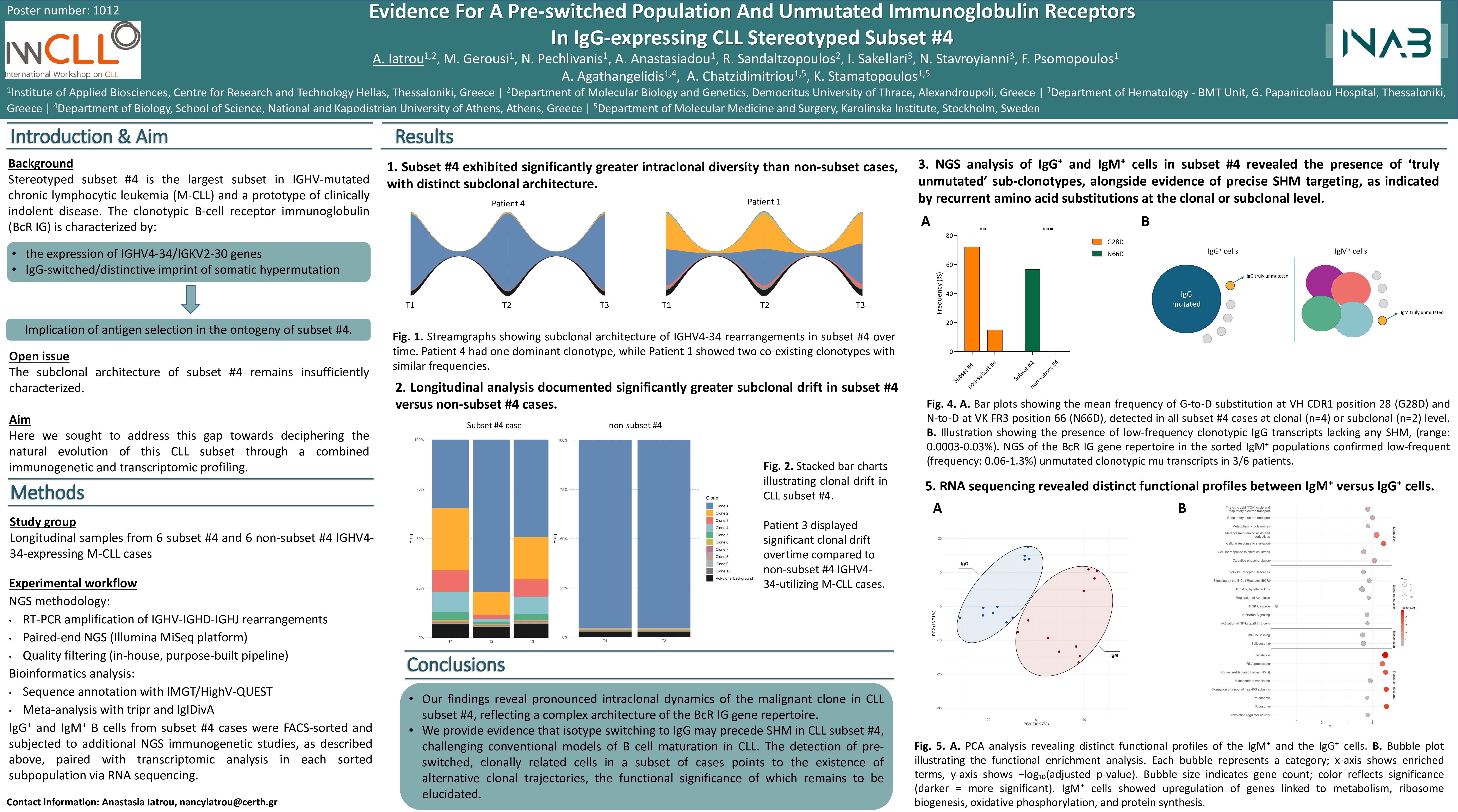
Subset #4 cases exhibited significantly (p < 0.05) higher intraclonal diversity versus non-subset cases, with distinct subclonal architecture. Specifically, 4 cases were dominated by a single clonotype, while the remaining 2 displayed co-existence of ≥2 significantly expanded clonotypes at comparable frequencies. Regarding the light chains, 5 cases harbored a single dominant clonotype, whereas the remaining case exhibited multiple expanded clonotypes. In contrast, all non-subset #4 cases displayed a single dominant clonotype for both IG heavy and light chains. Longitudinal analysis documented significantly (p < 0.05) greater subclonal drift in subset #4 versus non-subset #4 cases, as evidenced by great shifts in the size of expanded clonotypes, particularly for the heavy chains. Furthermore, precise SHM targeting was observed in subset #4, evidenced by recurrent amino acid substitutions at certain positions of the variable domain. Prominent examples concerned: (i) G-to-D at VH CDR1 position 28, detected in all cases at either the clonal (n=4) or subclonal level (n=2); N-to-D at VK FR3 position 66, detected in all cases at either clonal (n=4) or subclonal level (n=2). Rather unexpectedly, all subset #4 cases harbored IgG transcripts that lacked any SHM, albeit at extremely low frequencies (0.0003-0.03%). Furthermore, in 3 out of 6 patients, sorted IgM⁺ cells contained clonally-related mu transcripts that were unmutated, also at low frequencies (0.06-1.3%). RNA sequencing revealed that IgM⁺ and IgG⁺ cells exhibited distinct transcriptional signatures. In particular, IgM⁺ cells showed upregulated genes involved in metabolic processes, ribosome biogenesis, oxidative phosphorylation, and protein synthesis, compared to IgG⁺ cells, indicative of a metabolically active and potentially more proliferative phenotype. In contrast, IgG⁺ cells displayed a transcriptional signature characterized by reduced metabolic activity and cell proliferation, consistent with a functionally anergic state, in keeping with previous reports documenting an anergic state for subset #4 IgG cells.
Summary/
Conclusion
Our findings reveal extensive intraclonal dynamics of the malignant clone in CLL subset #4, underlying a particularly complex architecture of the BcR IG gene repertoire. Moreover, they indicate that isotype switching to IgG may precede SHM in CLL subset #4, while also documenting the existence of pre-switched clonally-related cells, at least in a fraction of cases, whose precise biological role requires further investigation.
Keywords : chronic lymphocytic leukemia, B cell receptor, stereotyped subset 4
Please indicate how this research was funded. :
Please indicate the name of the funding organization.: Institute of Applied Biosciences, Centre for Research and Technology Hellas