
Authors
Akinola Norah O., Bolarinwa Rahman Ayodele, Onwah Lawretta A., Gbotosho Olabisi A., Kotila Taiwo R., Aworanti Oladapo W., Adegbamigbe Oluwafemi J., Omoniyi-Esan Ganiat O., Bisiriyu Luqman Adeleke, Ofusori David Adesanya, Adelusola Kayode Adebowale.
Background
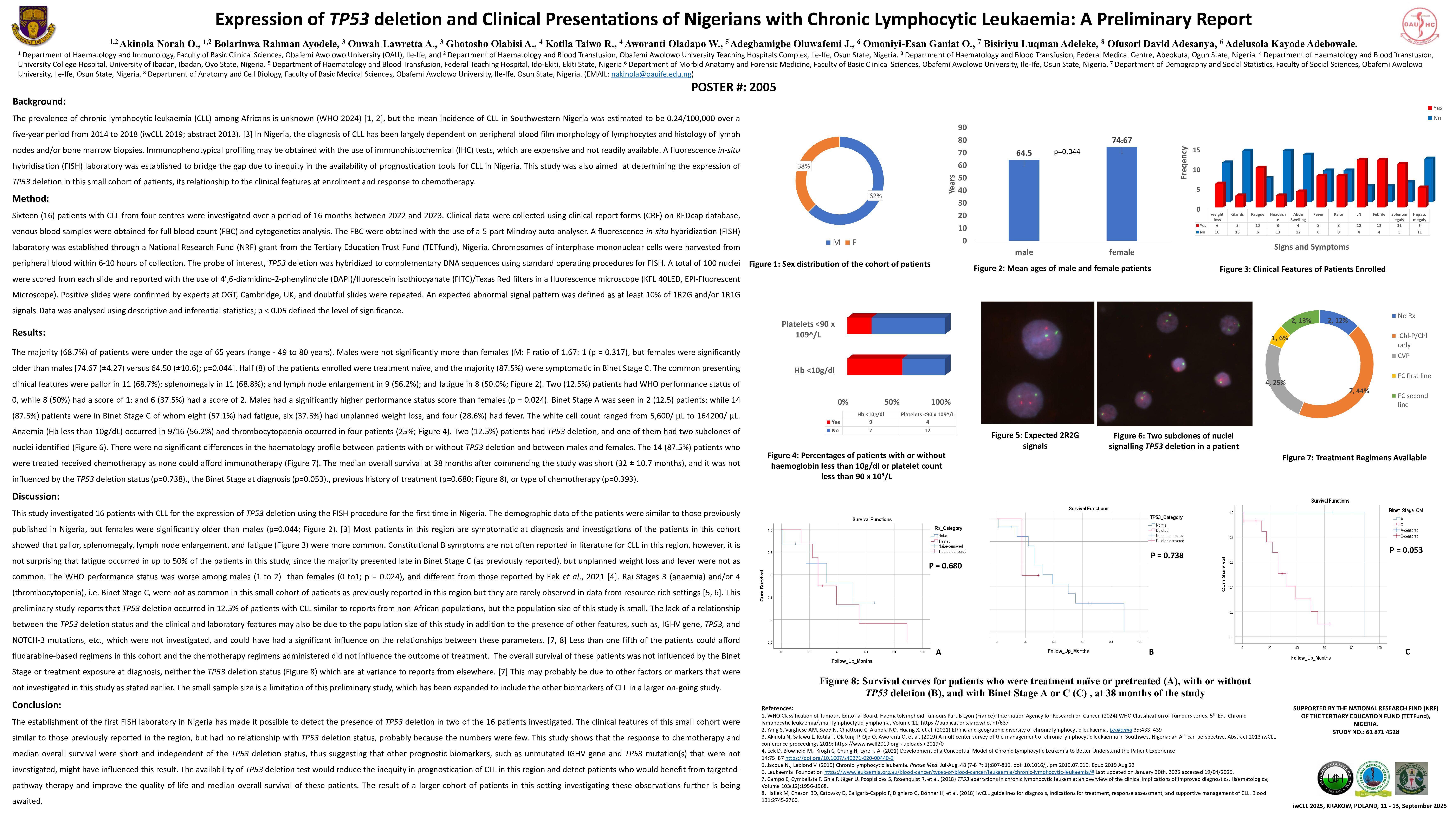
A fluorescence in-situ hybridisation (FISH) laboratory was established due to inequity in the prognostication of chronic lymphocytic leukaemia (CLL) in Nigeria, and to determine the prevalence of TP53 deletion in these patients, its relationship to the clinical features at enrolment and response to chemotherapy.
Method
Sixteen (16) patients with CLL from four centres were investigated over a period of 16 months. Clinical data were collected using forms on REDcap database, blood samples were obtained for full blood count (FBC) and FISH analysis using standard operating procedures. Data was analysed using descriptive and inferential statistics; p < 0.05 defined the level of significance.
Results
The majority (68.7%) of patients were under the age of 65 years (range – 49 to 80 years). Males were not significantly more than females (M: F ratio of 1.67: 1 (p = 0.317), but females were significantly older than males [74.67 (±4.27) versus 64.50 (±10.6); p=0.044]. Half (8) of the patients enrolled were treatment naïve, and the majority (87.5%) were symptomatic in Binet Stage C. Two (12.5%) patients had TP53 deletion, and two subclones of nuclei were identified in one of them. The common presenting clinical features were pallor in 11 (68.7%); splenomegaly in 11 (68.8%); and lymph node enlargement in 9 (56.2%); and fatigue in 8 (50.0%). Two (12.5%) patients had WHO performance status of 0, while 8 (50%) had a score of 1; and 6 (37.5%) had a score of 2. Males had a significantly higher performance status score than females (p = 0.024). Binet Stage A was seen in 2 (12.5) patients; while 14 (87.5%) patients were in Binet Stage C of whom eight (57.1%) had fatigue, six (37.5%) had unplanned weight loss, and four (28.6%) had fever. The white cell count ranged from 5,600/ µL to 164200/ µL. Anaemia (Hb less than 10g/dL) occurred in 9/16 (56.2%) and thrombocytopaenia occurred in four patients (25%). There were no significant differences in the haematology profile between patients with or without TP53 deletion and between males and females. The 14 (87.5%) patients who were treated received chemotherapy as none could afford immunotherapy. The median overall survival at 38 months after commencing the study was short (32 ± 10.7 months), and it was not influenced by the Binet Stage at diagnosis, previous history of treatment, type of chemotherapy, or TP53 deletion status.
Conclusion
This study has established the first FISH laboratory in Nigeria and has shown that one in eight patients with CLL has TP53 deletion. The clinical features of this small cohort of patients with CLL are similar to those previously reported in the region, but the relationship with TP53 status is being reported for the first time in Nigeria. This study shows that the response to chemotherapy was independent of TP53 deletion status probably because other prognostic biomarkers, such as unmutated IGHV gene and TP53 mutation(s), that were not investigated, might have been present. The availability of TP53 deletion test would reduce the time spent and resources wasted on giving patients chemotherapy, as first-line therapy, thus reducing the inequity that is evident, and improving the quality of life and overall survival of these patients.
Keywords : chronic lymphocytic leukaemia (CLL), TP53 deletion, fluorescence in-situ hybridisation (FISH), prognostication.
Please indicate how this research was funded. : An National Research Fund (NRF) grant through the university.
Please indicate the name of the funding organization.: Tertiary Education Trust Fund (TETFund), Nigeria.