
Authors
Anton von Lom, Alexander vom Stein, Hendrik Jestrabek, Phuong-Hien Nguyen, Michael Hallek.
Introduction
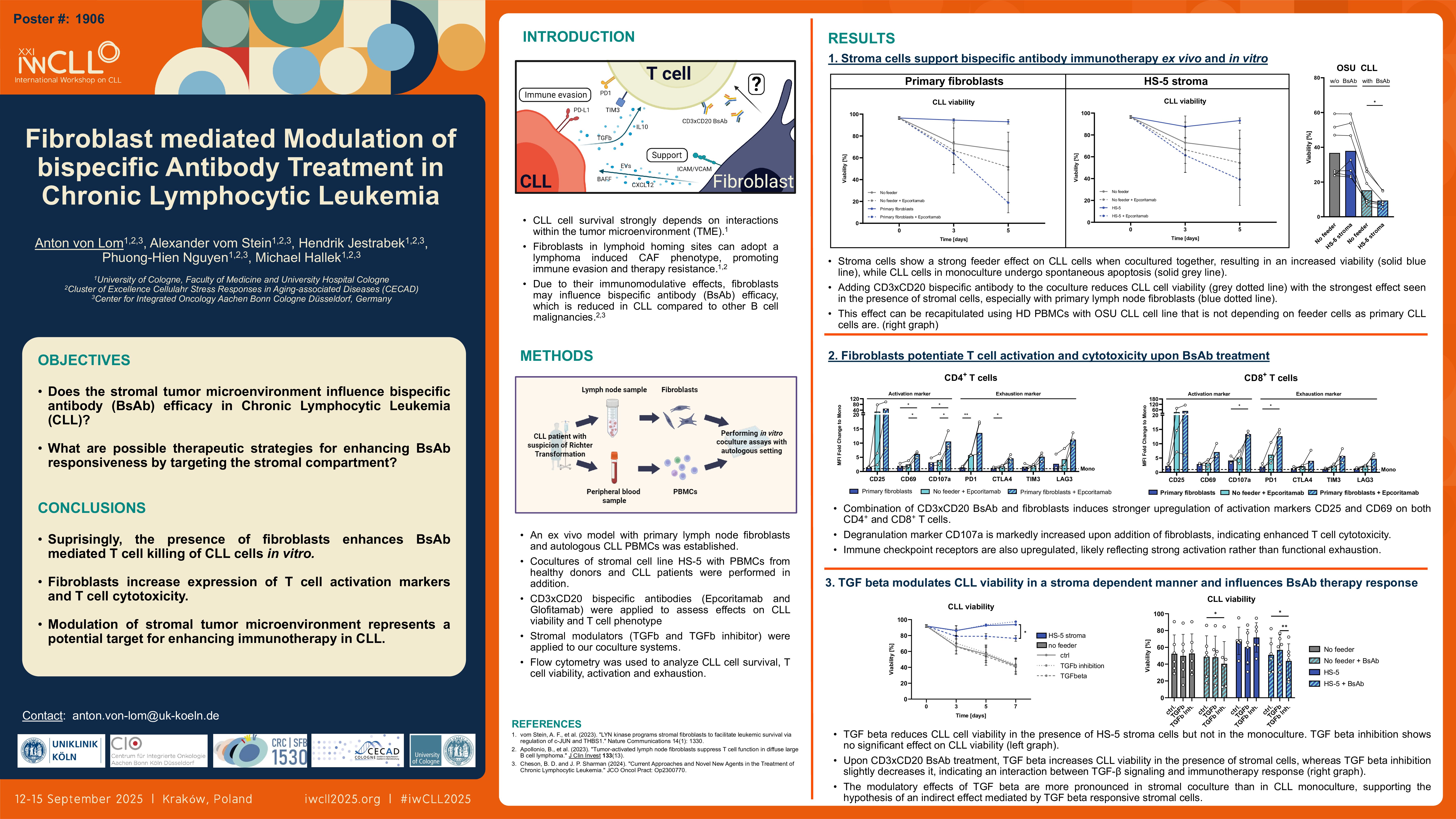
Chronic lymphocytic leukemia (CLL) survival and progression are critically supported by the tumor microenvironment (TME) (Burger and Gribben, 2014). Fibroblasts, as key TME components at homing sites, can acquire a CLL-induced cancer associated fibroblast (CAF) phenotype that promotes disease progression and therapy resistance (vom Stein et al, 2023). Due to their immunosuppressive properties, fibroblasts may affect the efficacy of immunotherapies such as bispecific antibodies (BsAb), which are generally less effective in CLL compared to other B cell malignancies (Apollonio et al, 2023; Falchi,et al, 2023). While CAFs have been extensively studied in solid tumors, their role in modulating immune responses in CLL is poorly understood. This study investigates how stromal fibroblasts influence BsAb efficacy in CLL and whether stromal modulation enhances immunotherapy responsiveness.
Methods
In vitro coculture assays were established using stromal cell lines and peripheral blood mononuclear cells (PBMC) from healthy donors and CLL patients. CD3/CD20 BsAbs and stromal modulators were applied, and effects on CLL cell viability and T cell phenotype including activation and exhaustion markers were assessed via flow cytometry. Additionally, an ex vivo coculture system using patient-derived lymph node fibroblasts and autologous CLL cells was developed.
Results
Our data demonstrates that various stromal cells support the viability of leukemic cells, consistent with previous reports. CLL PBMCs cocultured with stromal cells exhibited an enhanced response to BsAb treatment, whereas CLL PBMCs cultured without stromal support showed limited sensitivity. This establishes stromal coculture systems as a valuable model to study BsAb efficacy in primary CLL cells. The strongest effects were observed in autologous cocultures using patient-derived primary fibroblasts. Furthermore, coculture with stromal cells led to increased expression of T cell activation markers, indicating enhanced T cell cytotoxic activity and alterations in the composition of CD8⁺ and CD4⁺ T cell subsets. Notably, BsAb treatment induced a strong reduction in CD8 T cell frequencies, independent of the culture condition. Interestingly, stromal TGFβ receptor inhibition promoted CLL cell survival in the absence of BsAb, yet in combination with BsAbs, it increased cytotoxicity, implying that modulation of stroma cells affects BsAb efficiency.
Conclusion
This study indicates the potential of targeting the tumormicroenvironment in CLL, specifically stromal cells, to enhance immunotherapy efficacy.
Keywords : bispecific antibodies, cancer associated fibroblasts, tumormicroenvironment
Please indicate how this research was funded. :
Please indicate the name of the funding organization.: