
Authors
Joanna Kamaso, Silvia Ramos-Campoy, Carme Melero, Marta Salido, Marta Lorenzo, María Rodríguez-Rivera, Eva Gimeno, Miguel Alcoceba, Miguel Bastos-Boente, Ángel Ramírez-Payer, Alicia Rodríguez Fernández, Ángel Serna, Pau Abrisqueta, Marta Crespo, Alba Cabirta, Raquel Santiago, Dolores García-Malo, Ana Carla de Oliveira, Alicia Serrano, Blanca Ferrer, Miguel Perera, Alexia Suárez, Macarena Ortiz, Rosa Collado, Rocío García-Serra, Teresa Villalobos, Marta Julià, Sergio Ramos, Gemma Azaceta17, Janilson do Nascimento, Rafael Andreu, Íñigo Olazabal, Javier de la Serna, Eduardo Ríos, José María Arguiñano, Miguel Ángel Rodríguez, Ainara Ferrero, Lucrecia Yáñez, Emil de León, Isabel González-Gascón-y-Marín, Javier Loscertales, Xabier Gutiérrez, Ana Muntañola, Miguel Arguello, Ángeles Medina, Mª Victoria Calle, Christelle Ferrà, Francesc Bosch, Anna Puiggros, Blanca Espinet.
Introduction
TP53 alterations [17p13 deletions (TP53del) and TP53 mutations (TP53mut)] are adverse prognostic factors in chronic lymphocytic leukemia (CLL). Double-hit cases (TP53del+mut or multiple TP53mut) have a particularly poor prognosis (Brieghel et al, 2021). Complex karyotype (CK, ≥3 alterations) predicts worse outcome in chemoimmunotherapy (CIT)-treated patients. Low/intermediate CK (3-4 alt.) worsens evolution only in TP53-altered cases, while high CK (≥5 alt.) confers an aggressive outcome independently of other risk factors (Baliakas et al, 2019). The impact of CK in targeted therapy is still under analysis. Besides, although CK associates with TP53 alterations, the link between TP53-alteration type (single hit or double hit) and genomic complexity remains unclear. In recent years, optical genome mapping (OGM) has emerged as a new cytogenomic method that allows the detection of both balanced and unbalanced abnormalities with high resolution with promising results for CK assessment in CLL.
Objectives
Whitin the context of the COMPLEX project, which aims to assess the impact of CK on the outcome of CLL patients treated with targeted therapies in a real-life study in Spain, the main aims of this study were: (1) To characterize the genomic profile of TP53-altered patients and (2) To describe numerical/structural alterations in the TP53 genomic region and genomic complexity in a subgroup of cases using OGM.
Patients and methods
We included 355 CLL patients treated with iBTK and/or iBCL2 ± anti-CD20 from Nov 2021 to April 2025, with available data on FISH (13q,12, 11q, 17p), IGHV, TP53 mutations, and CK before treatment. Among them, 83 TP53-altered patients were selected: TP53 alteration type (del and/or mut) and its association with IGHV status and presence of CK were characterized. Peripheral blood samples from 65 of the TP53-altered patients were analyzed by OGM to detect numerical/structural alterations in 17p13 and to assess genomic complexity (GC). GC by OGM was defined as the presence of ≥5 alterations, including those ≥5Mb, rearrangements, CLL-related abnormalities and smaller alterations (≥200Kb) that were related with other events.
Results
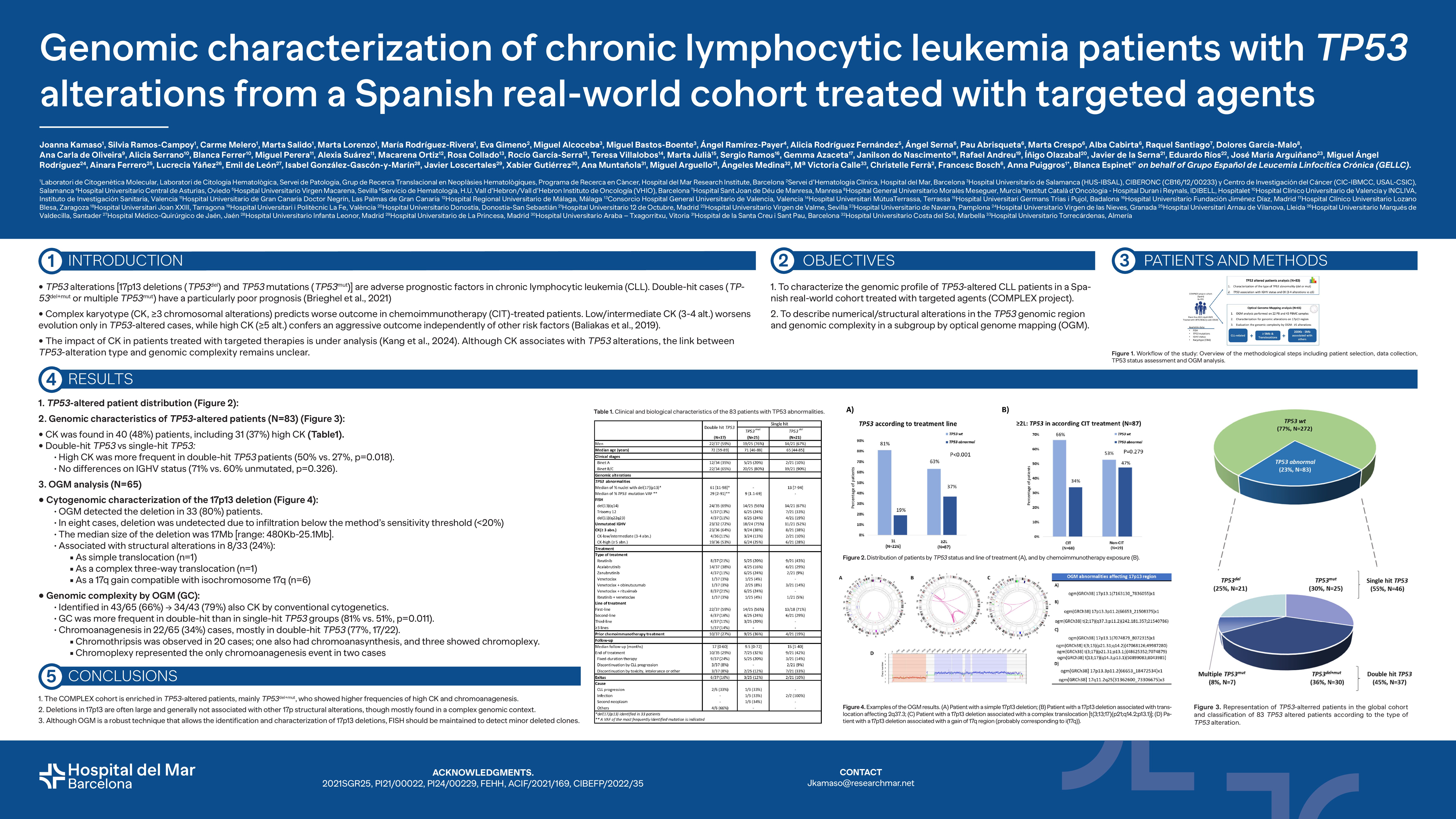
TP53-altered patients represented 23% of the cohort (83/355). TP53 alterations were more frequent in patients treated in second and subsequent lines (37%, 32/87) vs. first line (19%, 51/268) (p < 0.001). Prior CIT exposure did not significantly impact TP53 alteration rates (34% [23/68] vs. 47% no-CIT [9/19], p=0.279). Among 83 TP53-altered patients, 37 (45%) were double-hit (30 TP53del+mut, 7 multiple TP53mut), while 46 (55%) were single-hit (25 TP53mut, 21 TP53del). Median FISH-positive nuclei in the 51 patients carrying TP53 deletion was 45% [7-98%]. TP53 mutations had a median VAF of 24%, with 10/62 (16%) patients showing VAF < 5% [1-4.7%]. CK was found in 40 (48%) patients, including 31 (37%) high CK. High CK was more frequent in double-hit TP53 patients (50% vs. 27%, p=0.018), but unmutated IGHV frequency showed no differences between groups (71% vs. 60%, p=0.326). Among the 65 cases analysed by OGM [28 TP53del+mut, 20 TP53mut, 13 TP53del and 4 multiple TP53mut], OGM detected 33/41 (80%) TP53 deletions previously identified by FISH. Discrepancies were due to infiltrations below OGM sensitivity (20%). Deletions at 17p13 showed a median size of 17Mb (480Kb-25.1Mb), and 8/33 (24%) were associated with structural alterations: a simple translocation [t(2;17)(q37.3;p11.2)] (n=1), a complex three-way translocation [t(3;13;17)(p21.31;q14.2;p13.1)] (n=1), and a concomitant 17p loss/17q gain compatible with isochromosome 17q (n=6). OGM detected GC in 43/65 (66%), with 34/43 (79%) also CK by conventional cytogenetics. GC was more frequent in double-hit than in single-hit TP53 groups (81% vs. 51%, p=0.011). OGM identified chromoanagenesis in 22/65 (34%) cases, mostly in double-hit TP53 (77%, 17/22). Chromothripsis was observed in 20 cases; one also had chromoanasynthesis, and three showed chromoplexy. Moreover, in two cases, chromoplexy represented the only chromoanagenesis event.
Conclusion
(1) The COMPLEX cohort is enriched in TP53-altered patients, mainly TP53del+mut, who showed higher frequencies of high CK and chromoanagenesis events. (2) Deletions in 17p13 are often large and generally not associated with other 17p structural alterations, though mostly found in a complex genomic context. (3) Although OGM is a robust technique that allows the identification and characterization of 17p13 deletions, FISH should be maintained to detect minor deleted clones.
ACKNOWLEDGMENTS. 2021SGR25, PI21/00022, PI24/00229, FEHH, ACIF/2021/169, CIBEFP/2022/35
Keywords : Complex karyotype, TP53-alterations, Targeted therapy, OGM, Chromoanagenesis
Please indicate how this research was funded. :
Please indicate the name of the funding organization.: