
Author
Víctor Jiménez-Martínez, Judith Mateos-Jaimez, Marta Kulis, Vicente Chapaprieta, Martí Duran-Ferrer, Anna Vidal-Crespo, Alba Maiques-Diaz, Ferran Nadeu, Laura Llaó-Cid, Irene López-Oreja, Estella Matutes, Armando López-Guillermo, Elias Campo, Raúl F. Pérez, José I. Martín-Subero.
Background
Chronic lymphocytic leukemia (CLL) is a lymphoid neoplasm with considerable molecular and clinical diversity. A common transcriptional hallmark of CLL is the aberrant loss of expression of the B-cell transcription factor Early B cell factor 1 (EBF1), involved in early B-cell commitment and maturation, while illegitimate expression of T-cell related genes such as Lymphoid enhancer-binding factor 1 (LEF1) and Cytotoxic T-lymphocyte associated protein 4 (CTLA4) is typically observed. Nonetheless, a small number of CLL cases display high levels of EBF1 expression. In this scenario, whether the aberrant expression of these genes is interconnected and whether the retention of EBF1 expression may shape the molecular configuration of these cases is currently unknown.
Aims
We aimed to dissect the differential molecular characteristics of those CLL cases that maintain EBF1 expression and explore the functional consequences of this retention, as well as its relationship with cell of origin and B-cell identity.
Methods
We gathered diverse multi-omic datasets across a variety of CLL cases, including genomic features (N=560), transcriptomic (N=591), proteomic (N=72), and epigenomic profiling (i.e. ATAC-seq, N=104; H3K27ac ChIP-seq, N=102; DNA methylation 450k arrays, N=253). We first used the RNA-seq data to define EBF1+ CLLs and then performed integrative computational analyses for a deep characterization of their molecular profiles. We performed Multi-Omics Factor Analysis (MOFA), differential analyses with limma, gene set enrichment analyses, and epigenomic Locus Overlap Analysis (LOLA). Furthermore, we profiled a cohort of selected EBF1+, EBF1- and healthy control samples (N=28) using 10X Chromium Single Cell Multiome (ATAC + Gene Expression), which was processed with Seurat and used to infer regulome networks.
Results
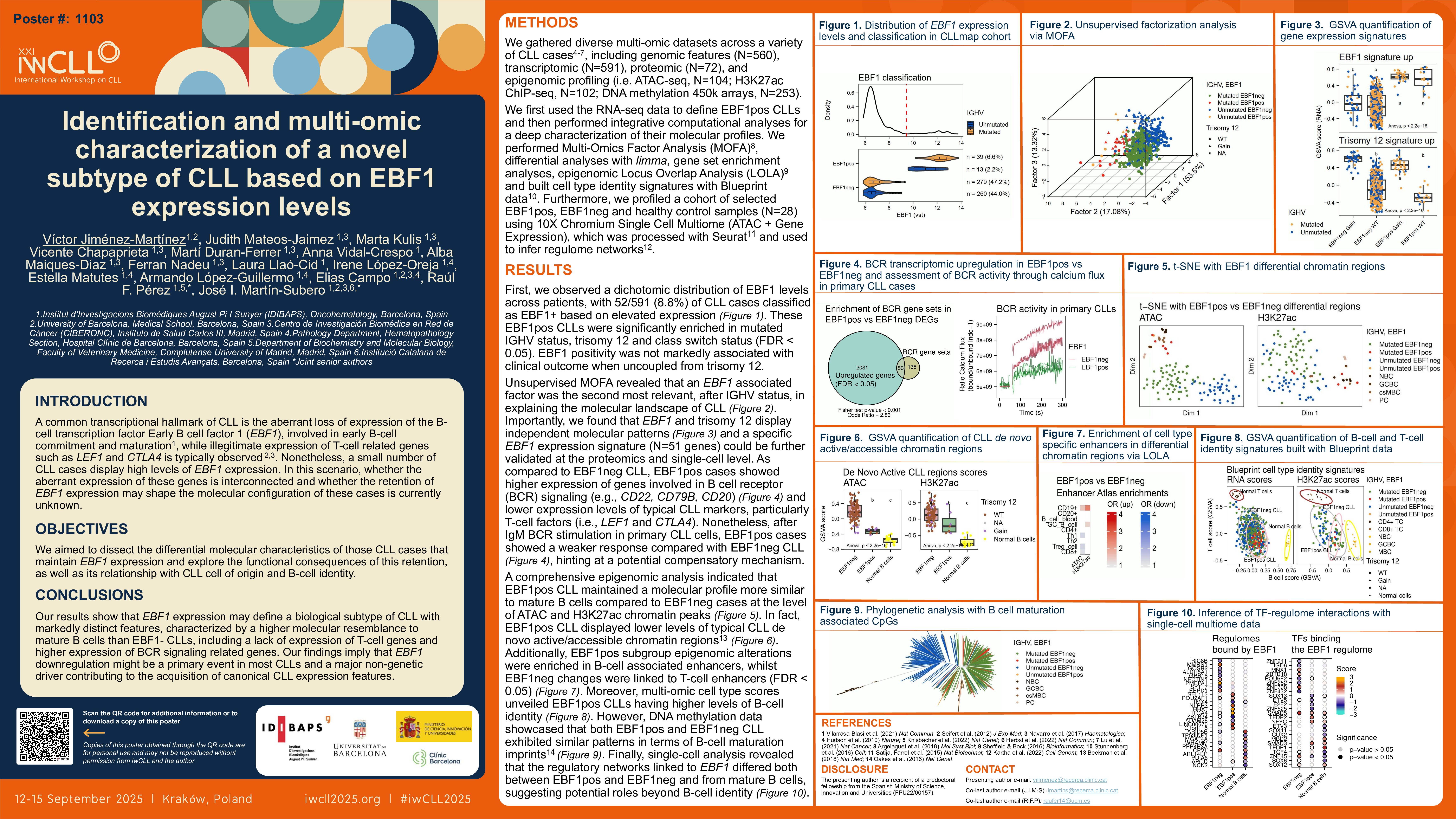
First, we observed a dichotomic distribution of EBF1 levels across patients, with 52/591 (8.8%) of CLL cases classified as EBF1+ based on elevated expression. These EBF1+ CLLs were significantly enriched in mutated IGHV status, trisomy 12 and class switch status (FDR < 0.05). EBF1 positivity did not show strong links to clinical outcome, although its simultaneous presence with trisomy 12 was associated with worse overall survival.
Unsupervised MOFA revealed that an EBF1-associated factor was the second most relevant, after IGHV status, in explaining the molecular landscape of CLL. Importantly, this integration revealed that EBF1 and trisomy 12 display independent molecular patterns. We defined a specific EBF1 expression signature (N=51 genes), which was further validated at the proteomics level. As compared to EBF1- CLL, EBF1+ cases showed higher expression of genes involved in B cell receptor (BCR) signaling (e.g., CD22, CD79B, CD20) and lower expression levels of typical CLL markers, particularly T-cell factors (i.e., LEF1 and CTLA4). The EBF1 signature could also be detected at the single-cell level, and we also observed gradients of the EBF1 program within CLL cases.
A comprehensive epigenomic analysis indicated that EBF1+ CLL maintained a molecular profile more similar to mature B cells compared to EBF1- cases. First, differential ATAC and H3K27ac chromatin peaks grouped EBF1+ CLLs closer to mature B cell samples. In fact, EBF1+ CLL displayed lower levels of typical CLL de novo active/accessible chromatin regions (p-value < 0.05). Secondly, in the EBF1+ subgroup epigenomic alterations were enriched in B-cell associated enhancers, whilst EBF1- changes were linked to T-cell enhancers (FDR < 0.05). The quantification of accessibility in the single-cell data also revealed a closer epigenetic profile between EBF1+ and normal B cells. However, harnessing the DNA methylation data to explore divergences in cell of origin showcased that both EBF1+ and EBF1- CLL exhibited similar patterns in terms of B-cell maturation imprints.
Conclusion
Our results show that EBF1 expression may define a biological subtype of CLL with markedly distinct features, characterized by a higher molecular resemblance to mature B cells than EBF1- CLLs, including a lack of expression of T-cell genes and higher expression of BCR signaling related genes. Our findings imply that EBF1 downregulation might be a primary event in most CLLs and a major non-genetic driver contributing to the acquisition of canonical CLL expression features. Given their markedly different molecular features, further studies are required to determine whether EBF1+ and EBF1- CLLs are associated with specific therapeutic vulnerabilities.
Keywords : EBF1, multi-omic profiling, B-cell identity
Please indicate how this research was funded. : The single-cell data generation and analysis was supported by BCLLATLAS with funding from the European Research Council (ERC) under the European Union’s Horizon 2020 Research and Innovation Programme (grant agreement no 810287 to J.I.M.-S., E.C.).
The presenting author is a recipient of a predoctoral fellowship from the Spanish Ministry of Science, Innovation and Universities (FPU22/00157).
Please indicate the name of the funding organization.: European Research Council (ERC); Spanish Ministry of Science, Innovation and Universties