
Authors
Yotam Bronstein, Shlomo Tsuriel, Shai Levi, Tamir Lotan, Yamit Shorer Arbel, Liron Yitzhak, Lior Rokach, Yair Herishanu.
Background
The immunoglobulin heavy-chain variable region (IGHV) gene status is a key biomarker in chronic lymphocytic leukemia (CLL), with mutated IGHV (M-IGHV) generally indicating a more indolent course than unmutated IGHV (UM-IGHV). In addition to mutational status, 30–40% of CLL cases in international cohorts can be classified into stereotyped subsets based on similarities in IGHV gene sequences. These subsets—particularly #1, #2, and #4—are associated with specific IGHV genes and distinct clinical features. However, data on IGHV usage and subset distribution among Israeli CLL patients remain limited.
Aims
To characterize the IGHV gene repertoire and prevalence of B-cell receptor (BcR) stereotyped subsets in an Israeli CLL cohort, and compare findings with global data.
Methods
This single-center retrospective study included all CLL patients with known IGHV mutational and subset status performed at Tel Aviv Sourasky Medical Center (TASMC) between 2020 and 2025. All IGHV sequencing was performed via next-generation sequencing (NGS) in an ERIC-accredited laboratory. Sequences with ≥98% germline homology were defined as UM-IGHV; those with < 98% as M-IGHV. Stereotyped subset assignment was performed using the ARResT/AssignSubsets platform. Data analysis was conducted using SPSS v29.
Results
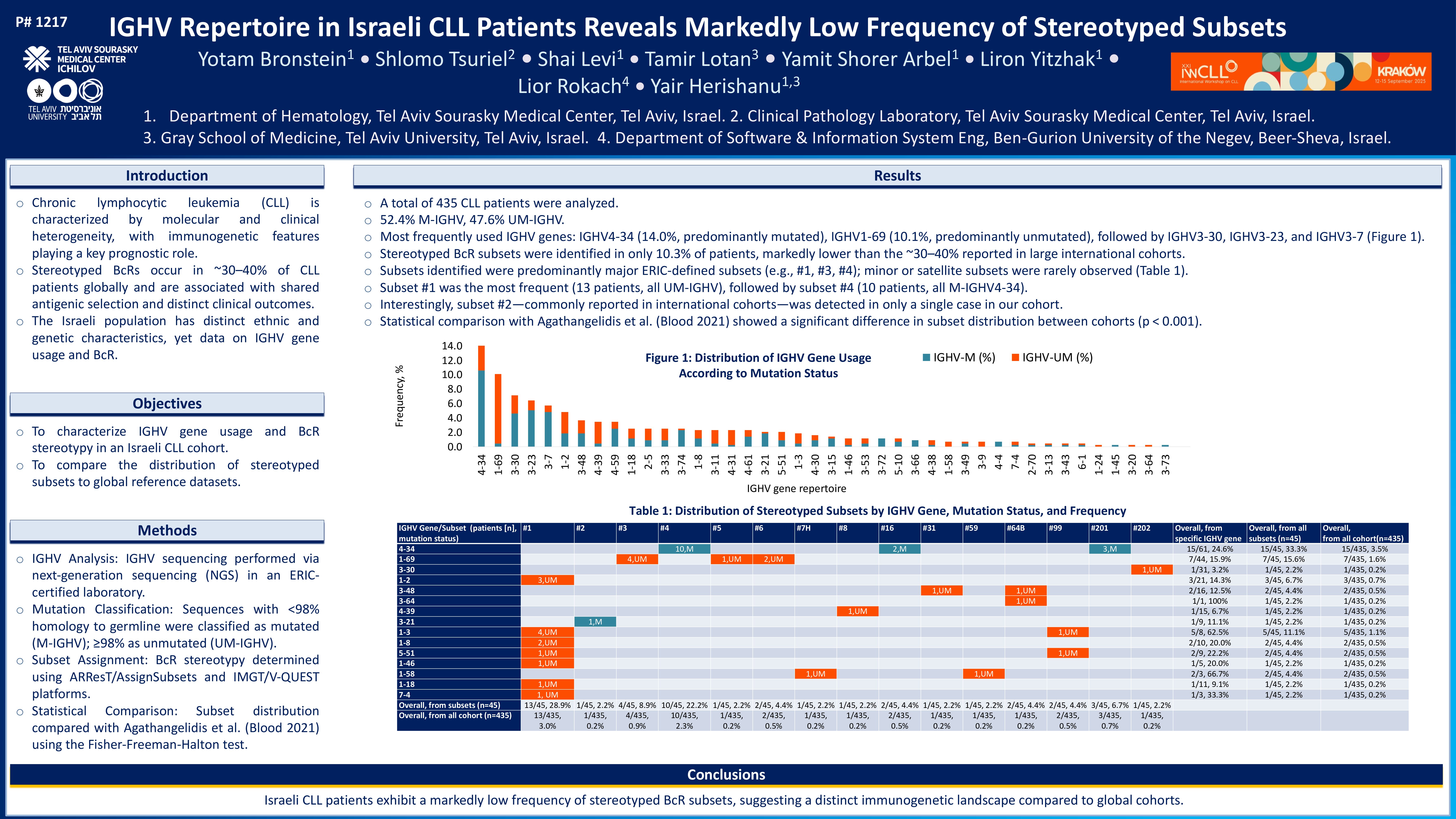
A total of 375 CLL patients included, 193 (51.5%) were M-IGHV and 182 (48.5%) were UM-IGHV. IGHV4-34 was the most common gene (54 patients, 14.4%), with a predominance of mutated cases (41 M vs.13 UM). IGHV1-69 was the second most frequent (43 patients, 11.5%), predominantly unmutated (41 UM vs. 2 M). Other frequently used genes included IGHV3-23 (6.4%), IGHV3-7 (6.1%), IGHV3-30 (5.6%), and IGHV1-2 (4.5%).
Stereotyped BcR subsets were identified in 36 patients (9.6%), of whom 21 (58.3%) were UM-IGHV. The most prevalent subsets were #4 (n=9; all M-IGHV4-34) and #1 (n=7; all UM). Subsets #201 and #3 were each detected in three patients; #201 cases were all M-IGHV, while #3 cases were UM-IGHV. Subsets #16 (M), #6 (UM), and #99 (UM) were each found in two patients. Eight additional subsets were found in single cases, including #2 (M), and #5, #8, #31, #59, #64B, #7H, and #202 (all UM). Among IGHV4-34 carriers, 14/54 (25.9%) were assigned to subsets (mainly #4 and #201). Among IGHV1-69 carriers, 6/41 (14.6%) were assigned (mainly #3 and #6). Other IGHV genes showed minimal subset clustering.
Compared to the large multinational cohort reported by Agathangelidis et al. (Blood, 2021), in which 41% of patients were classified into stereotyped subsets and major subsets comprised 13.5%, our cohort showed a markedly lower overall prevalence (9.6%) and reduced representation of major subsets. IGHV1-69 was the most common gene in the international dataset and displayed extensive connectivity to subsets #1, #3, #5, and #6. While IGHV1-69 also appeared frequently in our cohort, only a minority of cases (14.6%) were subset-assigned. Conversely, IGHV4-34, though less common globally, was frequently used in our cohort and maintained a strong association with subset #4; Despite comparable IGHV usage patterns, the subset distribution was considerably sparser than in international datasets, particularly for commonly stereotyped IGHV genes such as IGHV3-23, IGHV3-30, and IGHV3-7.
Conclusion
The prevalence of stereotyped BcR subsets in Israeli CLL patients was significantly lower than in global series (~10% vs. ~30–41%). This divergence may reflect underlying population-specific genetic factors, including the diverse IGHV haplotype composition among Jewish ethnic subgroups. Environmental or antigenic exposures may also contribute, potentially altering B-cell repertoire dynamics. While standardized tools were used, underrepresentation of rare or uncharacterized subsets may further account for the reduced detection rate. These findings underscore the importance of population-specific immunogenetic profiling and highlight the limitations of applying universal prognostic models to genetically diverse populations. Future studies should focus on high-resolution immunogenetic mapping and outcome correlations to define the clinical relevance of stereotypy in Israeli and other underrepresented cohorts.
Keywords : CLL, IGHV, Israeli patients
Please indicate how this research was funded. : This study did not receive any external funding.
Please indicate the name of the funding organization.: N/A