
Authors
Uday Aditya Sarkar, Dylan Tabang, Colin McNulty, Sabine Allam, Ayazhan Umutbayeva, Stacey Fernandes, Mariia Mikhaleva, Roberta Santos Azevedo, Zainab Wurie, Ava Bidgoli, Natalie O. Onofri, Joseph Flinn, Kiyomi Mashima, Ingrid Lourme, Elisavet Vlachonikola, Binu K. Sasi, Paulina Predko, Andreas Agathangelidis, Kenneth Parker, Kostas Stamatopoulos, Irene Ghobrial, Jennifer R. Brown, Hanno Steen, Paolo Ghia.
Background
Chronic Lymphocytic Leukemia (CLL) is the most frequent leukemia in adults and is typically preceded by a pre-malignant condition called Monoclonal B cell Lymphocytosis (MBL), which is detected in up to 10% of otherwise healthy individuals. Monoclonal gammopathy of undetermined significance (MGUS) of the IgM isotype is also a common pre-neoplastic condition concerning healthy individuals, also requiring regular clinical follow-up. MGUS can be detected before, after or simultaneously with a MBL/CLL diagnosis. Using innovative Ig proteomics methods in our study, we aimed at exploring whether the clonal CLL B cells could be responsible for the production of the serum IgM monoclonal component (MC), thus being directly responsible for the development of IgM MGUS, or if the latter should be considered a manifestation of another concomitant disease, given the increased risk of other neoplasias in patients with MBL/CLL.
Methods
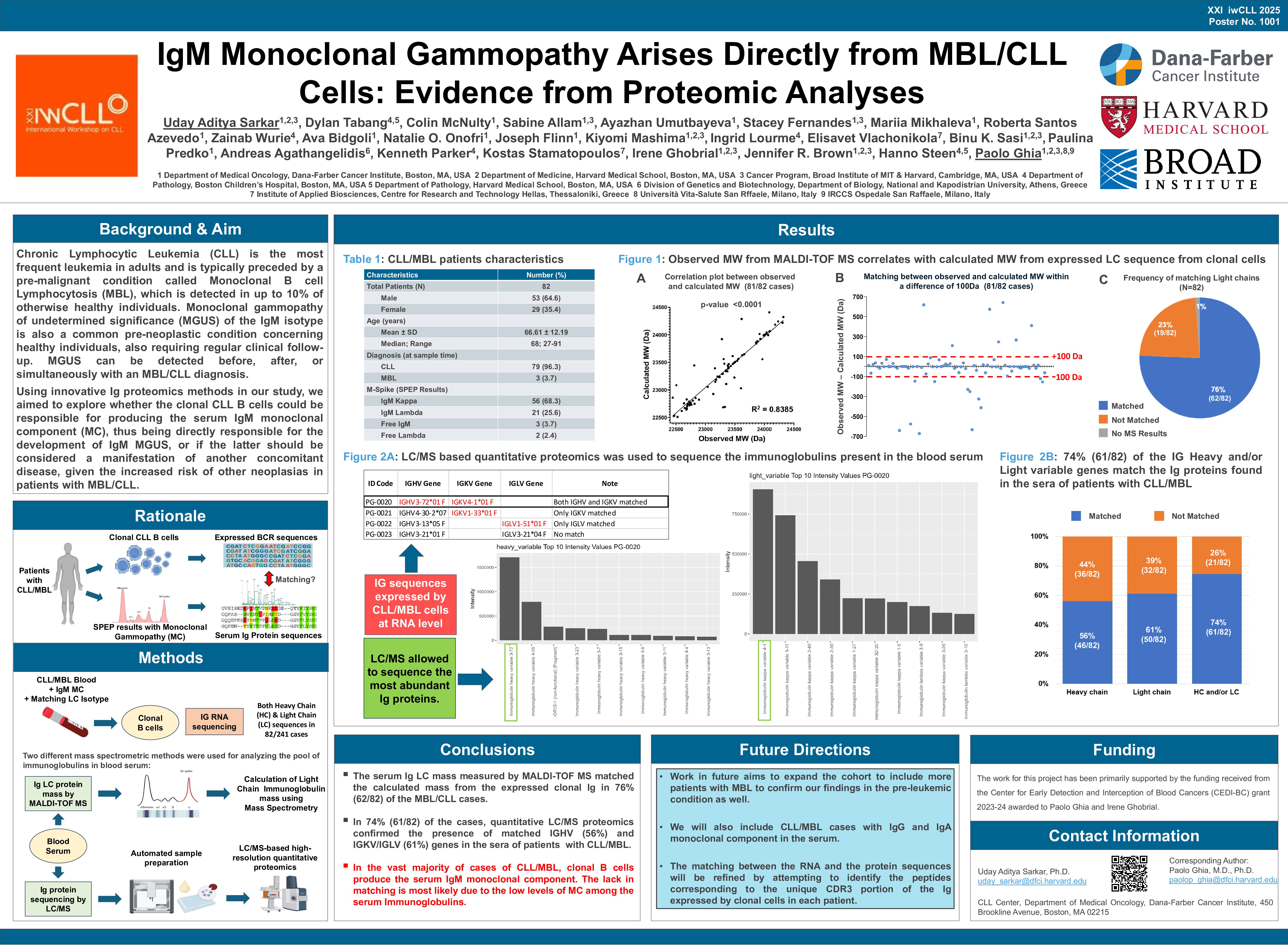
A series of 263 patients diagnosed with either MBL (91) or CLL (172), of whom 97 also had a circulating IgM monoclonal component, were analyzed for the expression of clonal Immunoglobulin heavy and light chains (Ig HC and LC, respectively). As a first step, RNA was isolated from the monoclonal B cells, those obtained from peripheral blood of patients and cryopreserved in the dedicated Dana-Farber Cancer Institute (DFCI) biobank. Using synthesized cDNA, PCR amplification was performed with specific IG gene primers, followed by bidirectional Sanger sequencing. Furthermore, sera from the same patients were analyzed with two different proteomic techniques: (i) Matrix-Assisted Laser Desorption/Ionization Time-of-Flight (MALDI-TOF) mass spectrometry (MS) to achieve a precise quantification of the LC’s mass-to-charge ratio (m/z), allowing the validation of Ig molecular mass results calculated from Sanger sequences; and, (ii) high resolution quantitative proteomic sequencing using an EvoSep One Liquid Chromatography system coupled to a timsTOF Pro 2 mass spectrometer (Bruker) to identify the most abundant serum proteins and compare the obtained protein Ig HC and LC sequences against the respective Sanger sequences in each individual patient.
Results
In a cohort of 3127 patients (followed up at DFCI) with serum protein electrophoresis (SPEP) results, 658 (21%) cases presented with a serum MC (either IgM, IgG or IgA). For this study, we selected 263 patients, including 97 cases with IgM MC (85 CLL and 12 MBL), for the thorough characterization of the paraprotein.
First, we compared the data from the Ig LC expressed by the leukemic cells, as obtained by Sanger sequencing and flow cytometry with the SPEP and MALDI-TOF MS data for the LC associated with the serum monoclonal protein. Interestingly, the serum Ig LC mass measured by MALDI-TOF MS matched the calculated mass from the expressed clonal Ig in 65% (51/78) of the MBL/CLL cases. We then utilized the high-resolution quantitative MS technique, which allows for the exact identification of the variable domain of the Ig HC and/or LC. Comparisons led to the identification of a high level of identity between the serum Ig protein sequences and the Ig expressed by the leukemic cells in a total of 64/89 cases (72%). In particular, we were able to identify a match for the HC and LC variable domains in 47/89 (53%) and 52/85 cases (61%), respectively. No match was identified in the remaining cases, due to low levels of the circulating paraprotein and/or the lack of MS results not being able to identify a discrete abundant protein. These unmatched cases are being studied in detail and are subject to further evaluation with more sensitive approaches in order to get definitive results that will be presented.
Conclusions
For the first time, to the best of our knowledge, we here provide robust evidence that, in the majority (~3 out of 4) of MBL/CLL cases with a concomitant IgM paraprotein, the clonal B cells are responsible for the production and release of the circulating IgM MC. This subset of IgM-producing cases closely resembles what occurs in lymphoplasmacytic lymphoma/Waldenström disease and raises a number of questions on the biological and immunological nature of the cells underlying the Ig production. In particular, these data could suggest a different path of B cell maturation and transformation in a significant fraction of CLL/MBL that warrants further research.
Keywords : Leukemia, Monoclonal Gammopathy, Immunoglobulins
Please indicate how this research was funded. : The work for this project has been primarily supported by the funding received from the Center for Early Detection and Interception of Blood Cancers (CEDI-BC) grant 2023-24 awarded to Paolo Ghia and Irene Ghobrial.
Please indicate the name of the funding organization.: Center for Early Detection and Interception of Blood Cancers (CEDI-BC) grant 2023-24, Dana-Farber Cancer Institute