Authors
John F Seymour, Peter Haggert, Catherine Moura, Vandana Gupta, Dr Tetiana Perekhrestenko, Comfort Maluleke, Bahija Gouimi, Yasmine Hassan, Paulo Andre Palhares de Miranda.
Background
In 2024 we convened a group of healthcare professionals (HCPs) and patient advocacy groups (PAGs) with expert knowledge in CLL to identify unmet needs for people living with the disease. We developed a charter summarising the key principles people living with CLL expect from their care experience. It comprises six principles surrounding improving diagnosis, information provision, shared decision-making (SDM), access to care, psychosocial support, and survivorship models. These needs are particularly pronounced in resource-limited countries (RLCs) (CLLAN 2023), where the disease burden is increasing (AU Rehman 2024).
Aims
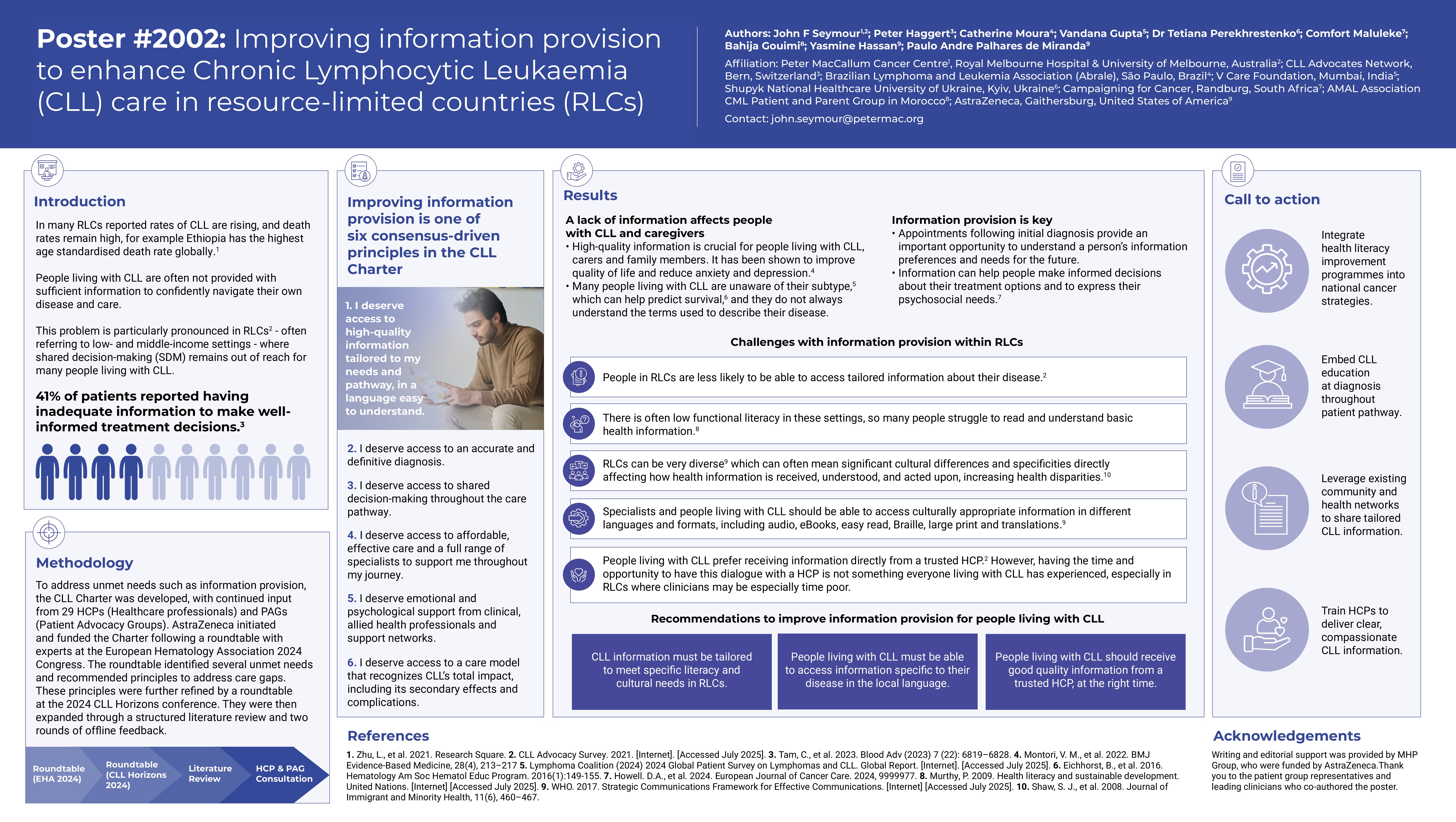
We outline recommendations to improve information provision for people living with CLL, particularly in RLCs. We propose that improving information provision is increasingly important as SDM becomes the norm in clinical practice (VM Montori 2022). This is especially true in CLL, a disease involving complex care and treatment decisions (EC Kranzler 2021). Yet, a global survey found that 41% of patients reported having inadequate information to make well-informed treatment decisions (C Tam 2023).
Methods
The charter’s development was iterative, with input from 29 HCPs and PAGs. AstraZeneca initiated and funded the charter following a roundtable with experts at the European Hematology Association 2024 Congress. The roundtable identified several unmet needs and recommended principles to address care gaps. These principles were further refined by a roundtable at the 2024 CLL Horizons conference. They were expanded through a structured literature review and two rounds of offline feedback.
Results
Information provision is poor for people living with CLL in RLCs (CLLAN 2023). People living with CLL cannot be expected to make important care and treatment decisions without having access to adequate information about their disease.
Ensuring increased participation in SDM in RLCs is essential. Research shows that the process can lead to significant patient benefits, cost savings and better resource allocation through improved health outcomes (VM Montori 2022). Therefore, improving information provision is also a cost-effective measure that RLCs should prioritise while navigating an increasingly challenging fiscal environment (E Warner 2025).
Below are some recommendations from the CLL charter to improve information provision for people living with CLL:
People living with CLL must be able to access information specific to their disease in the local language. CLL is a complex disease, and people living with CLL often have different needs from those with other types of cancer. These needs include deciding whether to undergo active surveillance (Blood cancer UK) and dealing with the impact of frequent infections due to being immunocompromised (International COVID-19 Blood Cancer Coalition). However, research shows that people living with CLL in RLCs are less likely to be able to access tailored information about their disease (CLLAN 2023).
CLL information must be tailored to meet specific literacy and cultural needs in RLCs. There is often low functional literacy in these settings, so many people can struggle to read and understand basic health information (P Murthy 2009). These countries are very diverse (E Gören 2013), which can often mean significant cultural differences and specificities directly affecting how health information is received, understood, and acted upon (SJ Shaw 2009). Tailoring information to different literary and cultural needs can help ensure more inclusive communication (US Centers for Disease Control and Prevention 2024), promoting trust and increasing engagement (World Health Organization 2017). Efforts should also be made to improve literacy and health literacy levels.
Ensure that people living with CLL receive information directly from their HCP at an appropriate time. Who delivers the information and when also matters. A global survey showed that people living with CLL prefer receiving information directly from their HCP when they are not in a state of shock (C Tam 2023 ; D Howell 2024). However, not everyone living with CLL has the opportunity to have this dialogue (D Howell 2024).
Conclusion
We, as HCPs and PAGs from across the globe, have developed a charter that outlines six principles to improve care for people living with CLL worldwide. Ensuring people living with CLL can access high-quality information about their disease, tailored to their needs and care pathway, is a valued starting point for delivering meaningful care improvements.
Keywords : CLL, Charter, education
Please indicate how this research was funded. : AstraZeneca initiated and funded the charter following a roundtable with experts at the European Hematology Association 2024 Congress. This abstract was organised and funded by AstraZeneca.
Please indicate the name of the funding organization.: AstraZeneca