
Authors
Amagoia Ruiz Martin, Cristina Bilbao Sieyro, Ruth Stuckey, Yanira Florido Ortega, Laura Navarrete Bullón, Daniel Mederos Hernández, Haridiandela Nuez Melian, Hugo Daniel Luzardo Henríque, Sandra Iraheta Reyes, Maria Angelina Lemes, Dolly Fiallo Suarez, Miguel Ángel Perera, Maria Teresa Goméz Casares, Alexia Suarez Cabrera.
Introduction
Chronic lymphocytic leukemia (CLL) is the most frequent leukemia in adults, marked by significant clinical heterogeneity. Most patients are diagnosed in early, asymptomatic stages, where the standard approach is active surveillance until disease progression warrants treatment. In this context, time to first treatment (TTFT) is a key parameter for assessing disease evolution.
Various clinical and biological factors have been previously identified and associated with a shorter TTFT. These factors include components of the IPS-E prognostic scale, such as lymphocytosis, the presence of adenopathy’s, and the IGHV mutational status. Other established risk factors are elevated beta-2 microglobulin levels, advanced disease stages according to the Rai classification I-IV and Binet classification B-C, and age over 65 years. Furthermore, the advent of Next-Generation Sequencing (NGS) has facilitated the identification of specific genetic alterations with established prognostic value. Studies, including those proposed by Mansouri et al. (Leukemia, 2023), have correlated these genetic alterations with a decrease in TTFT. Given this background, the primary objective of the study described in the sources was to identify the most frequent clinical variables and genetic alterations that influence TTFT, aiming to deepen the understanding of their prognostic value.
Methods
The study was designed as a multicenter, retrospective, and observational analysis. It involved the analysis of clinical and genomic data from patients diagnosed with CLL between 2009 and 2024. The data were collected from two hospitals in Spain: Hospital Universitario de Gran Canaria Dr. Negrín and Hospital Universitario de Canarias (Tenerife). Inclusion criteria stipulated that all patients included must not have required initial treatment at the time of diagnosis, adhering strictly to the criteria defined by the International Workshop on Chronic Lymphocytic Leukemia (IWGCLL).
Genetic testing was performed at diagnosis using NGS with the SOPHiA Genetics v3 panel for CLL, restricted to pathogenic or likely pathogenic variants with a Variant Allele Frequency (VAF) ≥10%. Statistical analysis included univariate chi-square tests and multivariate Cox regression. Variables with p ≤ 0.2 in univariate analysis were included in the multivariate models. Survival curves were generated using Kaplan-Meier and compared with the Log-rank test.
Results
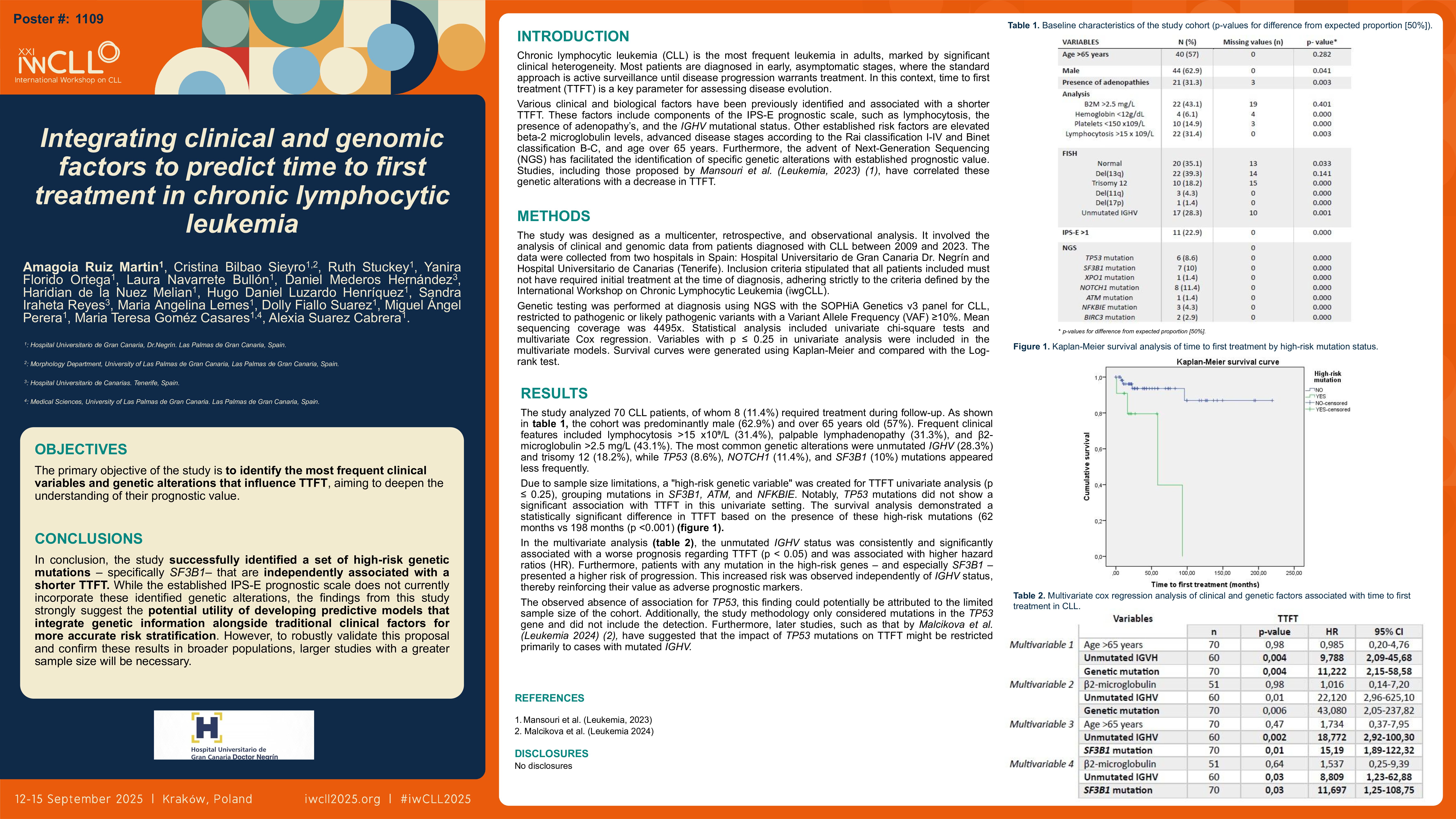
The study analyzed 70 CLL patients, of whom 8 (11.4%) required treatment during follow-up. The cohort was predominantly male (62.9%) and over 65 years old (57%). Frequent clinical features included lymphocytosis >15 x10⁹/L (31.4%), palpable lymphadenopathy (31.3%), and β2-microglobulin >2.5 mg/L (43.1%). The most common genetic alterations were unmutated IGHV (28.3%) and trisomy 12 (18.2%), while TP53 (8.6%), NOTCH1 (11.4%), and SF3B1 (10%) mutations appeared less frequently.
Due to sample size limitations, a “high-risk genetic variable” was created for TTFT univariate analysis (p ≤ 0.25), grouping mutations in SF3B1, ATM, and NFKBIE. Notably, TP53 mutations did not show a significant association with TTFT in this univariate setting. The survival analysis demonstrated a statistically significant difference in TTFT based on the presence of these high-risk mutations(62 months vs 198 months (p < 0.001).
In the multivariate analysis, the unmutated IGHV status was consistently and significantly associated with a worse prognosis regarding TTFT (p < 0.05) and was associated with high hazard ratios (HR). Furthermore, patients with any mutation in the high-risk genes – and especially SF3B1 – presented a higher risk of progression. This increased risk was observed independently of IGHV status, thereby reinforcing their value as adverse prognostic markers.
The observed absence of association for TP53, this finding could potentially be attributed to the limited sample size of the cohort7. Additionally, the study methodology only considered mutations in the TP53 gene and did not include the detection. Furthermore, later studies, such as that by Malcikova et al. (Leukemia 2024), have suggested that the impact of TP53 mutations on TTFT might be restricted primarily to cases with mutated IGHV.
Conclusions
In conclusion, the study successfully identified a set of high-risk genetic mutations – specifically SF3B1– that are independently associated with a shorter TTFT. While the established IPS-E prognostic scale does not currently incorporate these identified genetic alterations, the findings from this study strongly suggest the potential utility of developing predictive models that integrate genetic information alongside traditional clinical factors for more accurate risk stratification8. However, to robustly validate this proposal and confirm these results in broader populations, larger studies with a greater sample size will be necessary.
Keywords : Leukemia, time to first treatment, high-risk genes
Please indicate how this research was funded. : No found
Please indicate the name of the funding organization.: No found