
Authors
Jiatian Li, Jodie Hay, Karen Dunn, Martin Bushell, Alison M Michie
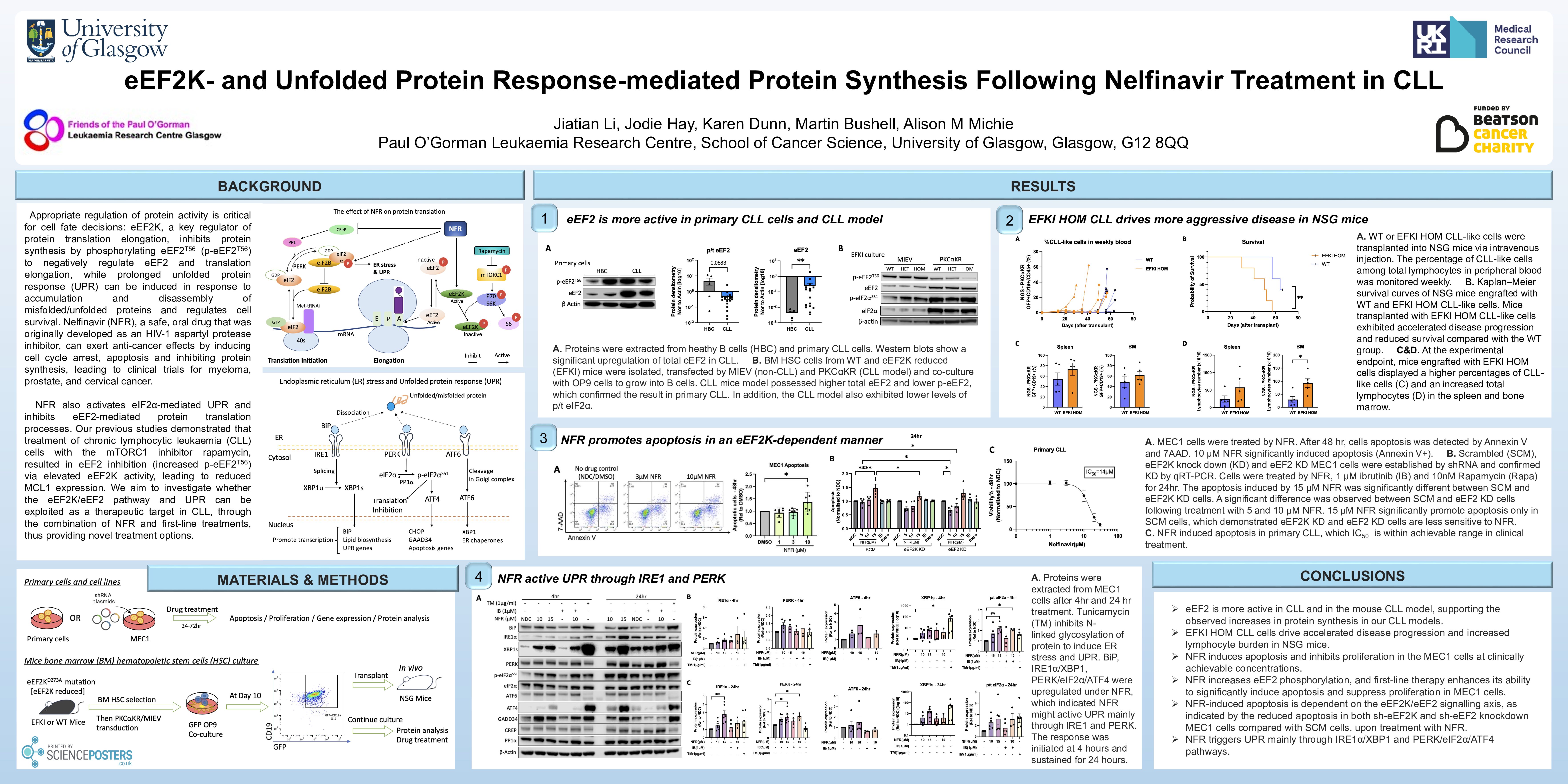
Appropriate regulation of protein synthesis is critical for cell fate decisions: eEF2K regulates cell survival through its phosphorylation of eEF2 T56 (p-eEF2 T56) to negatively regulate eEF2 and subsequently reduce translation elongation. Nelfinavir (NFR), a safe, oral drug that was originally developed as an HIV-1 aspartyl protease inhibitor, can exert anti-cancer effects by inducing cell cycle arrest, apoptosis and inhibiting protein synthesis. This has resulted in the inclusion of NFR in clinical trials for myeloma, prostate, and cervical cancer. NFR can also activate eEF2K, leading to an inhibition of eEF2-mediated protein translation. Our previous studies demonstrated that treatment of chronic lymphocytic leukaemia (CLL) cells with the mTORC1 inhibitor rapamycin, resulted in eEF2 inhibition (increased p-eEF2 T56) via elevated eEF2K activity, leading to reduced MCL1 expression. We aim to investigate whether the eEF2K/eEF2 pathway can be exploited as a therapeutic target in CLL, through the combination of NFR with first-line CLL treatments, thus providing novel treatment options.
We first stratified CLL patient samples for the expression/activation status of eEF2K/eEF2 and demonstrated that CLL samples exhibited higher total eEF2 protein expression and lower p-eEF2 T56 levels compared to healthy B cells. This indicates that CLL cells possess enhanced translation elongation activity. Generating shRNA-knockdown (KD) models in the CLL cell line MEC1, sh-eEF2K KD cells exhibited reduced p-eEF2 T56 levels and increased proliferation, suggesting that eEF2K inhibition promotes cell proliferation. In an in vitro CLL mouse model derived from wild type (WT) or eEF2K D273A/D273A (catalytically-reduced eEF2K; eEF2K-KI) bone marrow, we compared eEF2 activation status in control-B cells vs. WT-CLL model and WT-CLL vs. eEF2K-KI-CLL cells. The WT-CLL model, compared with control-B cells, and the eEF2K-KI-CLL, compared with WT-CLL, both showed lower p-eEF2 T56 levels compared with their respective controls, consistent with findings in primary CLL cells. Furthermore, analysis of proliferation in vitro using cell counts and cell trace violet assays demonstrated that eEF2K-KI-CLL cells proliferated faster than WT-CLL cells. Transplantation of WT-CLL or eEF2K-KI-CLL cells into immunodeficient (NSG) mice revealed that eEF2K-KI-CLL transplanted mice developed disease earlier in vivo and showed a significantly reduced survival compared to the WT-CLL transplanted mice. These data identify the eEF2K/eEF2 signalling axis as a potential target in CLL.
To address whether NFR has the ability to regulate the eEF2K/eEF2 signalling axis in our CLL models, cells were treated with clinically achievable doses of NFR. We noted that NFR promoted apoptosis in both MEC1 and primary CLL cells and increased p-eEF2T56 levels, suggesting that it activated eEF2K. Combining NFR with the BTK inhibitor ibrutinib enhanced the anti-proliferative activity of NFR in MEC1 cells. Of note, both sh-eEF2K- and sh-eEF2-MEC1 KD were found to be more resistant to NFR-mediated apoptosis and proliferation, indicating that each of these proteins plays a role in promoting NFR-sensitive cell fate decisions. In the WT-CLL mouse model, NFR significantly inhibited cell proliferation in vitro, while this trend was attenuated in eEF2K-KI-CLL cells, further strengthening the central role of eEF2K in the mechanism of action of NFR. In summary, our data demonstrate that NFR inhibits CLL cell proliferation and survival through the activation of eEF2K signaling, supporting the eEF2K/eEF2 axis as a potential therapeutic target and highlighting NFR as a novel treatment for CLL.
Keywords : translation elongation
eEF2K/eEF2
nelfinavir
Please indicate how this research was funded. :
Please indicate the name of the funding organization.: Beatson Cancer Charity