
Authors
Joanna Kamaso, Silvia Ramos-Campoy, Carme Melero, Marta Salido, Marta Lorenzo, María Rodríguez-Rivera, Lia Bonamici, Khyla Power, Anton Walter, Ana Ferrer, Eva Gimeno, Miguel Alcoceba, Miguel Bastos-Boente, Ángel Ramírez-Payer, Alicia Rodríguez Fernández, Ángel Serna, Pau Abrisqueta, Marta Crespo, Alba Cabirta, Raquel Santiago, Dolores García-Malo, Ana Carla Oliveira, Alicia Serrano, Blanca Ferrer, Miguel Perera, Alexia Suárez, Macarena Ortiz, Rosa Collado, Rocío García-Serra, Ana Muntañola, Teresa Villalobos, Marta Julià, Sergio Ramos, Gemma Azaceta, Janilson do Nascimento, Rafael Andreu, Javier de la Serna, Eduardo Ríos, Miguel Ángel Rodríguez, Ainara Ferrero, Ángeles Medina, Mª Victoria Calle, Christelle Ferrà, Francesc Bosch, Anna Puiggros, Blanca Espinet.
Introduction
Chromoanagenesis phenomena (CP), including chromothripsis (Cth), chromoplexy (Cpl), and chromoanasynthesis (Cas), are characterized by extensive chromosomal rearrangements arising from a single catastrophic event. CP has been identified in chronic lymphocytic leukemia, being Cth the most frequently reported. Although Cth incidence is low (1–3% in unselected cohorts), it has been associated with adverse prognostic factors, including TP53 alterations, high genomic complexity, and poor clinical outcomes. Conventional cytogenetic techniques routinely used in CLL, such as CBA and FISH, lack the resolution required to detect CP. Recently, optical genome mapping (OGM) has emerged as a powerful tool capable of providing a detailed overview of these complex genomic profiles. OGM can detect the copy number abnormalities (CNV) related to CP but also the related intra- and inter-chromosomal rearrangements. Finally, limited data is available regarding the mechanisms underlying CP, as well as their clinical impact in the current CLL therapeutic era.
Objective
To characterize chromoanagenesis phenomena in a cohort of CLL patients with TP53 alterations using OGM.
Patients and methods
We included 70 TP53 altered CLL patients (N=37 double hit TP53del+mut or TP53multiple mut and N=33 single hit TP53del or TP53mut) before receiving treatment with iBTK and/or iBCL2 (± anti-CD20) (May 2022-Dec 2024) from 24 Spanish hospitals. For OGM analysis, samples (25 peripheral blood and 45 PBMC) were processed using the Saphyr System and analyses were conducted using the Rare Variant Analysis pipeline from Bionano Access 1.8.2 (Bionano Genomics). Genomic Complexity (GC) by OGM was defined as ≥5 alterations, including those ≥5 Mb in size, and/or rearrangements, CLL-related abnormalities (irrespective of size), and smaller variants (200 Kb–5 Mb) associated with other events. As for chromoanagenesis phenomena, Cth was defined as ≥7 oscillating switches between two or three copy number states in one or a few chromosomes and associated rearrangements; Cpl as ≥4 chained rearrangements between at least 2 chromosomes accompanied or not with CNV at junctions; and Cas as presence of chromosomal duplications and triplications locally clustered on one single or few chromosomes, associated with various other types of structural rearrangements.
RESULTS
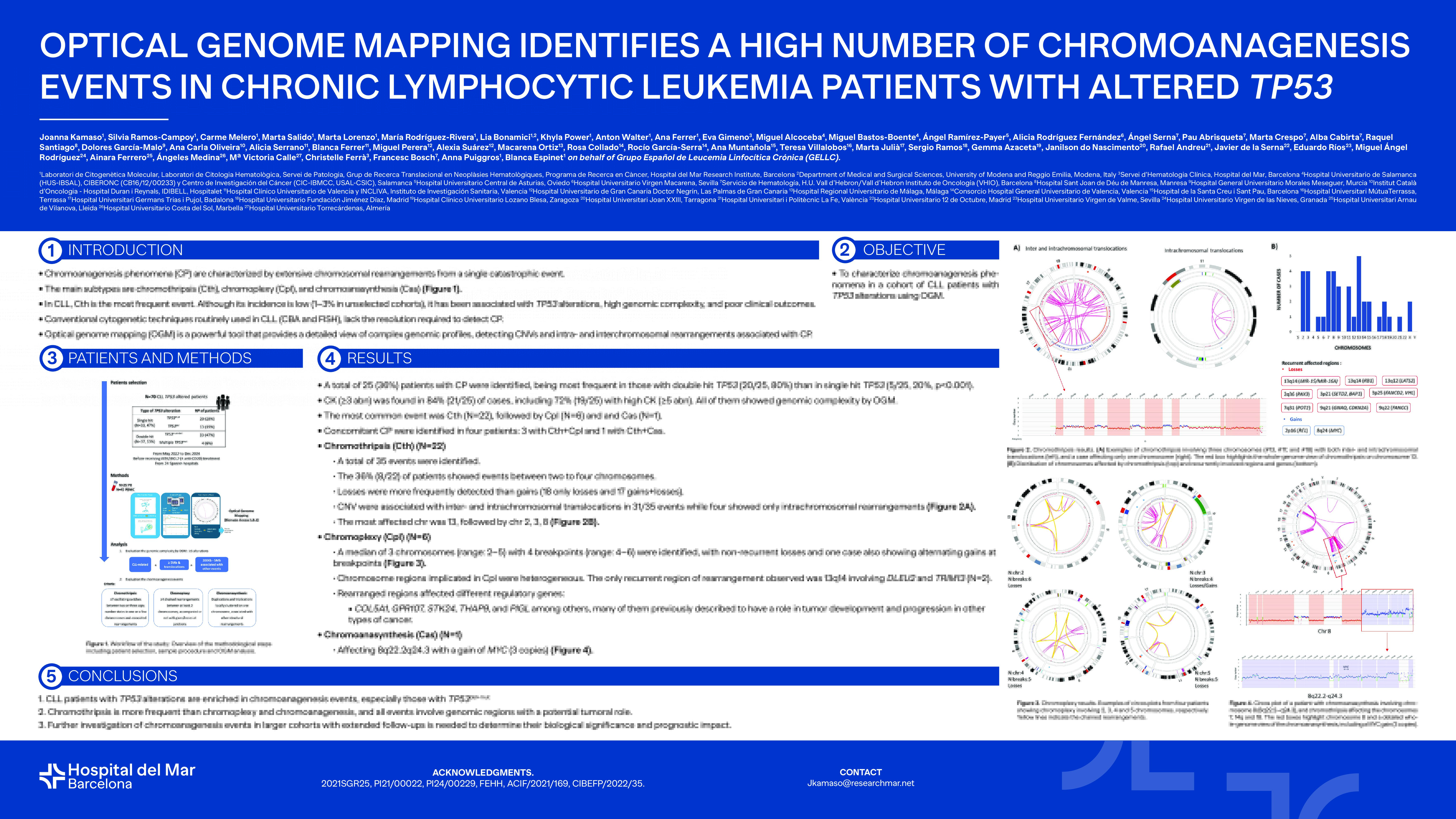
From the global cohort, OGM identified CP in 36% (25/70), being most frequently identified in patients with double hit TP53 (20/25, 80%) vs single hit TP53 (5/25, 20%, p< 0.001). Of them, 84% (21/25) showed a CK (≥3 abn). Cth was the most common event, detected in 22 patients. Cpl and Cas were observed in six and one patient, respectively. Concomitant CP were identified in four patients, showing Cth accompanied by Cpl (n=3) or Cas (n=1). Regarding Cth, a total of 35 events were identified, as 36% (8/22) of patients showed events in two to four chromosomes. As expected, losses were more frequently detected than gains (18 only losses and 17 gains+losses). CNV were associated with inter and intrachromosomal translocations in 31/35 events while four showed only intrachromosomal rearrangements. The most affected chromosome was the 13 (n=5) always showing loss of 13q14 (MIR-15/MIR-16A), and in four cases also involving (RB1) and in three cases 13q12 (LATS2). Other recurrent regions included gains at 2p16 (REL) and 8q24 (MYC), and losses at 2q36 (PAX3), 3p25 (FANCD2, VHL), 3p21 (SETD2, BAP1), 7q31 (POT1), 9q21 (GNAQ, CDKN2A), and 9q22 (FANCC). Concerning Cpl cases, the median number of chromosomes involved was 3 (range: 2-5), with a median of 4 breakpoints (range: 4-6). Chromosome regions implicated in Cpl were heterogeneous, being the only recurrent region of rearrangement 13q14, observed in two events, involving DLEU2 and TRIM13. Strikingly, rearranged regions affected different regulatory genes, including COL5A1, GPR107, STK24, THAP9, and PIGL among others, many of them previously described to have a role in tumor development and progression in other types of cancer. All Cpl events showed non-recurrent losses and one also displayed alternating gains at breakpoints. As for the only case with Cas, it was identified in chromosome 8 affecting 8q22.2q24.3 with a gain of MYC (3 copies).
Conclusions
(1)CLL patients with TP53 alterations are enriched in chromoanagenesis events, especially those with TP53del+mut;(2)Chromothripsis is more frequent than chromoplexy and chromoanagenesis, and all events involve genomic regions with a potential tumoral role;(3)Further investigation of chromoanagenesis events in larger cohorts with extended follow-ups is needed to determine their biological significance and prognostic impact.
ACKNOWLEDGMENTS. 2021SGR25, PI21/00022, PI24/00229, FEHH, ACIF/2021/169, CIBEFP/2022/35
Keywords : Chromoanagenesis, OGM, Genomic Complexity, TP53
Please indicate how this research was funded. :
Please indicate the name of the funding organization.: