
Authors
Sikander Ailawadhi, Swetha Challagulla, Dominic Pilon, Todor I Totev, Yan Meng, Lilian Diaz, Zhuo Chen, Keri Yang.
Background
Treatments for CLL differ in efficacy, safety, treatment duration and monitoring needs, all of which can impact overall treatment experience and outcomes. To better understand patient preferences for various treatment attributes, a comprehensive quantitative analysis was conducted.
Methods
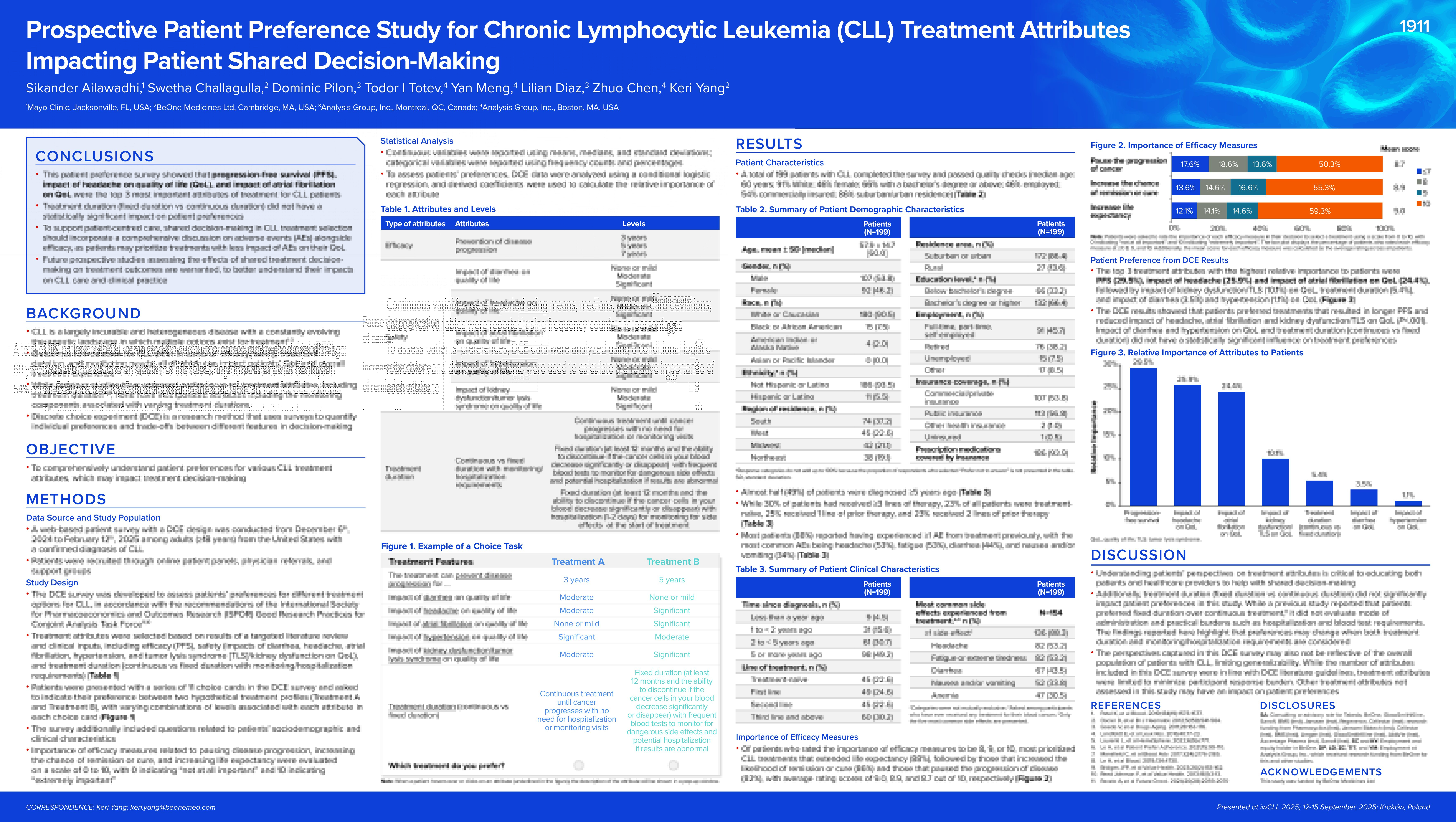
A patient survey with a discrete choice experiment (DCE) design was conducted from December 2024 to February 2025 among adults (≥18 years) from the United States with confirmed diagnosis of CLL, recruited through online patient panels, physician referrals, and support groups. Treatment attributes were selected based on results of a targeted literature review and clinical inputs. Patients responded to DCE questions on attributes related to efficacy (PFS), safety (impacts of diarrhea, headache, atrial fibrillation, hypertension and tumor lysis syndrome [TLS]/kidney dysfunction on quality of life [QoL]) and treatment convenience (treatment duration: continuous vs fixed duration with monitoring/hospitalization requirements). A conditional logistic regression model was used to calculate the relative importance of each attribute.
Results
A total of 199 patients with CLL completed the survey (median age: 60 years; 91% White; 46% female; 66% with a bachelor’s degree or above; 46% employed; 54% commercially insured; 86% suburban/urban residence; 49% diagnosed ≥ 5 years ago). While 30% of patients had received ≥3 lines of therapy, 23% of all patients were treatment-naïve, 25% received 1 line of prior therapy, and 23% received 2 lines of prior therapy. Most patients (88%) reported having experienced ≥1 AE from treatment previously, with the most common AEs being headache (53%), fatigue (53%), diarrhea (44%), and nausea and/or vomiting (34%). Based on DCE preference results, patients favored treatments with longer PFS and less impact of headache, atrial fibrillation and TLS/kidney dysfunction on QoL (P <.001). Impact of diarrhea and hypertension on QoL and treatment convenience did not have a statistically significant influence on treatment preferences. The top 3 treatment attributes with the highest relative importance to patients were PFS (30%), impact of headache on QoL (26%) and impact of atrial fibrillation on QoL (24%), followed by impact of TLS/kidney dysfunction (10%) on QoL, treatment convenience (5%), and impact of diarrhea (4%) and hypertension (1%) on QoL.
Conclusions
This patient preference survey showed that efficacy measured by PFS, the impact of headache, and impact of atrial fibrillation on QoL, were the most important attributes of treatment for patients with CLL. To support patient-centered care, shared decision-making in CLL treatment selection should incorporate a comprehensive discussion on AEs in addition to efficacy endpoints, as patients may prioritize treatments with less impact of AEs on their QoL. Future studies should assess the impact of shared decision-making on treatment adherence and outcomes.
Keywords : CLL, patient preference, impact of adverse events
Please indicate how this research was funded.: BeOne Medicines Ltd.
Please indicate the name of the funding organization. : BeOne Medicines Ltd.