
Author
Luomengjia Dai, Qian Wang, Ziyuan Zhou,Siqi Qian, Xiao Lu,Tonglu Qiu, Yi Miao, Shuchao Qin, Yi Xia, Lei Fan, Wei Xu, Juncheng Dai, Jianyong Li, Huayuan Zhu.
Aims
Metabolic reprogramming is a hallmark of cancer and may play a pivotal role in driving disease progression. However, large-scale studies focused on serum metabolite profiles across different stages of chronic lymphocytic leukemia/small lymphocytic lymphoma (CLL/SLL) remain scarce. Therefore, this study aims to employ untargeted metabolomics to depict the metabolic reprogramming landscape and explore differential metabolites associated with advanced disease and develop a model to distinguish asymptomatic and symptomatic CLL/SLL and further investigate their prognostic potential for predicting time to first treatment (TTFT).
Methods
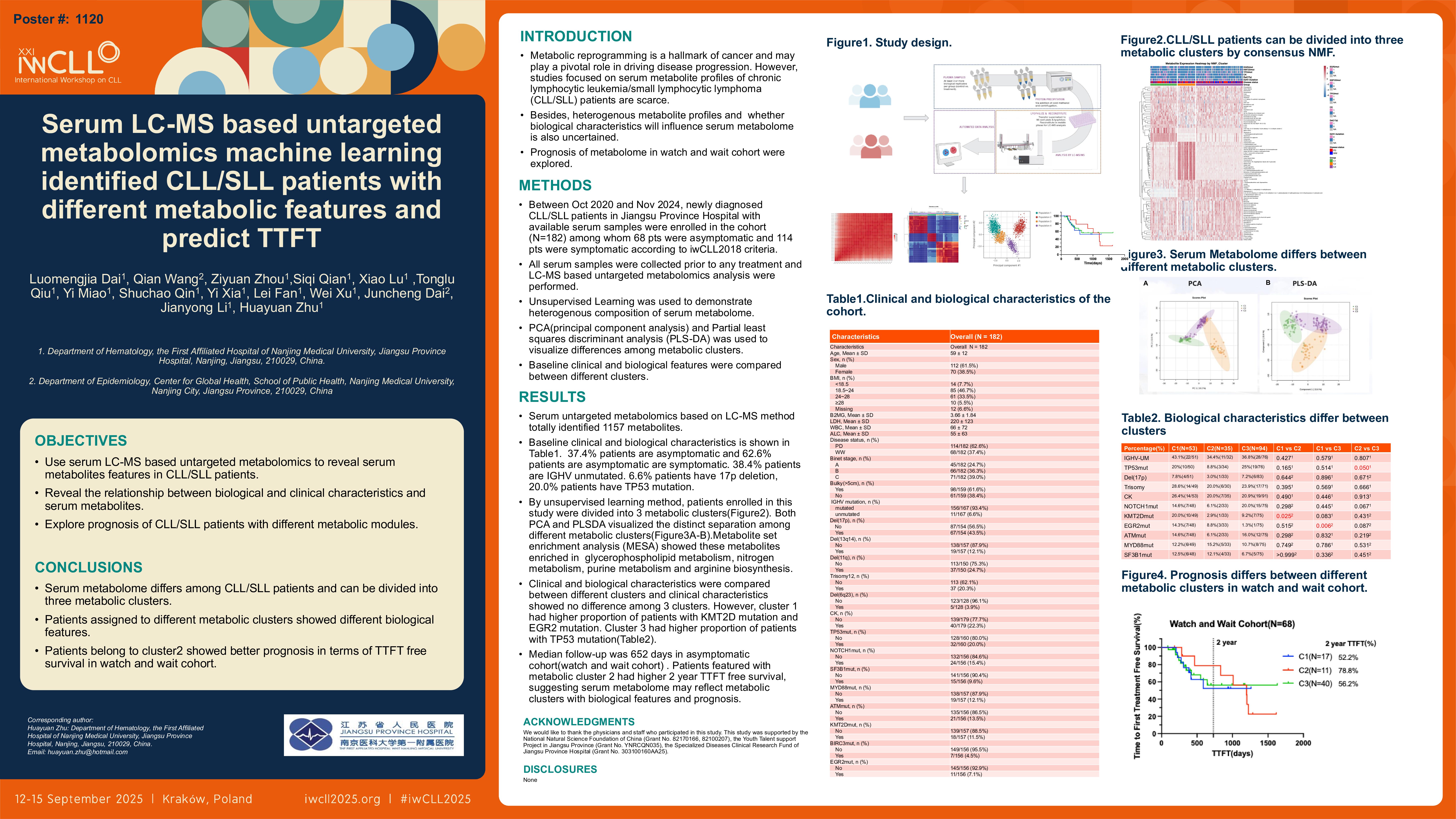
Between Oct 2020 and Nov 2024, patients newly diagnosed with CLL/SLL in Jiangsu Province Hospital with available serum samples were enrolled in the cohort (N=183) and were divided into asymptomatic group (N=70) and symptomatic group (N=113) according to iwCLL2018 criteria. All serum samples were collected prior to any treatment for LC-MS based untargeted metabolomics analysis. Baseline clinical and biologic characteristics of two groups were compared using Chi-square test or Fisher ‘s exact test. Orthogonal partial least squares discriminant analysis (OPLS-DA) was used to visualize metabolic differences between asymptomatic group and symptomatic group. Variable impact projection (VIP) values of metabolites were obtained from OPLS-DA model, and the fold changes (FC) and p-values of metabolites were obtained with MetaboAnalyst 6.0 based on the intensities of the spectrum. Initially, metabolites with VIP >1 , FC > 1.25 or < 0.8 and p-values < 0.05 were selected as differential metabolites. Differential metabolites enrichment analysis was conducted based on Kyoto Encyclopedia of Genes and Genomes (KEGG) database. A diagnostic model for distinguishing symptomatic from asymptomatic CLL/SLL patients was built using a random forest algorithm with LASSO feature selection. The participants were randomly stratified sampling into discovery dataset (n = 128) and test dataset (n = 55). The ROC curve was utilized to evaluate the performance of model. In asymptomatic group, we further used LASSO-Cox regression to predict time to first treatment.
Results
Baseline clinical and biological characteristics including age, BMI, del(17p), TP53 mutation, etc. were balanced between two groups except for higher proportion of male patients (67.26% vs 51.43%, p=0.033), elevated B2MG level (65.14% vs 13.24%, p< 0.001), IGHV unmutated status (82.35% vs. 51.38%, p< 0.001) and SF3B1 mutation (14.00% vs 1.82%, p=0.014) was found in symptomatic group. Serum untargeted metabolomics based on LC-MS totally identified 1157 metabolites. OPLS-DA model distinguished asymptomatic patients from symptomatic patients, indicating the metabolic remodeling in advanced stage. Hydrogen phosphate and Sphingosine 1-phosphate were top two ranked metabolites with highest VIP values and may play a key in disease progression. Then by screening with VIP >1 , FC > 1.25 or < 0.8 and p-values < 0.05, 51 metabolites were initially identified as differential metabolites and 37 metabolites were upregulated while 17 metabolites were downregulated in advanced stage. Further KEGG pathway analysis revealed significant dysregulation in pyrimidine metabolism and arginine biosynthesis between two groups. Hydrogen-phosphate, Riboflavine 2′,3′,4′,5′-tetrabutanoate, Sphingosine 1-phosphate, N-Undecanoylglycine, and beta-D-Glucopyranosyl-11-hydroxyjasmonic acid were incorporated to construct the 5-metabolite diagnostic model, the ROC-AUC is 0.93 (95% confidence interval (CI), 0.86-1.00, sensitivity: 0.90, specificity: 0.97) in test dataset. Among asymptomatic CLL/SLL patients, with a median follow-up of 385 days(range, 95 days-1632 days), totally 29 patients met the iwCLL2018 criteria for treatment initiation. Based on LASSO-Cox regression, an 11-metabolite signature dominated by amino acid (e.g. Threonine, Palmitoylglycine, Glutaminylproline, L-beta-aspartyl-L-leucine, ect.) and phospholipid (e.g. LysoPE, C24:1 Cer, ect.) derivatives further stratified asymptomatic patients into distinct progression risk groups.
Conclusion
Herein, we reported a large-scale study investigating serum metabolic profiles in different CLL/SLL stage and revealed metabolic reprograming in advanced disease and innovatively developed machine learning based diagnostic and prognosis models by serum metabolites combination.
Keywords : leukemia, biomarker, metabolic reprogramming
Please indicate how this research was funded. : This work was supported by the National Natural Science Foundation of China (Grant No. 82170166) , the Suqian Sci&Tech Program(Grant No.KY202305)and the Specialized Diseases Clinical Research Fund of Jiangsu Province Hospital (Grant No.DL202406).
Please indicate the name of the funding organization.: National Natural Science Foundation of China, Suqian Science and Technology Bureau, Jiangsu Province Hospital.