
Authors
Ziyuan Zhou, Luomengjia Dai, Siqi Qian, Xiao Lu, Ming Liu, Tonglu Qiu, Yi Miao, Shuchao Qin, Yi Xia, Lei Fan, Jianyong Li, Huayuan Zhu.
Aims
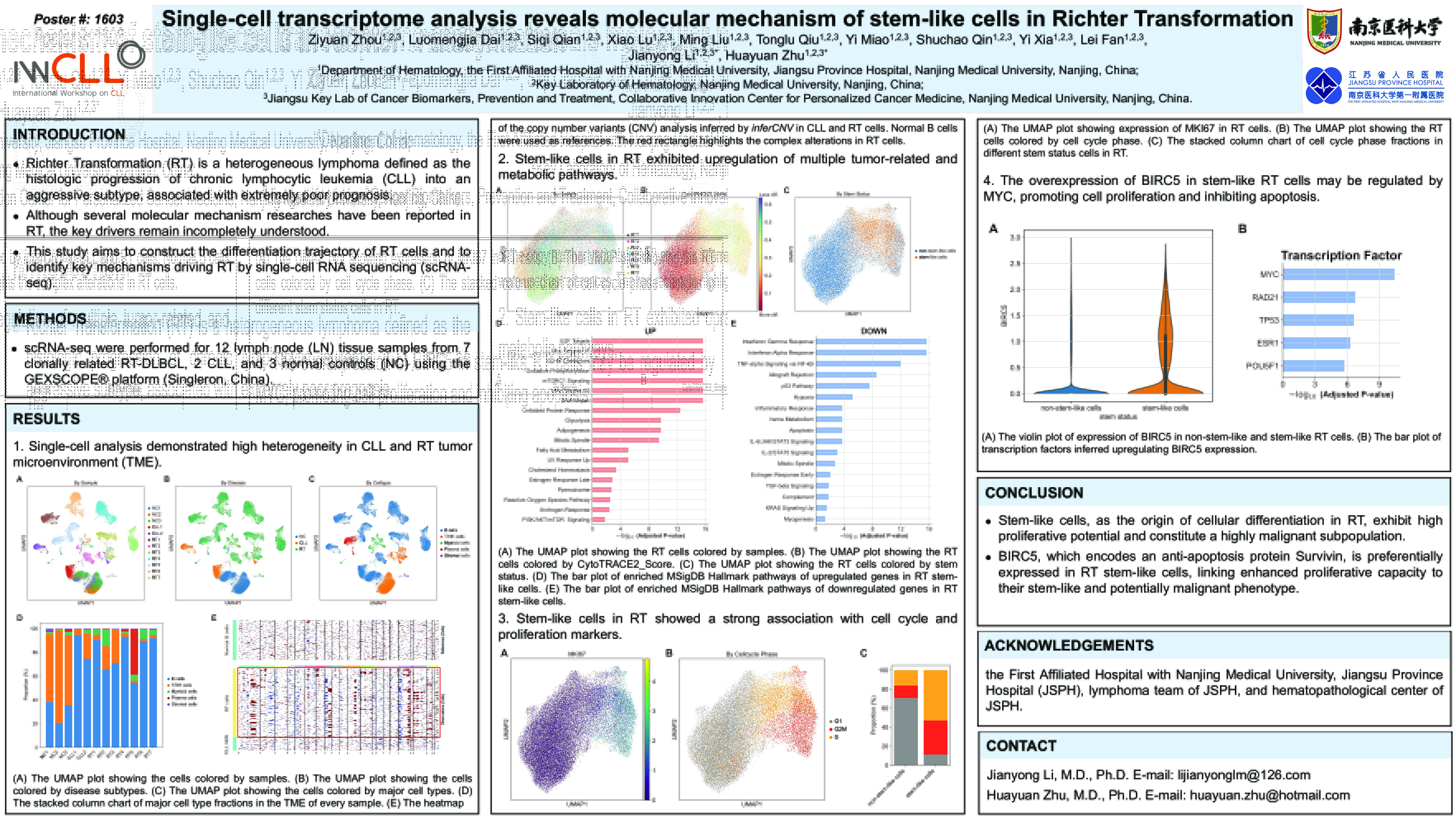
Richter Transformation (RT) is a heterogeneous lymphoma defined as the histologic progression of chronic lymphocytic leukemia (CLL) into an aggressive subtype, associated with extremely poor prognosis. Although several molecular mechanism researches have been reported in RT, the key drivers remain incompletely understood. This study aims to construct the differentiation trajectory of RT cells and to identify key mechanisms driving RT by single-cell RNA sequencing (scRNA-seq).
Methods
scRNA-seq were performed for 12 lymph node tissue samples from 7 clonally related RT-DLBCL, 2 CLL, and 3 normal controls (NC) using the GEXSCOPE® platform (Singleron, China). Raw sequencing data were preprocessed using Cell Ranger. Quality control, dimension reduction, clustering, and cell type annotation were performed via Scanpy. Evaluation of tumor cell chromosomal copy number variations (CNVs) and genomic alterations was conducted using inferCNV. AUCell was used to score every single cell within HALLMARK pathways and metabolism-related pathways, and their correlation with CNV scores was analyzed. CytoTRACE2 was applied to predict cellular developmental potential and identify stem-like tumor cell subpopulations. Monocle2 was utilized to perform pseudotime analysis of tumor cells to evaluate the developmental trajectory of RT cells. Differential expression and enrichment analyses were conducted to identify key genes associated with tumor stemness.
Results
We obtained scRNA-seq data, comprising 80,253 cells, and we annotated the cells into five major clusters, B cells, T/NK cells, myeloid cells, plasma cells, and stromal cells. Based on tissue type, B cells were further classified into normal B cells, CLL cells, and RT cells. In RT, a remarkedly higher proportion of myeloid cells was observed compared to CLL and NC, suggesting a potentially important role of myeloid cells in RT. InferCNV analysis further revealed that CLL and RT cells exhibited higher CNV scores compared to normal B cells, with RT cells showing the most complex alterations. This supported both the accuracy of tumor cell annotation and the complex genomic landscape of RT. Furthermore, RT cells exhibited more activity in multiple hallmark pathways, including E2F targets, G2M checkpoint, MYC targets, NOTCH signaling, PI3K/AKT/mTOR signaling, and apoptosis, and were positively correlated with CNV scores. In addition, RT cells exhibited upregulation in metabolic activity, particularly oxidative phosphorylation, glycolysis, and TCA cycle, suggesting that metabolic reprogramming may promote proliferation and resistance to apoptosis in RT. CytoTRACE2 identified a subpopulation with high differentiation potential and stemness in RT cells, and pseudotime analysis revealed a developmental trajectory from low-differentiation/high-stemness to high-differentiation/low-stemness states in RT cells. A total of nine RT cell subclusters were defined along this trajectory. Based on stemness scores, the developmental starting point was confirmed as state 8, and genes highly expressed in this subcluster were enriched in pathways such as MYC signaling, cell cycle, oxidative phosphorylation, and mTORC1 signaling. Notably, we found BIRC5 (survivin) were significantly overexpressed in stem-like RT cells, suggesting that BIRC5 may represent novel molecular drivers in the pathogenesis and progression of RT.
Conclusions
In this study, we constructed a single-cell atlas of RT lymph node samples using scRNA-seq and identified a stem-like cell subcluster as the origin of cellular differentiation and proliferation in RT. The characterization of stemness-associated genes and metabolic reprogramming provides novel insights into the molecular drivers and targeted therapeutic strategies of RT.
Keywords : Richter Transformation, single-cell transcriptome, molecular mechanism
Please indicate how this research was funded. :
Please indicate the name of the funding organization.: