
Authors
Martina Pasino, Andrea Speciale, Silvia Ravera, Giovanna Cutrona, Rosanna Massara, Nadia Bertola, Maurizio Viale, Irena Velkova, Andrea Nicola Mazzarello, Franco Fais, Fabrizio Loiacono, Serena Matis, Giulia Elda Valenti, Nicola Traverso, Cinzia Domenicotti, Barbara Marengo, Bruno Tasso, Adalberto Ibatici, Emanuele Angelucci9, Tiziana Vaisitti, Paola Monti, Paola Menichini.
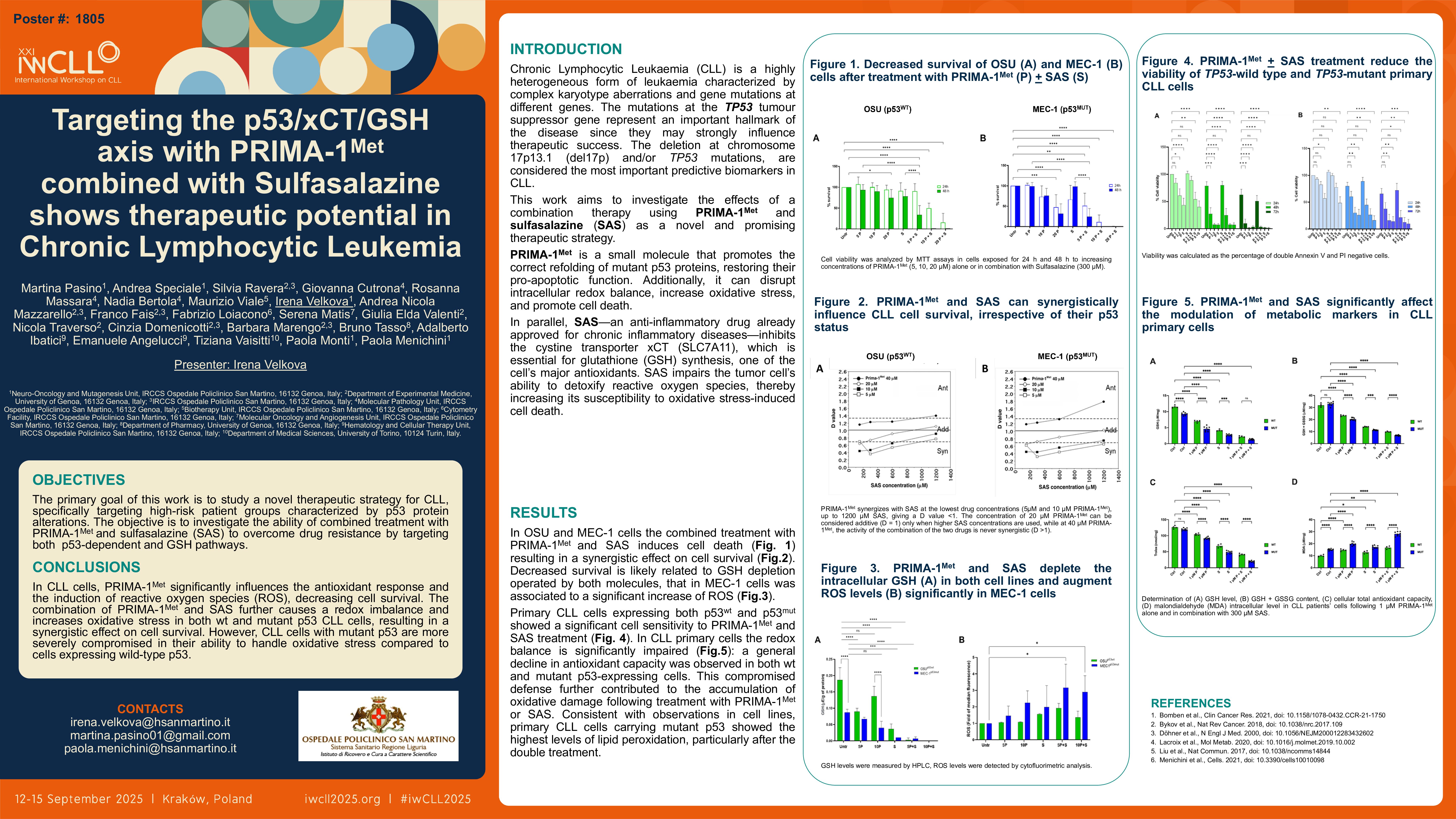
Chronic lymphocytic Leukaemia (CLL) is a highly heterogeneous form of leukaemia with a heterogeneous clinical course ranging from a rapid disease progression to decades of survival without the need for treatment. At diagnosis CLL is characterized by complex karyotype aberrations, the most frequent being partial deletions at 13q (~55%), 11q (~15%), 17p (~8%), gain of chromosome 12 (~15%), and by gene mutations at different genes including TP53, SF3B1, BIRC3, NOTCH1 and ATM. The TP53 tumour suppressor gene encodes a tetrameric transcription factor that regulates a multitude of key pathways, including cell cycle control, DNA damage response, apoptosis, senescence, DNA repair, cell migration, autophagy, and energy metabolism. Mutations in the TP53 gene represent a significant hallmark of the disease, as they can significantly impact the success of treatment protocols. A low incidence of TP53 mutations, ranging from 5% to 7%, is found at diagnosis, while it increases to approximately 40% in refractory CLL. Thus, the deletion at chromosome 17p13.1 (del17p) and/or TP53 mutations are considered the most important predictive biomarkers in CLL. Nowadays, new treatments are available for CLL patients carrying TP53 aberrations, such as ibrutinib and idelalisib, which inhibit the signalling pathway initiated by the B-cell antigen receptor, or venetoclax, which facilitates cell apoptosis. However, with these new drugs, TP53 alterations may be associated with therapy resistance. In recent years, several molecules that can target mutant TP53 for reactivation have been isolated. PRIMA-1Met/APR-246 is the most clinically advanced mutant p53-targeting agent, which has been shown to reactivate wild-type p53 apoptotic functions. Furthermore, PRIMA-1Met can deplete the glutathione (GSH) reservoir, thereby leading to an increased production of reactive oxygen species (ROS). The GSH level can also be diminished by Sulfasalazine (SAS), an anti-inflammatory drug belonging to the class of sulphonamides. This drug inhibits the xC- transporter, a key component of the xC- system that imports cystine, a dimer of cysteine, the limiting amino acid for GSH synthesis. Since the inhibition of the xC- system by SAS leads to decreased levels of GSH, the association of SAS and PRIMA-1Met could further increase the intracellular ROS and promote cell death. In this work, we investigate the p53/xCT/GSH axis as a potential therapeutic target for CLL. For this purpose, we used two CLL cell lines expressing wild-type or mutant p53 proteins (OSU and MEC-1 cells, respectively) and performed combined treatments with PRIMA-1Met and SAS. Through MTT and Annexin/PI assays, we found that this drug combination may sensitise CLL cells to cell death. In addition, PRIMA-1Met and SAS depleted the intracellular amount of GSH and augmented the level of ROS, particularly in MEC-1 cells carrying mutant p53. The modulation of metabolic markers, such as glutathione reductase (GR) and glutathione peroxidase (GPx), as indicators of glutathione deficit, NADPH oxidase as a marker of reactive oxygen species (ROS) production, and malondialdehyde (MDA) as a marker of lipid peroxidation, was investigated. We found that SAS impacted GR and GPx levels, while PRIMA-1Met determined an increase in NADPH oxidase. Interestingly, a remarkable increase in MDA was observed in both cell lines following co-treatment with PRIMA-1Met and SAS. Also, we demonstrated that PRIMA-1Met and SAS synergistically decrease survival in CLL cells, regardless of their p53 status. The same studies have also been performed in CLL primary cells carrying wild-type or mutated p53. Preliminary data and evidence will be presented and discussed.
Keywords : CLL, p53, PRIMA-1Met
Please indicate how this research was funded. :
Please indicate the name of the funding organization.: