
Authors
Eugenia Payque, María Elena Márquez, Rita Uría, Santiago Rodríguez, Juliana Querol, Florencia Palacios, Gimena dos Santos, Cecilia Guillermo, Carolina Oliver, Gabriela de Gálvez, Mariana Stevenazzi, Lilian Diaz, Mercedes Lassus, Raúl Gabus, Ana Inés Landoni, and Pablo Oppezzo.
Introduction
Chronic Lymphocytic Leukemia (CLL) is characterized by the clonal expansion of B cells in the peripheral blood, bone marrow (BM), and secondary lymphoid organs (SLOs), with variable proliferation rates observed in classical proliferative centers (PCs). Several studies have shown that poor prognosis in CLL is associated with increased proliferation, primarily driven by interactions between the leukemic clone and the tumor microenvironment (TME). A major challenge in CLL is the development of therapies capable of blocking these interactions to overcome treatment resistance.
To address this, our laboratory previously characterized the proteomic profile of serum-derived exosomes released by CLL cells from poor-prognosis patients. Among the most abundant cargo proteins, we identified the pro-inflammatory molecule S100A9, which is aberrantly expressed in leukemic cells from these patients. Exosomes carrying S100A9 activate the NF-κB pathway in CLL cells from patients with active disease. We also found that EMMPRIN (Extracellular Matrix Metalloproteinase Inducer), a key receptor for dimeric S100A9, is overexpressed in clinically progressive cases compared to indolent forms.
Our results further demonstrated that the S100A9–EMMPRIN interaction activates not only NF-κB but also the PI3K/AKT and MAPK/ERK pathways, promoting tumor cell proliferation and survival. These findings suggest that the S100A9/EMMPRIN axis is a critical driver of CLL progression and represents a potential therapeutic target.
Previous studies have shown that CLL cells infiltrate BM and SLOs by degrading the basement membrane through MMP2 and MMP9 (Angeles García-Pardo and Redondo-Muñoz 2021). BTK inhibitors (BTKi) disrupt TME interactions, promoting egress of CLL cells from PCs to peripheral blood and preventing re-entry, thereby inducing tumor cell death (Lu, Wang et al. 2021). BTKi also alter chemokine expression, including CCL3 and CCL4, which mediate cell homing (Ponader, Chen et al. 2012). Given that EMMPRIN is a classical inducer of MMP2/9, we investigated whether S100A9/EMMPRIN pathway activation influences CLL cell migration in response to BTKi.
Working Hypothesis: The S100A9/EMMPRIN axis is a novel pathway involved in CLL progression, which is blocked by BTKi in treatment-responsive patients. However, its behavior in non-responder or refractory patients remains unknown.
Goals
1. To demonstrate that the S100A9/EMMPRIN axis is a new putative therapeutic target in CLL.
2. To explore molecular mechanisms underlying resistance to BTKi in CLL with focus on S100A9/EMMPRIN axis.
Methodology
CLL samples were obtained with informed consent and Ethics Committee approval. PBMCs before and after treatment were collected and stored in the GURU-LLC Biobank (project GURU-01). In-vitro activation experiments with S100A9 and inhibition of BTK pathway were performed using PBMCs from untreated CLL patients. Ex-vivo studies with PBMC from treated CLL patients were also conducted.
Result
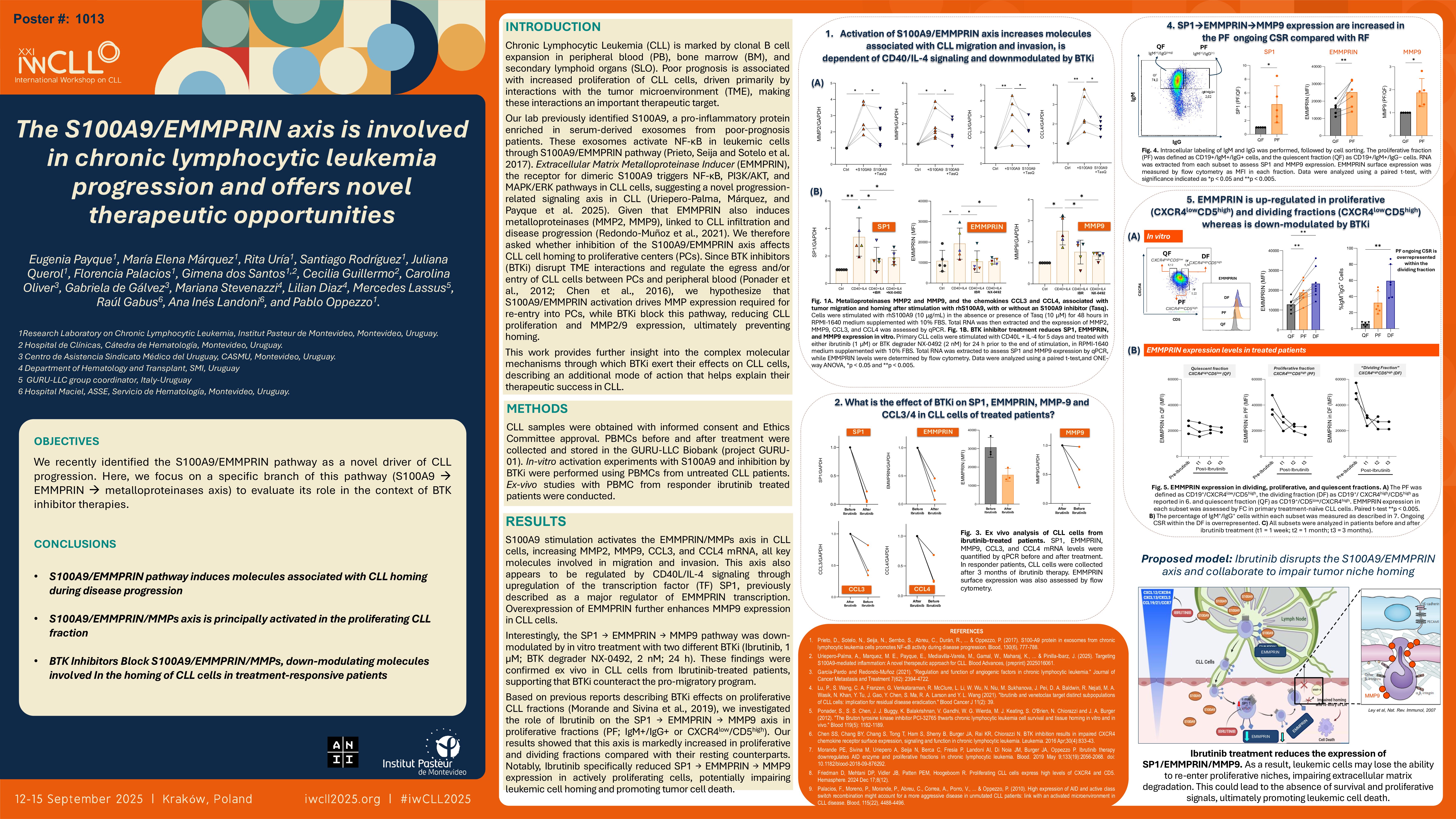
Our results show that S100A9 stimulation promotes survival, proliferation, and angiogenic capacity of CLL cells. After in-vitro S100A9 stimulation, primary CLL cells exhibit increased expression of EMMPRIN and its transcription factor SP1 (specificity protein 1). In addition, proliferating subsets (CXCR4dim/CD5high, or IgM/IgG) obtained after treatment show higher EMMPRIN expression than quiescent cells. These data suggest that the proliferative fitness of these subsets is enhanced, as evidenced by increased S100A9/EMMPRIN activity. Moreover, CLL cells activating this axis express higher levels of MMP2, MMP9, CCL3, and CCL4, all key molecules involved in migration and leukemic progression. Interestingly, in vitro treatment with ibrutinib (1 µM, 24 h) downregulates this pro-angiogenic profile.
SP1 and EMMPRIN upregulation, and their subsequent reduction after ibrutinib treatment, suggest that the S100A9/EMMPRIN axis is a TME-triggered program involved in disease progression. Consistent with this, CLL cells from patients treated with ibrutinib show decreased SP1 and EMMPRIN levels post-treatment, along with reduced MMP2, MMP9, and CCL3/4 mRNA expression.
Together, these findings suggest that inhibition of BTK pathway also blocks the S100A9/EMMPRIN axis by suppressing SP1 and EMMPRIN expression, thereby hindering MMP2/9 and CCL3/4 induction, which in turn prevent lymph node re-entry, and promoting leukemic cell death in periphery.
Conclusions
Our data indicate that the S100A9/EMMPRIN axis significantly contributes to CLL cell proliferation, survival, and migration. Understanding how this pathway interacts with targeted therapies such as BTKi may reveal new insights into resistance mechanisms and guide therapeutic strategies.
Keywords : S100A9/EMMPRIN, BTKi, migration
Please indicate how this research was funded. :
Please indicate the name of the funding organization.: