
Authors
Collin Nzunda, Eliud Buchard, Jeffer Bhuko, Heavenlight Christopher, Emmanuel Saukiwa, Caro Mollel, Rehema Shungu, Doreen Kamori, Clara Chamba, Helene Dreau, Kate Ridout, Antony Cutts, Ahlam Nasser, Anna Schuh, Dimitris Vavoulis, Adam Burns, William Mawalla.
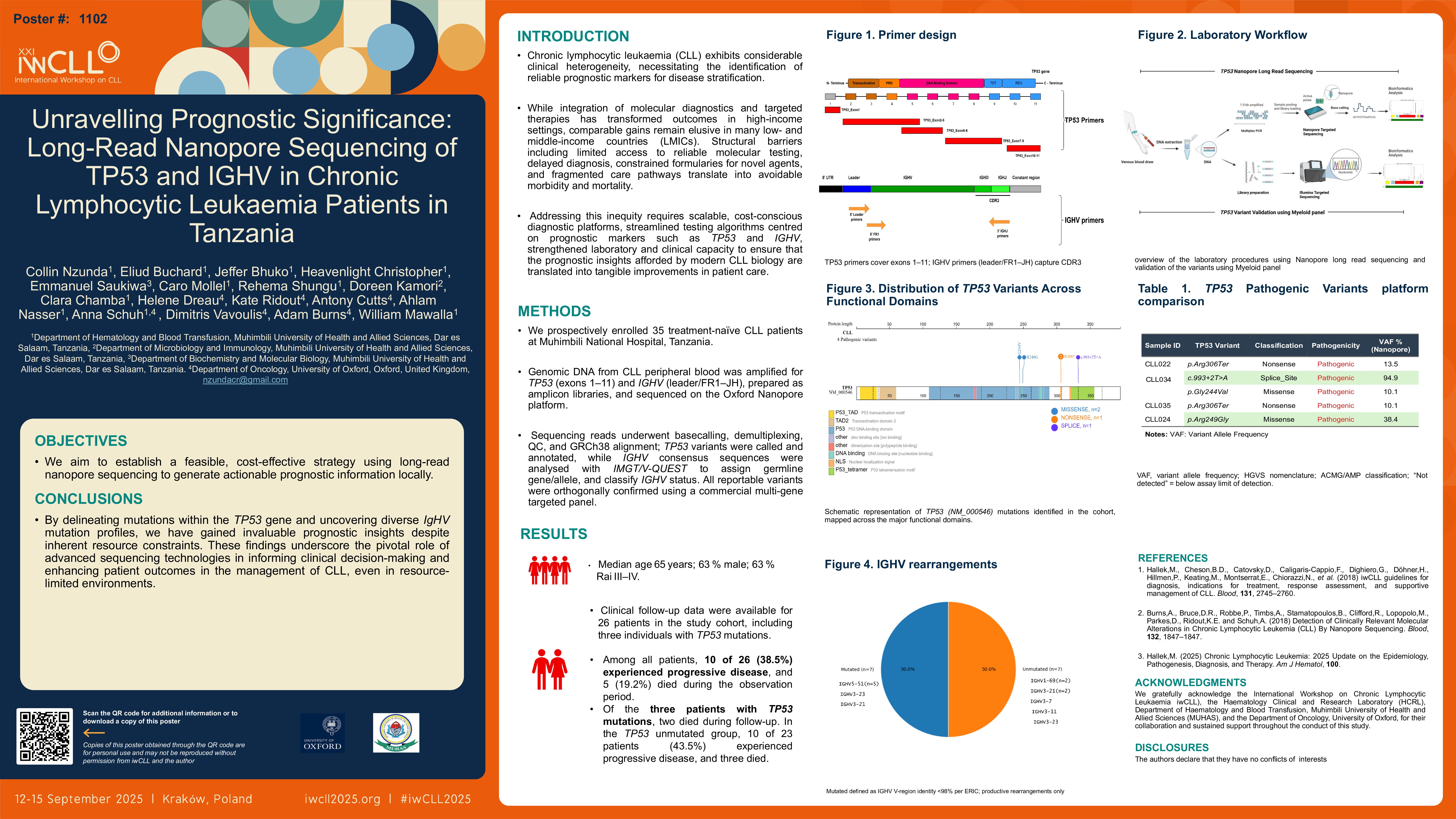
Chronic lymphocytic leukaemia (CLL) displays substantial clinical heterogeneity, necessitating molecular biomarkers for accurate risk stratification and therapeutic guidance. Mutations in the TP53 gene and the somatic hypermutation status of the immunoglobulin heavy chain variable region (IGHV) are among the most reliable prognostic markers (Zenz et al., 2010; Malcikova et al., 2018). However, resource-constrained settings often lack access to advanced molecular diagnostics. This study evaluates the feasibility and utility of Oxford Nanopore long-read sequencing to detect TP53 mutations and IGHV rearrangements in Tanzanian CLL patients, addressing an urgent need for region-specific genomic insight.
Thirty-one treatment-naïve CLL patients were recruited from Muhimbili National Hospital in Tanzania. Genomic DNA was extracted from peripheral blood. TP53 exons 1–11 and the IGHV locus were PCR-amplified using barcoded primers. Sequencing was performed on a MinION Mk1C platform. A bioinformatics pipeline (Minimap2, Samtools, VarScan, Sniffles, Annovar) was employed for alignment, variant calling, and annotation (Li, 2018; Koboldt et al., 2012). IgHV sequences were aligned and analysed per European Research Initiative on CLL (ERIC) recommendations (Stamatopoulos et al., 2007).
We detected 201 TP53 variants, 74% of which were intronic. After filtering, seven nonsynonymous SNVs were identified in the coding region, including four pathogenic variants: p.Arg249Gly (variant allele frequency [VAF] 67%), p.Arg273Cys (VAF 38%), p.Arg306* (VAF 10%), and p.Gly244Val (VAF 13.5%). The p.Arg249Gly variant was confirmed using an Illumina Myeloid panel with a concordant VAF of 56%. Although p.Arg273Cys was not validated by the panel, its detection at subclonal frequency highlights the capacity of long-read sequencing to identify minor leukemic populations, which may drive clonal evolution (De Luca et al., 2022).
IgHV status revealed 10 patients with unmutated sequences (U-CLL) and 2 with mutated sequences (M-CLL), reflecting a predominance of high-risk disease. Frequent IgHV gene usage included IGHV1-69, IGHV3-21, and IGHV3-23, consistent with patterns reported in other populations (Forconi & Potter, 2004).
This study demonstrates the feasibility of long-read sequencing for comprehensive genomic profiling in a low-resource setting. The pathogenic TP53 variants identified occur in the DNA-binding domain, a hotspot region associated with aggressive clinical behaviour and resistance to chemoimmunotherapy (Kwok et al., 2021). The presence of both clonal (VAF >20%) and subclonal (VAF < 20%) mutations illustrates the complex clonal architecture of CLL. While clonal variants such as p.Arg249Gly represent dominant disease-driving mutations, subclonal variants like p.Arg306* may serve as reservoirs for relapse post-treatment (Bomben et al., 2021).
Clinically, patients with TP53 mutations exhibited features of advanced disease, including lymphadenopathy and leucocytosis, consistent with high-risk CLL. Despite this, most patients lacked access to targeted agents like Bruton’s tyrosine kinase (BTK) inhibitors or BCL2 antagonists, limiting the impact of molecular diagnostics on treatment decisions. These findings emphasise the importance of not only introducing molecular testing but also ensuring access to genomics-guided therapies (Hallek et al., 2018).
This is the first study to apply Oxford Nanopore long-read sequencing to profile TP53 mutations and IgHV status in Tanzanian CLL patients. The technology demonstrated robust performance in identifying both clonal and subclonal mutations, along with accurate IgHV classification. This integrated approach is scalable and cost-effective, offering a promising solution for improving precision diagnostics in resource-limited environments. The findings advocate for broader implementation of long-read sequencing in Sub-Saharan Africa to support equity in cancer genomics and guide clinical decision-making.
Keywords : Chronic lymphocytic leukaemia, TP53 mutations, Long-read sequencing
Please indicate how this research was funded. : This research was funded by the International Workshop on Chronic Lymphocytic Leukaemia (iwCLL). The support enabled the implementation of advanced genomic sequencing technologies and bioinformatics analyses to investigate TP53 mutations and IgHV status in Tanzanian CLL patients.
Please indicate the name of the funding organization.: International Workshop on Chronic Lymphocytic Leukaemia (iwCLL)